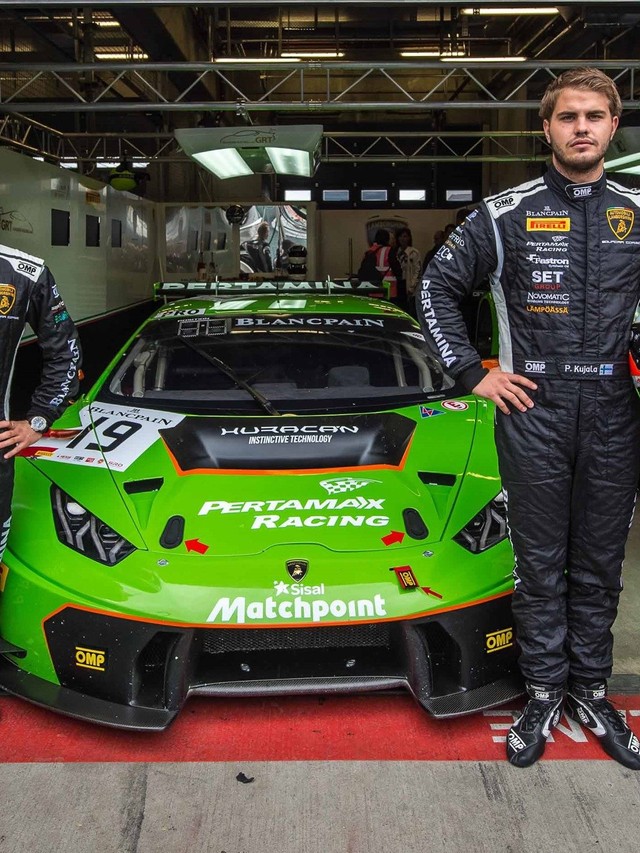
Factory Veterans and Super Trofeo Graduates Share the Same Garage
Lamborghini could have filled every Grasser Racing Team seat with proven professionals and optimized for points. Instead, Squadra Corse is treating the Blancpain Endurance Series as a finishing school, pairing two factory drivers with two 19-year-old graduates of its own Super Trofeo one-make series across a pair of Huracan GT3 entries. The bet is straightforward: embedding young talent alongside factory-caliber drivers accelerates development faster than any simulator session or test day, and the results that follow will justify the gamble.
Mirko Bortolotti, who already holds two Blancpain Endurance Series pole positions, shares a car with Finnish driver Kujala, the reigning 2015 Lamborghini Blancpain Super Trofeo PRO Class champion. In the second entry, Jeroen Mul, the Dutch factory driver who won the series’ opening round at Monza alongside Fabio Babini and Andrew Palmer, teams up with Roman Alberto Di Falco, a second-year member of Lamborghini’s Young Drivers Program and the 2014 European Super Trofeo PRO-AM title holder. The final rounds run through Misano and close at Zandvoort in Holland.
The arrangement reveals how Lamborghini thinks about its motorsport future. Rather than chasing short-term silverware, Squadra Corse is building a system, one where every Super Trofeo season feeds the next generation of GT3 contenders.
From Super Trofeo to GT3: Inside the Development Ladder
Both young drivers arrived at this point through a pathway Lamborghini constructed for exactly this purpose, though their routes through it look quite different.
Kujala’s credentials are hard to argue with. Racing for Bonaldi Motorsport, he won eight of ten races in his first full GT season after spending two years in GP3 open-wheel competition. That conversion rate from single-seaters to tin-tops is unusual, and it explains why Squadra Corse matched him directly with Bortolotti rather than easing him in through a lower-profile program.
Di Falco’s trajectory is equally intentional. He carries single-seater experience of his own, and his Super Trofeo PRO-AM championship came in 2014, giving him a full extra season of GT machinery familiarity before stepping into GT3 hardware. His win at Spa Race One in July, driving a Raton Racing entry, confirmed he can produce results on circuits that punish mistakes.
One report indicates the Lamborghini Young Drivers Program operates on a multi-tiered structure, progressing drivers from Super Trofeo Junior status through GT3 Junior and eventually to Young Professional ranks. Drivers in the program reportedly participate in dedicated training camps at Sant’Agata Bolognese and are assessed on everything from single-lap pace to technical feedback quality and off-track professionalism. If that structure is accurate, the Blancpain seats represent a significant promotion for both Kujala and Di Falco, not a casual opportunity.
The Mentorship Model: What Factory Drivers Actually Provide
Pairing a 19-year-old with a factory driver in endurance racing goes well beyond sharing steering duties. In a format where driver changes, tire management, and race-long strategy matter as much as raw pace, the young driver absorbs lessons that only come from racing alongside someone who already knows the series intimately.
Bortolotti and Mul bring complementary strengths to the mentorship. Bortolotti is a qualifier, the kind of driver who extracts pole laps from the Huracan GT3 when the pressure is highest. Mul is a race winner who demonstrated at Monza that he can manage the long game of endurance formats. For Kujala and Di Falco, the education is anything but abstract: they will debrief with drivers who know exactly where the Huracan GT3 gains and loses time relative to the competition, and they will do it under real championship pressure rather than in a controlled test environment.
This approach carries genuine risk. A young driver making a costly error in a Blancpain round can torpedo a factory driver’s championship ambitions. Lamborghini is accepting that trade-off, which tells you something about how seriously the brand views its development pipeline. The willingness to sacrifice short-term consistency for long-term depth is the clearest signal yet that Squadra Corse sees driver cultivation as central to its GT3 strategy, not peripheral to it.
The Huracan GT3: A Platform for Future Champions and Brand Ambition
The Super Trofeo series exists specifically to produce drivers who can step into customer GT3 racing with minimal friction. Lamborghini does not need to compete with larger programs on the sheer volume of young drivers it processes. What it needs is a handful of graduates who can win races in customer Huracan GT3 entries and, eventually, anchor factory-supported efforts in the world’s top endurance events. The Grasser Racing lineup suggests Squadra Corse understands this clearly.
For those watching the brand’s motorsport trajectory, the pattern set here became even more significant in subsequent seasons. The Grasser Racing Team, running the same Huracan GT3 platform, went on to secure the 2017 Blancpain GT Series title with Bortolotti among the drivers who fought for the championship across all ten rounds. The investment in driver continuity and platform familiarity paid off in the most concrete way possible, vindicating the decision to prioritize development over immediate results.
What This Means for Lamborghini’s Racing Future
The practical takeaway from this lineup announcement reaches well beyond two specific races. A brand that builds a repeatable system for identifying, training, and promoting young drivers creates a competitive advantage that compounds over time. Every Super Trofeo season becomes a scouting exercise. Every GT3 pairing becomes a development opportunity. The pipeline, once established, feeds itself.
As Car and Driver reported, the Temerario GT3 will eventually replace the Huracan GT3 as Lamborghini’s factory-backed customer racing platform. When that transition happens, the drivers who cut their teeth in programs like this one will be the ones Squadra Corse calls first. Building the car is engineering. Building the roster is strategy. With these Grasser Racing pairings, Lamborghini is investing in both.
Gallery


