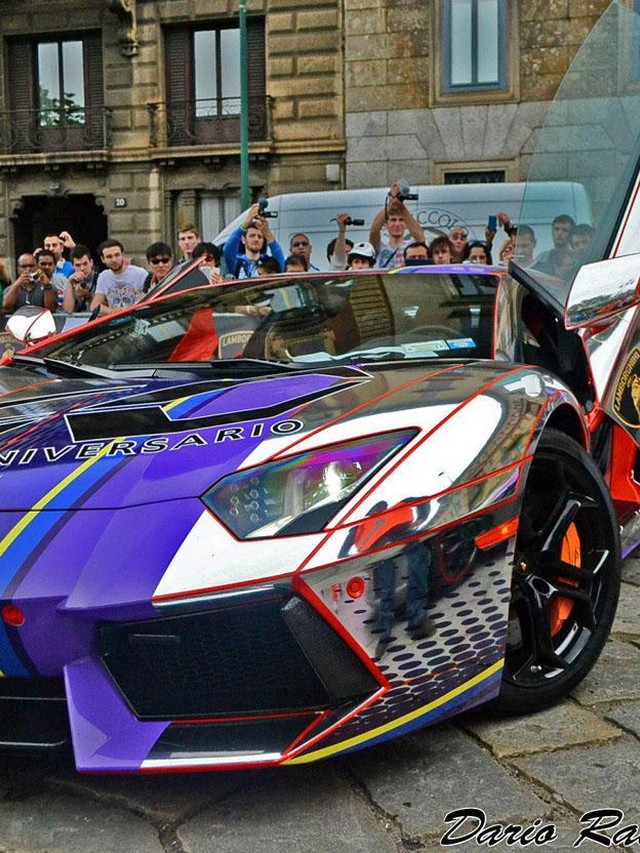
Lamborghini Meets L’Uomo Vogue on the Venice Waterfront
When Automobili Lamborghini and Condé Nast’s L’Uomo Vogue co-hosted an evening at the 73rd Venice International Film Festival in September 2016, the pairing looked natural in a way that most automotive brand partnerships never quite manage. CEO Stefano Domenicali and L’Uomo Vogue Editor-in-Chief Franca Sozzani greeted guests at the Scuola Grande San Giovanni Evangelista, where an exhibition titled “The 10th Starry Year in Venice” celebrated a decade of the magazine’s dedicated festival coverage. The show featured iconic photographs of Italian and international cinema stars drawn from those collector’s editions, placing Lamborghini’s name alongside imagery that spoke to glamour, artistry, and cultural permanence rather than horsepower.
The evening then moved to Palazzina G, the Philippe Starck-designed hotel where the Aventador Miura Homage sat dockside, framed by Venetian architecture and canal light. Three powerful brands, as Lamborghini described them, sharing style, innovation, and excitement as their common denominator. The phrase sounds like corporate boilerplate until you consider what it reveals about the company’s broader ambitions: Lamborghini was not simply sponsoring a film festival. It was staking a claim in a cultural conversation that extends well beyond the supercar world.
Why a Film Festival Matters More Than a Motor Show
Parking a supercar at a film festival instead of, say, the Geneva Motor Show might seem like an odd allocation of marketing budget. The logic becomes clearer when you consider who attends Venice in early September. The audience is wealthy, culturally engaged, and largely outside the traditional car-enthusiast bubble. These are exactly the buyers Lamborghini wanted to reach under Domenicali’s leadership: people who might cross-shop a yacht, a villa renovation, or a contemporary art collection before they ever configure an Aventador on the company’s website.
Lamborghini describes its commitment to placing cars inside what it calls “complementary luxury environments.” Selling fewer cars at higher margins requires that each unit carry enormous aspirational weight, and events like Venice reinforce that weight. When a potential buyer encounters a Lamborghini beside a Starck hotel during a black-tie film premiere, the car absorbs the cultural prestige of its surroundings. That kind of brand equity is difficult to manufacture in a convention center.
Lamborghini owners who attend events like Monterey Car Week or Serata Italiana already understand this dynamic. The car itself is the entry ticket, but the curated social environment is what sustains long-term loyalty. Multiple owners on enthusiast forums describe these gatherings as a significant part of the ownership experience, citing VIP hospitality, access to executives, and the sense of belonging to a distinct community. Venice operated on the same principle, just aimed at a different audience: the fashion and film world rather than the existing collector base.
The Aventador Miura Homage as a Rolling Heritage Argument
Lamborghini could have displayed any car on that quayside. The choice of the Aventador Miura Homage was deliberate and telling. Built to celebrate the Miura’s 50th anniversary, the Homage edition wrapped the Aventador’s V12 architecture in design cues that traced a direct line back to the car that essentially invented the mid-engine supercar in 1966. For a Venice audience that might not know a Huracán from a Gallardo, the Miura name carries a different kind of currency: it signals history, rarity, and cultural significance that extends well beyond lap times.
At Venice, the Miura Homage functioned less as a product showcase and more as a piece of kinetic sculpture, a conversation starter that could hold its own alongside the exhibition photography inside the Scuola Grande. This is the thread that ties the entire evening together. The photographs on the gallery walls celebrated a decade of cinematic glamour; the car on the quayside celebrated half a century of automotive design. Both spoke the same language of Italian craftsmanship and visual drama, and placing them in the same orbit gave each more resonance than it would have carried alone.
For prospective buyers encountering the brand in this context, the message was clear: Lamborghini ownership connects you to a lineage that predates most luxury fashion houses, and the company is willing to place that lineage in settings where it will be appreciated on aesthetic terms rather than purely mechanical ones.
Competitive Luxury: Positioning the Brand Beyond the Track
Ferrari’s lifestyle extension strategy operates on a fundamentally different axis. Maranello monetizes its brand through licensed merchandise, theme parks, and fashion collaborations that generate revenue directly. Lamborghini’s approach under Domenicali leaned more toward curated exclusivity. Rather than licensing the badge broadly, the company embedded itself in environments that reinforced scarcity and taste. The Venice partnership with L’Uomo Vogue fits this pattern precisely: no merchandise booth, no branded cocktail menu, just the car and the context.
McLaren, by comparison, barely plays in this space at all. Woking’s brand identity remains rooted almost entirely in engineering and racing, which appeals to a specific buyer but leaves the lifestyle flank wide open. When a McLaren appears at a cultural event, it tends to feel like product placement. When the Aventador Miura Homage appeared at Palazzina G, it felt like it belonged.
The practical implication for Lamborghini buyers and prospective owners is worth noting. These cultural partnerships shape the narrative around the brand. A Lamborghini that carries associations with Venice, with Condé Nast, with Philippe Starck, occupies a different mental category than a supercar known primarily for straight-line acceleration. That distinction matters at resale, and it matters even more when explaining to a skeptical partner why the garage needs one more Italian thoroughbred.
What Venice Signaled for Lamborghini’s Brand Direction
Lamborghini did not disclose the cost of the Venice partnership, nor did it tie the event to any specific sales target. The safer interpretation is pure brand-building: placing the company’s heritage and design language in front of an audience that values those qualities instinctively, without expecting a measurable return in near-term orders.
What the event confirmed is that Domenicali’s Lamborghini viewed itself as competing not just with other supercar makers on the road, but with the broader universe of ultra-luxury brands for a share of its customers’ identity. A Lamborghini owner in 2016 was being told, explicitly, that the car in the garage connected them to the same cultural ecosystem as L’Uomo Vogue and Philippe Starck. Whether that resonated depended on the individual buyer, but the strategic intent was unmistakable.
The Aventador Miura Homage eventually sold out its limited production run, and the Miura name continues to carry extraordinary weight among collectors. Venice did not create that demand, but events like it sustained the atmosphere of cultural relevance that keeps Lamborghini’s waiting lists long and its residual values strong. For a company that caps production to maintain exclusivity, atmosphere is not a luxury. It is the product.


