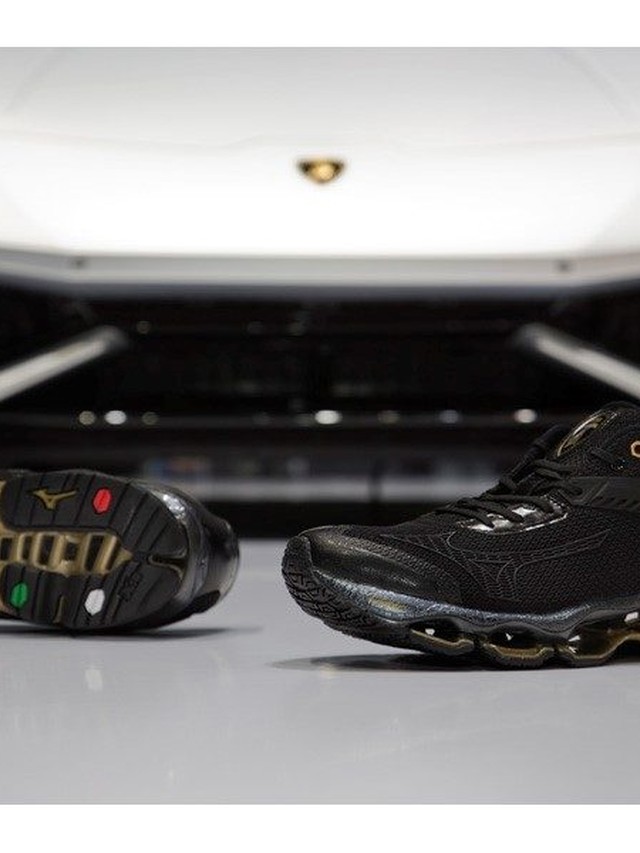
A Running Shoe Debuts at the Geneva Motor Show
At the 2015 Geneva Motor Show, where new supercars typically steal the spotlight, Lamborghini staged something deliberately different: the debut of a running shoe. Together with Japanese sports brand Mizuno, the company announced a five-year partnership covering co-branded sports apparel and footwear, with the Mizuno Wave Tenjin as the opening act. Both brands emphasized shared values of innovation, design, and craftsmanship as the foundation for the deal.
Lamborghini President and CEO Stephan Winkelmann framed the collaboration as a way for enthusiasts to celebrate their passion for the brand beyond the car itself. Mizuno Corporation Director Takeshi Shichijo called the agreement a platform to introduce Mizuno to Lamborghini’s global fanbase. Products bearing the Automobili Lamborghini shield went on sale from August 2015 through both Lamborghini dealers and Mizuno retailers worldwide.
According to multiple reports, the Wave Tenjin drew on Lamborghini’s principles of comfort, speed, performance, dynamism, and style. One source indicates the shoe was offered in four colorways, including a black and gold combination reflecting the Lamborghini crest and a green, white, and red option nodding to the Italian flag. The collaboration eventually produced follow-up models: the Wave Tenjin 2 arrived in 2017, and the Wave Tenjin 3 followed in 2018, expanding distribution to platforms like lamborghinistore.com and Farfetch.
Why a Supercar Brand Sells Sneakers
Lifestyle merchandise generates revenue for supercar manufacturers, but the strategic logic runs deeper than margin. Lamborghini builds roughly 10,000 cars per year. Its global fanbase, measured by social media followers, merchandise buyers, and event attendees, dwarfs that production number by orders of magnitude. A collaboration like the Mizuno deal lets Sant’Agata monetize that broader enthusiasm while keeping the cars themselves exclusive.
The tension is obvious. Lamborghini’s core product is defined by scarcity and six-figure price tags. A running shoe sold through Mizuno retailers sits at the opposite end of the accessibility spectrum. Getting the balance right matters: the merchandise should feel like a genuine extension of the brand’s design language, not a logo slapped on commodity goods. The Wave Tenjin’s design details suggest Lamborghini took that distinction seriously. One report describes hexagonal motifs echoing the Aventador’s front grille, an upper textured to resemble carbon fiber, and resin side panels shaped like air ducts. Whether those details register on someone’s morning jog is debatable, but they signal intent.
For enthusiasts who already own the cars, branded lifestyle products tend to sell briskly when they feel curated rather than generic. A Lamborghini-branded Secretlab gaming chair announced in 2025 sold out on its first day, according to discussion on Lamborghini-Talk forums. The appetite for well-executed brand extensions clearly exists within this community.
Design Translation: From Bodywork to Footwear
The central question with any automotive lifestyle collaboration is how literally the car’s design DNA transfers to the product. Lamborghini’s visual identity is defined by sharp, angular surfacing, aggressive proportions, and a color palette that ranges from restrained black and gold to attention-demanding Verde Mantis. Mizuno, meanwhile, builds performance-oriented athletic gear with its own engineering heritage, particularly in midsole technology.
According to one report, the Wave Tenjin drew inspiration specifically from the Aventador, translating the car’s hexagonal design language into the shoe’s structural elements. The black and gold colorway visible in official imagery reinforces this connection, with gold accents on a predominantly black mesh upper that reads as distinctly Lamborghini without being cartoonish about it. In the launch imagery the shoe sits in front of a white Huracán, suggesting Lamborghini wanted to visually anchor the product to its current lineup rather than treating it as an abstract brand exercise.
Lamborghini did not publicly detail pricing for the Wave Tenjin line. What the collaboration’s structure does confirm is dual-channel distribution through both Lamborghini’s dealer network and Mizuno’s own retail footprint, a strategy designed to reach existing Lamborghini customers and the much larger pool of brand admirers who walk into a Mizuno store.
How Lamborghini’s Approach Compares to Rival Brands
Lamborghini was not the first supercar manufacturer to venture into branded apparel and lifestyle goods. Ferrari has maintained an extensive merchandise operation for decades, ranging from branded clothing to theme parks, and formalized its fashion ambitions with a standalone boutique strategy. Porsche Design operates as an entirely separate lifestyle brand with product lines spanning electronics, luggage, and eyewear.
Sant’Agata chose a different philosophy: rather than building an in-house fashion operation, Lamborghini collaborated with an established performance brand that brought its own technical credibility. Mizuno’s reputation in running and athletic footwear gave the partnership a functional anchor that a purely fashion-driven collaboration would lack. The risk with the in-house approach, as Ferrari’s merchandise has occasionally demonstrated, is that volume dilutes perceived exclusivity. By partnering with a specialist, Lamborghini could control the design narrative while letting Mizuno handle manufacturing and athletic performance credibility.
The five-year term also signals a measured commitment. Rather than an open-ended licensing arrangement that could flood the market, the defined partnership window allowed both brands to evaluate results and adjust. The collaboration ran its course around 2020, giving Lamborghini the flexibility to pursue other lifestyle partnerships or bring merchandise efforts closer to home.
What This Means for Lamborghini Enthusiasts
For the core LamboCars audience, the Mizuno collaboration demonstrated that Lamborghini views its brand as something larger than the cars alone, and that the company is willing to invest in partnerships extending its design language into new product categories. The Wave Tenjin line, which spanned three generations over the partnership’s duration, showed this was a sustained effort rather than a one-off publicity stunt.
Online reaction was mixed, as it tends to be with any automotive lifestyle product. Some sneaker community commentary dismissed the shoes as overpriced novelty items, while others appreciated the design execution. That split is predictable and, frankly, beside the point for the core audience. Lamborghini owners and dedicated enthusiasts tend to evaluate branded merchandise on craftsmanship and design authenticity, not sneaker-forum hype cycles.
The broader signal worth watching is how Lamborghini’s lifestyle strategy evolves from here. The company continues to pursue selective collaborations across categories, from gaming chairs to digital experiences, each calibrated to reach enthusiasts who may never visit a dealership but who identify deeply with the Raging Bull. For a brand that builds fewer than 11,000 cars annually, that extended community represents both a commercial opportunity and a long-term brand investment. The Mizuno deal was an early, deliberate step in that direction.
Gallery


