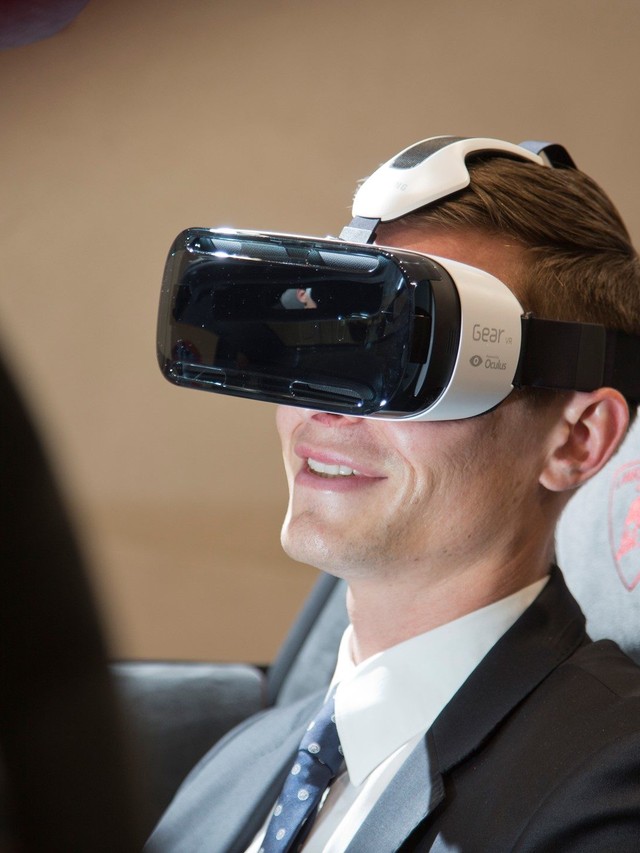
A Virtual Huracán at the 2015 Geneva Motor Show
At the 2015 Geneva International Motor Show, Lamborghini and Samsung staged something that felt genuinely novel for an automotive booth: a virtual reality driving experience built around the Huracán LP 610-4, powered by the Samsung Gear VR headset with Oculus technology. Visitors could sit inside a show car, strap on the headset, and find themselves transported onto a cliff-hugging Sport route along the Amalfi Coast, a gentler Strada cruise through the town of Amalfi itself, or a flat-out Corsa lap of the Imola racing circuit. The three modes mapped directly to the Huracán’s own ANIMA drive-mode selector, a detail that hinted Lamborghini wanted this to feel like more than a tech demo. It was, in retrospect, the first visible sign that Sant’Agata intended to treat digital engagement not as a marketing afterthought but as a core brand pillar, a thread that now runs all the way to the real-time 5G telemetry of Telemetry X.
The hardware, by 2025 standards, looks almost quaint. Samsung’s Gear VR relied on a Galaxy Note 4 smartphone as its display, slotted into a plastic cradle that sat over the user’s eyes. Lamborghini says the experience incorporated 360 binaural sound technology, designed to reproduce the naturally aspirated V10’s exhaust note in spatial audio. According to Visualise, the production studio involved in the project, the viewer’s perspective also allowed them to examine the interior details of the Huracán from the driver’s seat. For a show floor in March 2015, when consumer VR barely existed outside developer kits, this counted as a genuinely ambitious piece of experiential marketing.
What the Experience Actually Offered
Lamborghini structured the three virtual routes to mirror the car’s personality rather than simply showcase scenery. Sport placed users on the twisting coastal roads above Amalfi, where the simulation emphasized lateral forces and the V10’s mid-range pull through tight corners. Strada offered a more relaxed tour through the town itself, presumably aimed at visitors who cared more about the Huracán‘s grand-touring composure than its lap-time potential. Corsa dropped participants onto the Autodromo Internazionale Enzo e Dino Ferrari at Imola, one of the most demanding circuits in European motorsport, complete with simulated racing conditions.
The clever part was contextual. Most auto-show demonstrations in 2015 involved static displays, maybe a short film on a screen behind the car. Lamborghini’s VR booth let people who would never get a dealership test drive, let alone a track day, feel some approximation of the Huracán’s world. Whether the Galaxy Note 4’s resolution and the Gear VR’s limited field of view could genuinely convey the violence of a 5.2-liter V10 accelerating to redline is a fair question, and the honest answer is probably not. But the intent was less about simulation fidelity and more about emotional priming. Lamborghini wanted visitors to leave the booth wanting the real thing, and that impulse to use technology as an aspirational amplifier is exactly what matured into the data-driven systems the company builds today.

A man experiences a virtual reality driving simulation while seated in a car, featuring a visible Lamborghini logo on the seat.
Why VR in 2015? The Strategic Bet Behind the Headset
To appreciate what Lamborghini was doing here, you need to remember the landscape. In early 2015, the Oculus Rift consumer edition was still a year from shipping. HTC’s Vive prototype had just been announced. PlayStation VR was a rumor. The Samsung Gear VR itself was technically a limited “Innovator Edition” aimed at developers and early adopters, not a mainstream product. Lamborghini chose to build a flagship motor-show activation around hardware that most consumers could not yet buy.
That decision reveals something about Sant’Agata’s brand calculus. Lamborghini’s core audience skews younger and more tech-forward than Ferrari’s or Bentley’s. The company understood, even a decade ago, that its aspirational buyers respond to technology as a status signal. The teenagers who once pinned Countach posters to bedroom walls had grown into adults putting Huracán configurator screenshots on Instagram, and partnering with Samsung and Oculus positioned Lamborghini as the supercar brand willing to experiment rather than rely solely on heritage and exclusivity.
Ferrari, by contrast, kept its experiential marketing closer to traditional channels: factory tours, track days for owners, and carefully controlled media drives. Porsche invested heavily in digital configurators and later in its own esports programs, but a consumer VR activation at a major show in 2015 was unusual for any luxury automaker. Lamborghini moved first, and the marketing press noticed. More importantly, the willingness to partner with consumer-electronics companies and to show up at technology-forward venues planted a seed that would bear fruit years later at CES.
How Realistic Could It Actually Be?
The honest assessment, with a decade of hindsight, is that the 2015 Gear VR experience was more spectacle than simulation. The Galaxy Note 4 ran a Quad HD display at 2560×1440 pixels, split across both eyes. Anyone who used early mobile VR remembers the screen-door effect, where visible pixel grids broke the illusion of immersion every time you focused on a detail. Latency was acceptable for a seated experience but nowhere near the standards that modern racing simulators demand.
The binaural audio was likely the strongest element. A naturally aspirated V10 at full song is one of the most distinctive sounds in automotive engineering, and spatial audio can convey the character of an exhaust note even when the visuals lag behind. Lamborghini’s official material described the experience as making visitors feel as if they were genuinely driving the supercar. That is marketing language doing its job. What the activation actually delivered was closer to a 360-degree video ride-along than an interactive driving simulation. Users did not appear to control throttle, braking, or steering inputs in the way a proper sim rig would allow. The value proposition was sensory, not dynamic: hear the engine, see the cockpit, absorb the scenery, and leave wanting more.
For the show-floor context, that was enough. Lamborghini was selling aspiration, not lap times. And the lines at the booth reportedly proved the concept worked as intended. The real payoff, though, would come not from any single headset session but from the institutional confidence the project built: proof that digital experiences could carry the emotional weight of the brand.
From Gear VR to Telemetry X: Tracing the Digital Thread
The 2015 Geneva activation looks different when you trace the line forward through Lamborghini’s subsequent digital investments. In 2020, when pandemic restrictions forced the virtual launch of the Huracán EVO RWD Spyder, Lamborghini deployed an augmented reality experience using Apple’s AR Quick Look, letting users place a full-scale digital Spyder in their own driveway via iPhone or iPad. The company announced plans to extend that AR capability across the entire range. The instinct to use consumer technology as a brand-engagement tool, first tested with the Gear VR at Geneva, had clearly survived and matured.
The most significant evolution arrived at the 2024 Consumer Electronics Show, where Lamborghini unveiled Telemetry X. One source describes it as an advanced track-connectivity concept integrating three core technologies: a real-time remote garage using 5G for live telemetry and video, a biometric data system analyzing the driver’s physical state, and an enhanced coaching interface. Telemetry X builds on the telemetry architecture first introduced in the 2020 Huracán STO, and it represents a fundamentally different ambition from the 2015 VR demo. Where the Geneva experience was passive, inviting visitors to watch, listen, and feel, Telemetry X is active and data-driven, designed to make owners measurably faster on track.
Lamborghini did not publicly draw a direct line between the two initiatives. But the institutional willingness to partner with consumer-electronics companies, to show up at CES rather than only at Pebble Beach, and to treat digital engagement as a core brand pillar can be traced back to that Geneva booth. The Gear VR headset was primitive. The strategic instinct behind it was not.
What This Means for Lamborghini Enthusiasts Today
If you are a current or prospective Lamborghini owner, the practical takeaway from this decade-old VR experiment is less about the technology itself and more about the brand’s trajectory. Lamborghini consistently invests in digital touchpoints that extend the ownership experience beyond the car. Telemetry X is the most tangible current example: real-time performance data, remote coaching, biometric feedback. These are features that could meaningfully change how owners use their cars at track days, and they descend from the same philosophy that put a Galaxy Note 4 on someone’s face in Geneva.
For the broader enthusiast community, the 2015 activation also illustrates how Lamborghini approaches its aspirational audience. Most people who tried the Gear VR Huracán experience at Geneva were not buyers. They were fans, journalists, and curious showgoers. Lamborghini invested in giving those people a taste of the brand because it understood that today’s spectator is tomorrow’s customer. That same logic now drives everything from Lamborghini’s presence in Forza and Gran Turismo to its social-media strategy.
The Huracán LP 610-4 that starred in the 2015 VR demo went on to become one of the most commercially successful Lamborghinis ever built, eventually spawning the Performante, the EVO, the STO, and the Sterrato before the platform gave way to the Temerario. Whether the Geneva VR booth moved any metal directly is impossible to measure. What it did establish, quietly and early, was Lamborghini’s comfort with using emerging technology as a brand amplifier. A decade later, that comfort looks less like a marketing stunt and more like the opening chapter of a strategy that now includes real-time 5G telemetry and biometric driver analysis. The Gear VR is a museum piece. The instinct that put it on the show stand still drives decisions in Sant’Agata.


