A Six-Figure Milestone in Sant’Agata Bolognese
The Lamborghini Museum in Sant’Agata Bolognese welcomed 100,000 visitors in 2017, a figure the company calls its best year on record. Turnover increased two-and-a-half times in just two years, a pace suggesting that the investment in refreshing the space and programming ambitious exhibitions paid off faster than anyone in the Emilia-Romagna countryside probably expected.
Lamborghini attributes the surge to three factors: a comprehensive restyling of the exhibition complex, the wildly popular Ayrton Senna exhibition, and the broader pull of the brand itself. Yet the round number is less interesting than what the demographic data behind it reveals about who is making the pilgrimage to Via Modena 12. Teenagers, a growing female audience, and visitors from every continent all showed up in record proportions, and that pattern points to something more significant than a good year at the turnstile. It points to a museum that is quietly cultivating the next generation of Lamborghini owners.
The Senna Exhibition: Why a Racing Legend Packed a Supercar Museum
Special exhibitions live or die by emotional resonance, and the Ayrton Senna show clearly struck a nerve. Titled “Ayrton Senna. The Last Night,” the exhibition opened in April 2017 and drew visitors who might never have otherwise planned a trip to a small town between Bologna and Modena. The show was a photographic record curated by Formula 1 photographer Ercole Colombo and journalist Giorgio Terruzzi, featuring every race car Senna drove from his debut to his final, tragic weekend at Imola. A white McLaren MP4/8, identical to the car Senna tested with a Lamborghini V12 engine, reportedly anchored the display.
That last detail is the key. Senna’s brief, tantalizing connection to Lamborghini power gives the exhibition a legitimacy that a purely sentimental tribute would lack. It reminds visitors that Lamborghini’s V12 nearly found its way into Formula 1 through one of the sport’s greatest drivers. For a brand that prizes its engine heritage above almost everything else, that is a story worth building a room around.
Once the Senna exhibition closed, Lamborghini says the museum was completely reorganized, with models now classified by engine type, tracing the company’s history from the 350 GT through to the Urus. The inclusion of the LM002 and the extremely rare Cheetah prototype alongside the Urus draws a direct line from Lamborghini’s unlikely military-vehicle experiment to its current best-selling model, giving visitors a narrative arc rather than a static car park.
Walking the Production Line: The Factory Tour Advantage
Most luxury automotive museums offer polished cars under dramatic lighting. Lamborghini offers that, plus the chance to walk through the factory where those cars are actually being assembled. The museum sits in the same building as the production facility, and guided tours of the lines remain one of its strongest differentiators.
Visitors on enthusiast forums describe the factory tour as the highlight of the experience, with the ability to see hand-assembly processes up close and watch cars progress through various stages of completion. Forum discussion on Lamborghini-Talk notes that factory tours must typically be arranged through a dealer and are unavailable during public holidays, worth knowing if you are planning a trip around the Italian calendar. Half of the museum’s 2017 visitors arrived between July and October, so expect crowds during peak summer months. The busiest days were Saturday, Monday, and Friday.
The factory tour transforms a museum visit from passive observation into something closer to a brand initiation. You are not just looking at finished products behind velvet ropes; you are watching the next Lamborghini take shape. For prospective buyers, it is a remarkably effective way to build emotional commitment before anyone hands over a deposit. For the teenagers and first-time visitors who made up a growing share of the 2017 audience, it plants a seed that no brochure or Instagram post can replicate.
New Faces: Under-18 Fans and a Growing Female Audience
The demographic numbers from 2017 reveal why this milestone matters beyond tourism statistics. Female visitors rose to over 35% of total attendance, and Lamborghini says the year saw a significant increase in visitors under 18.
Both figures carry commercial weight. Lamborghini’s traditional buyer profile skews male and affluent, but brand loyalty often starts decades before anyone writes a check. A teenager who walks through the museum and watches a supercar being assembled is absorbing a brand identity that competitors will struggle to dislodge later. The growing female audience, meanwhile, reflects a broader shift in how luxury automotive brands are perceived and consumed. Lamborghini is no longer speaking exclusively to a narrow demographic, and the museum’s programming appears to be accelerating that broadening.
Geographically, the audience was genuinely global. Italian visitors accounted for 30%, while the rest of Europe (excluding Italy) represented 42%, with Germany at 9%, France and Great Britain at 5% each, and Holland at 4%. American visitors made up 15%, and the Asia-Pacific region contributed 13%. For a museum in a town of roughly 7,000 people, drawing a crowd that is 70% international speaks to the gravitational pull of the brand itself, and to the museum’s emerging role as a gateway experience for future customers worldwide.

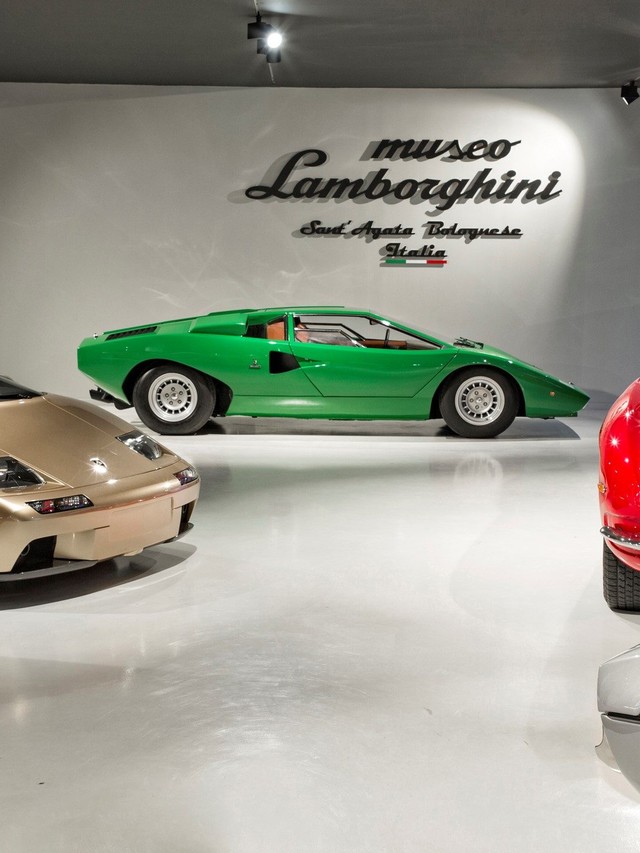
A stunning display of classic Lamborghini models, including a gold Diablo and a green Countach, at the Museo Lamborghini.
How Lamborghini’s Museum Stacks Up Against Rival Experiences
Ferrari’s museum operation in Maranello, just an hour’s drive away, and the Porsche Museum in Stuttgart both attract significantly larger raw visitor numbers, but they also benefit from locations in major cities or well-established tourist corridors. Sant’Agata Bolognese is, to put it diplomatically, not on most travel itineraries by accident. Every visitor who shows up chose to be there.
Lamborghini’s advantage is intimacy. The Porsche Museum is a slick, architecturally celebrated destination, but you cannot walk through the production facility in the same visit. Ferrari’s Maranello museum offers factory-adjacent experiences, but the scale is different. Lamborghini’s smaller footprint means visitors are closer to the cars, closer to the assembly process, and closer to the sense that they are seeing something not everyone gets to see. That exclusivity is entirely on-brand, and it is precisely the quality that turns casual visitors into future owners.
The 100,000 figure also reflects a company that, in 2017, was still building momentum toward its current production volumes. Lamborghini confirmed that the growing global attraction of the brand played a role, and the Urus was about to launch and transform the company’s commercial scale entirely. The museum’s 2017 record likely represents a snapshot of a brand on the cusp of a much larger chapter.
What Comes Next for the Lamborghini Museum
Lamborghini confirmed that a program of new exhibitions is in preparation, though specific themes and dates remain unannounced. The Senna show demonstrated that the museum can function as a rotating cultural venue, not just a static car collection, and the attendance spike it generated makes a strong case for continuing that approach.
The post-Senna reorganization, classifying the collection by engine type, is a smart structural choice for a brand whose identity is so deeply tied to its powertrains. Walking from the front-engine 350 GT at the entrance through the mid-engine V12 era and into the current chapter gives visitors a narrative arc that most car museums lack. The two-floor layout, which multiple sources describe as housing everything from road cars to Formula 1 machines and even marine motors, reinforces the idea that Lamborghini’s engineering ambitions extend well beyond the supercar segment.
For anyone planning a visit, the practical advice from the enthusiast community is straightforward: book the factory tour through your dealer well in advance, avoid public holidays, and consider pairing the trip with a stop at the separate Ferruccio Lamborghini Museum in nearby Funo di Argelato, which focuses on the founder’s broader industrial legacy. The Automobili Lamborghini Museum is the brand’s public face; the Ferruccio museum, by most accounts, is the deeper cut for history enthusiasts. Both are worth the detour, and if the 2017 numbers are any indication, both are doing their part to ensure that the next generation of Lamborghini buyers already knows exactly what the raging bull stands for.


