The ‘Beyond’ Podcast Goes Video, and the First Guest is the Man Who Draws Your Next Lamborghini
Lamborghini’s fourth episode of its Beyond podcast series pairs the company’s Head of Design, Mitja Borkert, with Simon Halfon, the music industry designer and film producer whose credits run from George Michael and Paul Weller album art to the Oasis Supersonic documentary and Kenneth Branagh’s Sleuth. Titled “Music for the eyes,” the installment marks the first time the series is available as video, hosted by Lamborghini Director of Communications Tim Bravo and lifestyle broadcaster Giulia Salvi.
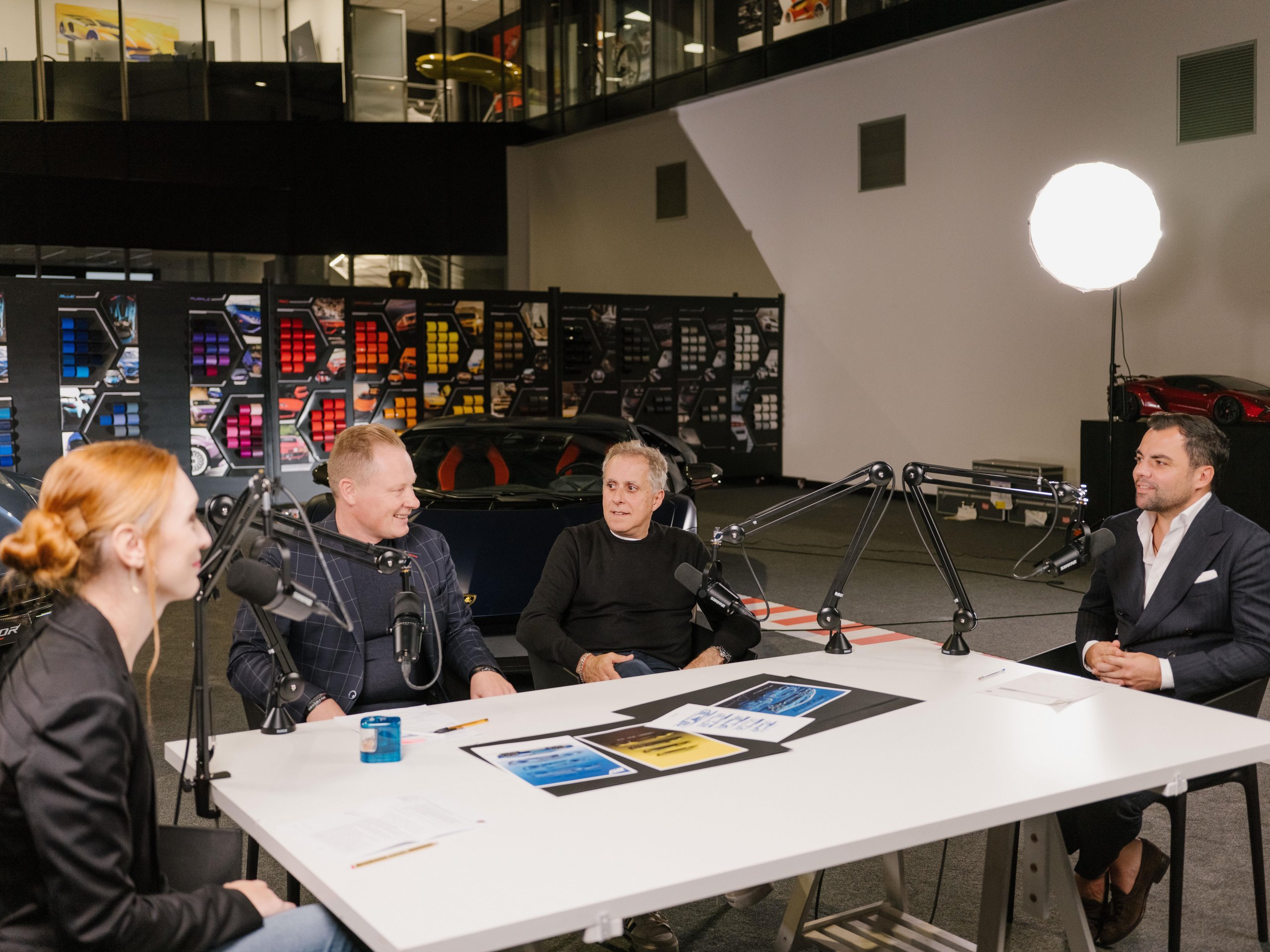
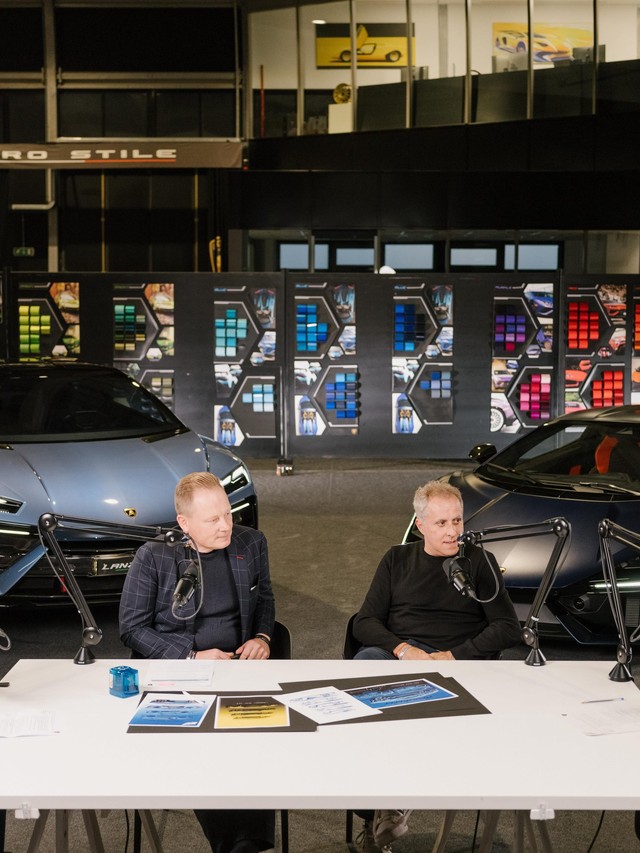
The format is deliberately intimate: four people around a table with microphones, the Lanzador concept and a Revuelto parked in the background like silent co-hosts. Lamborghini says the series puts its own people alongside figures from outside the automotive world to explore the creative parallels that shape both disciplines. In practice, this episode functions as a window into how Borkert thinks about form, emotion, and cultural reference when he picks up a pen at Centro Stile. At a moment when every model in the lineup carries hybrid electrification and the brand’s emotional identity can no longer rest on exhaust notes alone, understanding the cultural instincts of the man drawing these cars matters more than ever.
New episodes drop monthly, available on Spotify, Apple Podcasts, YouTube, and Lamborghini’s dedicated podcast hub at lamborghini.com/podcast.

A panel discussion takes place in front of the Lamborghini Lanzador concept and the Revuelto at Centro Stile.
Why a Supercar Company Needs a Podcast (and Why You Should Care)
Lamborghini producing branded audio and video content is not new. The company launched its own smart TV streaming app, Lamborghini TV, in late 2024, as Road & Track reported. The Beyond podcast fits into a broader media strategy that treats brand storytelling as a product in its own right, not a supplement to a car launch.
The strategic logic ties directly to the design question at the heart of this episode. Lamborghini’s current lineup, the Revuelto, Temerario, and Urus SE, represents the most dramatic engineering pivot in the company’s history: every model now carries hybrid electrification. Buyers spending north of $300,000 on a supercar are purchasing an identity, and Lamborghini knows that identity is built on emotional resonance, not just power-to-weight ratios. A podcast that lets the Head of Design explain his creative philosophy in his own words reinforces the idea that these cars are authored objects, not committee products.
Ferrari, by contrast, tends to guard its design narrative more tightly, parceling out creative insight through controlled media events and the occasional Maranello studio tour. McLaren leans into engineering transparency but rarely foregrounds the cultural or artistic dimensions of its work. Lamborghini’s willingness to let Borkert sit across from a record sleeve designer and talk about Depeche Mode is a different posture entirely, one that signals confidence that the brand’s creative foundation can withstand casual scrutiny and that the people behind the cars are genuinely interesting.
East German Radio, Depeche Mode, and the Origins of a Lamborghini Designer
Borkert’s backstory, as shared in the episode, is genuinely compelling and goes a long way toward explaining why he treats visual culture as inseparable from car design. Growing up in 1980s East Germany, access to Western pop culture and the broader automotive world was restricted. Borkert consumed whatever music he could find through West Berlin and American radio stations, developing a love for sketching that led him to recreate record sleeves by hand. He even drew himself into those recreations, a detail that says something about the ambition and imagination of the teenager who would eventually lead Lamborghini’s design studio.
Lamborghini says Borkert describes discovering Depeche Mode as a transformative creative experience. The significance goes beyond nostalgia. Depeche Mode’s visual identity in the 1980s, shaped by Anton Corbijn and others, was stark, geometric, and deliberately futuristic. If you look at the sharp creases, hexagonal motifs, and aggressive negative space that define current Lamborghini design language, the aesthetic lineage is not difficult to trace. Borkert began his professional career at Porsche in 1999 before eventually moving to Sant’Agata Bolognese, and the contrast between those two design philosophies, Porsche’s evolutionary restraint versus Lamborghini’s theatrical aggression, makes his creative journey all the more interesting.
Simon Halfon’s path started in the postroom of Stiff Records during the punk and New Wave era of the 1980s before he moved into the design department. He cites The Beatles as a foundational influence, both musically and visually. The conversation between the two men, according to Lamborghini, explores how designing a record sleeve and designing a car share a common imperative: you represent something larger than yourself, but you need personal vision and conviction to push the work forward.
“Music is part of every sketch, and for sure artists and album covers and images have influenced my creative work,” Borkert says in the episode.
That quote is not throwaway autobiography. It is a design methodology, and the cars parked behind him in the studio prove it.

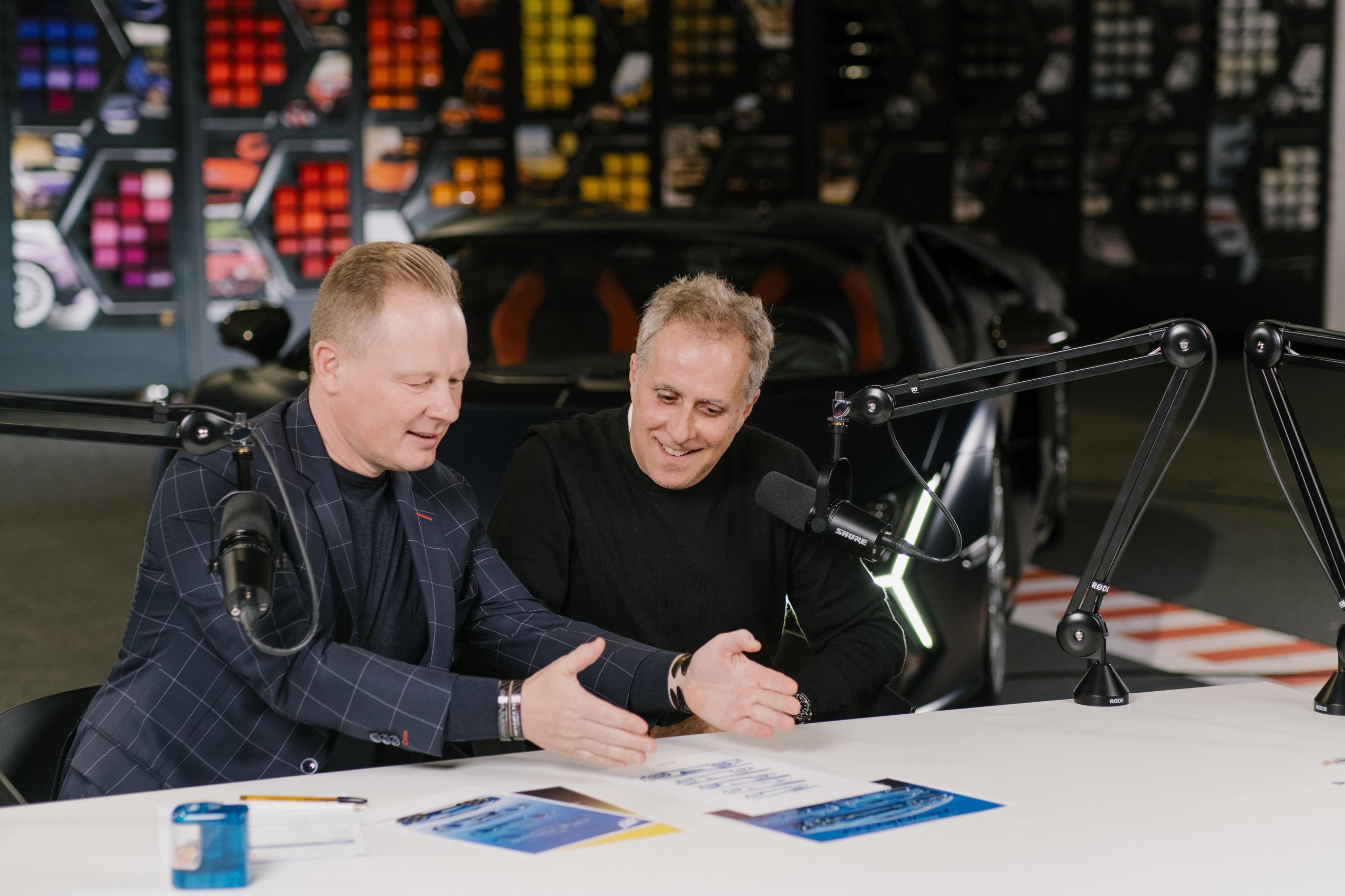
Mitja Borkert and a guest share insights during a captivating discussion, with the Lanzador concept in the background.
Where You Can See the Music: Revuelto, Lanzador, and Lamborghini’s Design DNA
The podcast’s abstract discussion of inspiration becomes tangible when you look at the cars parked behind the hosts. The Revuelto and Lanzador concept, both clearly visible in the episode’s setting, represent two very different expressions of Lamborghini’s current design philosophy, and both carry the fingerprints of the cultural cross-pollination Borkert describes.
Lamborghini’s design DNA frequently incorporates hexagonal shapes, a motif that runs from air intakes to tail light clusters to interior switchgear. The Revuelto’s Y-shaped daytime running lights, visible in the episode’s backdrop, are a signature element that Borkert’s team developed as a modern evolution of the brand’s visual identity. The Lanzador concept, Lamborghini’s preview of its electric future, pushes those cues further: its proportions are lower and wider than the Urus, with surfacing that feels more sculptural than any production Lamborghini to date.
The commercial stakes behind all of this are real. As the lineup transitions to hybrid and eventually full-electric powertrains, the visceral engine note that once defined a Lamborghini experience will change or, in the Lanzador’s case, disappear entirely. Design becomes the primary carrier of emotional identity. The way a Lamborghini looks when it rounds a corner, the way light catches its surfaces, the way it occupies space in a parking lot: these visual qualities will need to do more of the heavy lifting that exhaust notes used to handle. Borkert’s insistence that music and visual culture inform his sketches is not merely autobiographical color. It is a design methodology that prioritizes emotional impact over aerodynamic optimization alone, and for buyers who worry that electrification will sand down Lamborghini’s edges, the podcast offers some reassurance that the people making these decisions are thinking in terms of drama and visceral reaction, not just efficiency targets.

Two men pose with the Lamborghini Lanzador concept and Revuelto in a design studio setting.
The Sketch Swap: When a Record Designer Draws a Car and Borkert Draws an Album Cover
The episode closes with an exercise that sounds gimmicky but actually reveals something useful about how deeply cultural instinct shapes Lamborghini’s visual language. Lamborghini says Borkert and Halfon swap disciplines: Halfon sketches a car, Borkert sketches a record cover. Images from the session show both men drawing on black paper with white pens, a Centro Stile presentation technique that emphasizes form and light.
The exercise matters because it strips away expertise and exposes instinct. When a music designer draws a car, you see which shapes and proportions feel inherently “Lamborghini” to someone outside the automotive bubble. When Borkert draws a record sleeve, you see how he composes a visual narrative without the constraints of aerodynamic function or crash regulation. Both results presumably appear in the video episode, and for design enthusiasts, they are likely the most revealing few minutes of the conversation.
Lamborghini owners and prospective buyers who spec their cars through the Ad Personam program understand intuitively that these vehicles are as much about visual statement as mechanical performance. The sketch exercise is a distilled version of the same creative negotiation that happens when a buyer sits down with Centro Stile to choose a bespoke color or interior treatment. The designer’s cultural vocabulary directly shapes the options available to you, and this episode makes that vocabulary visible in a way that a configurator session never could.

Designers meticulously sketch automotive concepts on black paper, bringing ideas to life with white pens.
AI, the Human Hand, and What the Podcast Leaves Unanswered
Lamborghini says the conversation also touches on whether artificial intelligence can produce the designs and creative passion of the future. The company does not elaborate on Borkert’s specific position, and the episode’s treatment of the topic is described only in general terms. This is a question that matters enormously to anyone following automotive design: generative AI tools can already produce photorealistic car renderings in seconds, and their influence on the early ideation phases of design studios is a subject of active debate across the industry.
What the podcast does not appear to address, based on available material, is how Lamborghini’s Centro Stile currently uses or plans to integrate AI tools. Lamborghini has not publicly detailed its position on AI-assisted design beyond acknowledging the topic in this episode. For a brand whose identity depends on the idea of human authorship, the answer carries real weight. If a future Lamborghini’s proportions were partially generated by an algorithm, does that diminish the car’s emotional value? Borkert’s background, a man who hand-drew himself into record sleeves as a teenager, suggests he would argue strongly for the primacy of the human hand. But the podcast, at least as described, leaves that tension unresolved.
The broader question for Lamborghini enthusiasts is whether content like this podcast genuinely deepens your connection to the brand or functions primarily as sophisticated marketing. The honest answer is probably both. Hearing Borkert talk about his creative influences in his own words, without the filter of a press event or a journalist’s interpretation, offers something that a spec sheet or configurator session cannot.
For current owners and anyone on a Revuelto or Temerario waiting list, the practical takeaway circles back to the thesis running through this entire episode: Lamborghini is investing meaningfully in explaining why its cars look the way they do, at a moment when the mechanical character of the brand is changing faster than at any point since the Miura. The design philosophy Borkert articulates, rooted in cultural obsession and personal conviction rather than trend-chasing, is the clearest signal yet of how Lamborghini intends to keep its cars feeling unmistakably Lamborghini in a world where every competitor is reaching for the same battery cells.
Gallery