Lamborghini Super Trofeo North America Secures First U.S. Television Package
The Lamborghini Blancpain Super Trofeo North America championship has landed its first United States television package, with CBS Sports Network set to cover all six event weekends and the season-ending World Final. Broadcasts begin Wednesday, June 24 with a one-hour program featuring Rounds 1 and 2 from Mazda Raceway Laguna Seca in Monterey, California.
For a series entering only its third North American season, a dedicated broadcast window on a national sports network is a genuine milestone. It moves the championship out of niche livestream territory and into a format where casual channel surfers can stumble onto a grid of 620-horsepower Huracans going wheel to wheel. The timing aligns with what Lamborghini describes as record numbers of cars and drivers on the 2015 grid, a detail suggesting the series crossed whatever internal threshold justified the cost and logistics of a television partnership.
“This exciting television partnership with CBS Sports Network is a significant milestone in the growth of the Lamborghini Blancpain Super Trofeo North America, providing even more evidence of its increasing popularity with fans and competitors,” Lamborghini Head of Motorsport Giorgio Sanna said.
Why Television Changes the Commercial Equation
Single-make racing series live or die on visibility. A championship can field spectacular cars and talented drivers, but if nobody outside the paddock sees the racing, the commercial loop never closes. Manufacturers use these series to sell race cars, deepen brand loyalty among existing owners, and create aspirational content that makes the road car feel more legitimate. Television is the accelerant for all three, and for the Super Trofeo, the most direct pipeline between Lamborghini’s showroom and the circuit, the stakes are particularly high.
Every car on the grid started life as a customer purchase. Consistent CBS Sports Network time slots mean potential participants, and their sponsors, can point to real viewership numbers when justifying the investment. That matters enormously in a market segment where the decision to go racing often hinges on whether anyone outside your pit crew will notice. Lamborghini owners who never intend to race still benefit from the perception that their car’s engineering is validated at speed, on camera, in front of a national audience.
The Super Trofeo series originated in Europe in 2009 and expanded into Asia in 2012 before arriving in North America in 2013. Each expansion followed the same logic: put the cars where the buyers are, then make sure the buyers can watch. The CBS deal completes that logic for the American market.
The Huracan Super Trofeo: What the Camera Will Actually Show
The star of every broadcast will be the Huracan LP 620-2 Super Trofeo, a purpose-built race car powered by a naturally aspirated 5.2-liter V10 producing 620 horsepower. It replaced the 570-horsepower, all-wheel-drive Gallardo LP 570-4 Super Trofeo as the series flagship, and the upgrade brought more than additional power. The Huracan version switched to rear-wheel drive, a configuration that rewards precise throttle inputs and punishes lazy corner exits. For a series that doubles as a driver development ladder toward GT3 competition, that rear-drive layout is a deliberate pedagogical choice.
Lamborghini states the race car incorporates technology, performance elements, and design lines taken directly from the Huracan LP 610-4 street car, which made its global debut in 2014. The race version strips away the road car’s comforts and sheds serious weight: its dry weight sits at 1,270 kg (2,800 lb), producing a weight-to-power ratio of 2.05 kg/CV. That figure puts it among the most aggressive cars in any single-make series globally. One source indicates the Huracan LP 620-2 Super Trofeo weighs 335 pounds less than its street-legal counterpart, with savings coming from a hybrid carbon/aluminum frame construction, race-specification Brembo/PFC brakes, and the wholesale removal of anything not essential to going fast.
What remains is the V10’s naturally aspirated character, which translates beautifully to television audio. That shrieking engine note, unfiltered by turbochargers or hybrid system intervention, is arguably the series’ best marketing asset and precisely the kind of sensory detail that turns a casual viewer into a curious one.

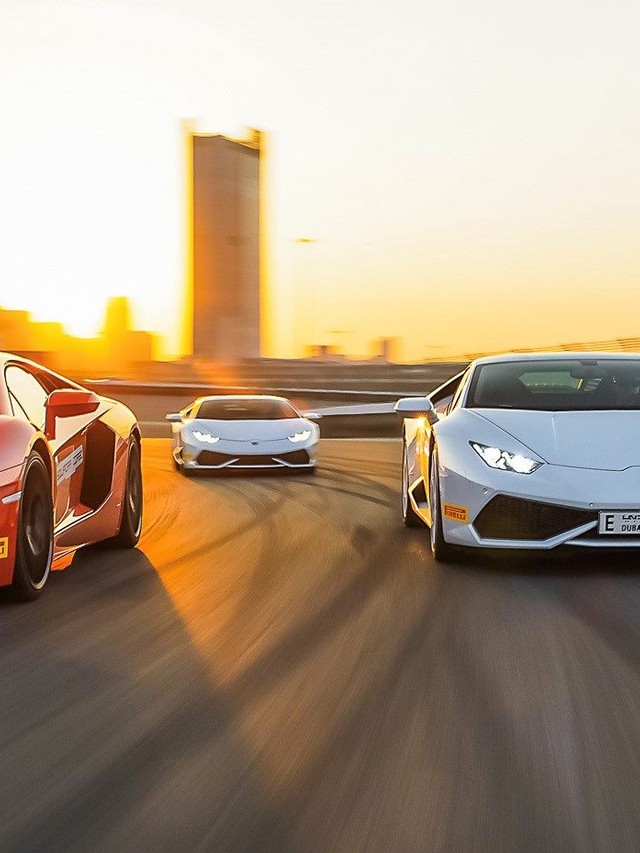
A white Lamborghini Huracan safety car leads a line of race-prepped Huracan Super Trofeo cars on the track.
Positioning Against Ferrari and Porsche’s Established Broadcasts
Lamborghini is not the only manufacturer running a single-make customer racing series, and the television question is where the competitive comparison sharpens. Ferrari’s Challenge series and Porsche’s various Cup championships both benefit from decades of established broadcast relationships and deeply rooted racing cultures. Lamborghini’s North American series is only three years old. Securing a national broadcast deal this early suggests the series is growing faster than its age would predict.
The strategic difference lies in positioning. Ferrari Challenge and Porsche Cup function partly as hospitality extensions of their respective brands, partly as genuine competition. Lamborghini’s Super Trofeo occupies similar territory but leans harder on the gentleman driver pathway, offering categories for amateur racers alongside more experienced competitors. The series explicitly functions as a stepping stone toward GT3 endurance racing, giving participants a reason to stay in the Lamborghini ecosystem as their skills develop. Television coverage strengthens every rung of that ladder by making each step visible to the audience, and to the sponsors, who fund it.
What Comes Next for Super Trofeo Visibility
Lamborghini confirmed the CBS Sports Network deal covers the 2015 season’s six event weekends and the World Final but stopped short of discussing multi-year commitments or expansion to additional platforms. The practical takeaway for enthusiasts and prospective participants: if the ratings justify it, expect this to become a permanent fixture rather than a one-season experiment. Television deals in niche motorsport categories tend to expand when grid numbers hold steady or grow, and Lamborghini reports this season’s participation is already at record levels.
The deal also reshapes the value proposition for sponsors. A team running in a broadcast championship can offer measurably more exposure than one competing in an unfilmed paddock, which may help offset the considerable expense of campaigning a purpose-built V10 race car across six weekends. The Blancpain partnership, which extends beyond title sponsorship to include special edition road cars and limited chronographs, benefits from broader viewership as well. One source recounts that Blancpain’s CEO, Marc Hayek, drove one of the original eleven cars in the series’ inaugural European season. That kind of principal-level involvement from a luxury watchmaker suggests the relationship runs deeper than a logo on the bodywork, and national television coverage only strengthens the case for its continuation.


