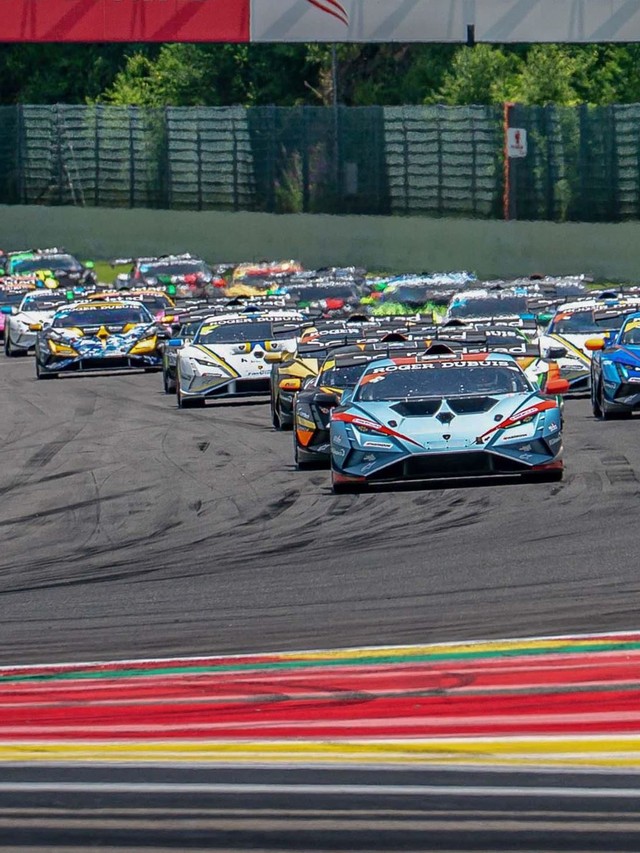
Monza Kickoff: The Super Trofeo Europe Enters Its Tenth Season
When the Lamborghini Super Trofeo Europe held its inaugural season in 2009, the grid was modest and the concept still needed proving: could a one-make championship built around Sant’Agata Bolognese’s entry-level supercar attract serious teams, develop real talent, and sustain itself commercially? Ten years later, the answer arrived at Monza on April 21-22, 2018, in the form of approximately 50 cars fielded by 22 teams, the largest grid the European series had ever assembled.
The Monza weekend also marked the European competition debut of the Huracán Super Trofeo Evo, a car Lamborghini says features completely revised aerodynamics aimed at improving on-track efficiency. The Evo had already turned laps in anger at Sepang during the Asian series opener and in pre-season testing at Monza itself, but this round represented its first appearance in the championship’s most competitive continental theater. Four new teams joined the paddock for 2018: AKF Motorsport, Iron Lynx Motorsport Lab, Micanek Motorsport, and MSG Motorsport. That kind of expansion, a decade into a series’ life, signals something beyond novelty. It suggests the commercial model works for the teams buying and running these cars, and that Squadra Corse’s organizational structure keeps the barrier to entry achievable while the racing stays credible.
Deconstructing the Evo’s Aerodynamic Overhaul
Lamborghini says the Evo’s aerodynamic package was developed in collaboration with Dallara Engineering and Lamborghini Centro Stile, a combination of race-car engineering rigor and design-house aesthetics that rarely overlap this directly. Nearly every carbon fiber body panel was reportedly redesigned. The front bumper gained larger lower air intakes and more aggressive side spoilers (known as flics in aero parlance), increasing front-axle downforce and improving high-speed stability into corners. The front splitter, flat floor, and rear diffuser were largely carried over or only lightly modified, meaning the team concentrated its effort on the upper bodywork where the biggest efficiency gains were available.
The most visually distinctive element is the rear “fin” positioned on the engine cover. In aerodynamic terms, a dorsal fin like this stabilizes the car in yaw, reducing the tendency for the rear to step out under crosswinds or during abrupt direction changes. It also cleans up airflow feeding the rear wing, making that wing’s downforce more consistent rather than simply greater. The goal, Lamborghini says, was improved efficiency: maintaining high downforce while reducing drag, which translates to better straight-line speed without sacrificing corner grip.
For the drivers and teams racing these cars in 50-minute stints with mandatory pit stops, that efficiency equation matters enormously. Lower drag means less tire degradation on long straights and better fuel economy across a stint, while consistent downforce builds driver confidence lap after lap. In a one-make series where every car is mechanically identical, aerodynamic confidence becomes one of the few variables a driver can exploit.
Forging Future Champions: The Super Trofeo as a Motorsport Ladder
One-make series live or die by the quality of their driver pipeline, and the 2018 Super Trofeo Europe entry list read like a deliberate exercise in talent cultivation. The most headline-grabbing name was Fabian Vettel, the 19-year-old brother of four-time Formula 1 world champion Sebastian Vettel, making his series debut with Konrad Motorsport alongside Carrie Schreiner, who had already won the PRO-AM title in the Middle East Series. Francesca Linossi returned to the series after a single appearance back in 2011, now racing with the newly formed Iron Lynx Motorsport Lab team.
Beyond the familiar surname, the grid featured a striking number of drivers under 23: Davide Venditti (22, from single-seaters), James Pull (18, from open wheels), Frederik Schandorff (21), Marko Helistekangas (23), Simon Larsson (20, from ADAC TCR), Kikko Galbiati, Joffrey De Narda, and 17-year-old Giacomo Altoè. The Super Trofeo’s class structure, splitting competitors into Pro, Pro-Am, Am, and Lamborghini Cup categories, creates an environment where young professionals race alongside experienced gentleman drivers. That mix keeps the grid full, the budgets flowing, and the learning curve steep.
The most telling presence on the 2018 grid was Rik Breukers. The 19-year-old Dutchman, a product of Lamborghini Squadra Corse’s GT3 Junior Program, arrived at Monza as the reigning Asian series champion, 2017 European vice-champion, and a GTD class winner at the 24 Hours of Daytona alongside Mirko Bortolotti, Rolf Ineichen, and Franck Perera. Breukers embodied exactly what the Super Trofeo is designed to produce: a driver who enters the one-make series as a prospect and graduates into factory-backed GT3 competition at the sport’s highest level. That pathway, from Super Trofeo seat to Daytona podium, is the strongest argument Lamborghini can make for the series’ competitive legitimacy.
A Decade of Growth and a Calendar Built for Visibility
The 2018 calendar reflected a series confident enough to share the stage with GT racing’s biggest events. Five of the six double rounds ran on the same weekends as the Blancpain GT Series, putting Super Trofeo cars in front of the exact audience most likely to care about them: GT racing fans, team principals scouting talent, and sponsors evaluating motorsport investments. The Spa-Francorchamps round coincided with the 24 Hours of Spa, arguably the most prestigious GT endurance race in Europe.
The circuit rotation carried some historical weight as well. Misano returned to the calendar after a five-year absence, while Vallelunga was chosen to host both the season finale and the Lamborghini World Final, a tradition that began at the same Roman circuit in 2013. Since that inaugural World Final, the event has grown into a global gathering where champions from the European, North American, and Asian series compete for an overall title across two 50-minute sprint races.
The weekend format stayed consistent: two 50-minute races per round, rolling starts, mandatory pit stops between the 26th and 30th minute. Friday offered two one-hour free practice sessions, Saturday morning brought two 20-minute qualifying sessions, Race 1 launched Saturday at 3:10 p.m., and Race 2 followed Sunday at 12:20 p.m. Both races were available via live streaming on Lamborghini Squadra Corse’s website and Facebook page.
Beyond the Track: Roger Dubuis and Lamborghini’s Brand Calculus
The 2018 season also introduced a new partnership with Swiss luxury watch brand Roger Dubuis. Lamborghini did not detail the financial terms or specific activations, but the pairing fits a pattern visible across high-end motorsport: luxury brands attach themselves to racing series where the paddock audience overlaps with their customer base. In the Super Trofeo, that audience includes team owners, gentleman drivers, and the corporate sponsors who fund their seats.
For Lamborghini, the strategic value runs in both directions. A prestige watch partner reinforces the series’ positioning as something more elevated than a regional club-racing championship, while Roger Dubuis gains access to Lamborghini’s global motorsport platform across three continents. The presence of such a brand signals that the Super Trofeo had matured into a commercially viable property rather than a loss-leading promotional exercise.
Taken together, the record grid, the Evo’s aerodynamic refinement, the young-driver pipeline feeding GT3 programs, and the arrival of a luxury brand partner all point to the same conclusion. By its tenth season, the Super Trofeo had evolved from a promotional exercise into genuine motorsport infrastructure: a self-sustaining system that develops cars, cultivates drivers, and builds the institutional knowledge Squadra Corse needs for its broader racing ambitions.
2018 Lamborghini Super Trofeo Europe Calendar
| Round | Circuit | Dates |
|---|---|---|
| 1 | Monza, Italy | April 21-22 |
| 2 | Silverstone, England | May 19-20 |
| 3 | Misano, Italy | June 23-24 |
| 4 | Spa-Francorchamps, Belgium | July 26-27 |
| 5 | Nürburgring, Germany | September 15-16 |
| 6 | Vallelunga, Italy (World Final) | November 15-16 |
Gallery


