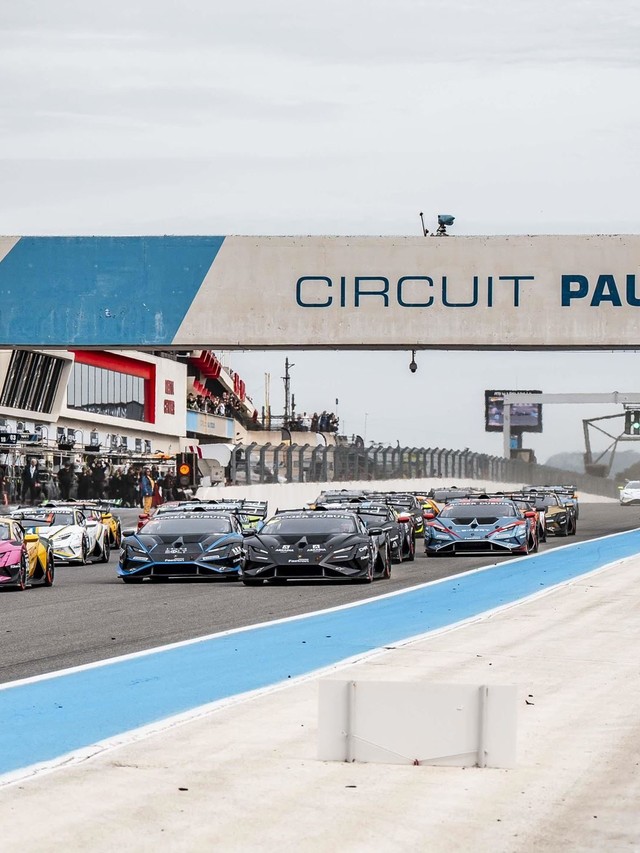
Lamborghini’s Super Trofeo Arrives in Abu Dhabi and Dubai
Lamborghini Squadra Corse confirmed a fourth continental chapter for its one-make racing series in late October 2016: the Lamborghini Super Trofeo Middle East, with an inaugural season slated to begin in February 2017 at circuits in Abu Dhabi and Dubai. The championship would run identically to the established European, Asian, and North American legs, featuring double-round weekends reserved exclusively for the Huracán Super Trofeo and split across four driver classes.
Giorgio Sanna, head of Motorsport at Automobili Lamborghini, framed the expansion as a consolidation of the brand’s customer racing strategy:
“We are proud to announce the birth of this new championship in a strategic market for our brand, to consolidate a strategy in Customer Racing.”
The phrasing was diplomatic, but the underlying logic was blunt. The Gulf states already bought plenty of Lamborghinis. Giving those owners a factory-backed racing program on their home circuits would convert passive brand loyalty into something far stickier, binding customers to the marque not just through ownership but through competition.
Why the Middle East, and Why Now
Abu Dhabi and Dubai already hosted major international motorsport events, from Formula 1 at Yas Marina to the Dubai 24 Hours at the Autodrome. The infrastructure was proven. The customer base was wealthy, enthusiastic, and underserved by manufacturer-backed racing programs tailored to gentleman drivers.
Lamborghini’s move addressed a practical gap as well. The Super Trofeo Middle East season runs during the European and North American off-season, so professional drivers could treat it as a pre-season shakedown without calendar conflicts. For regional gentleman drivers who might otherwise need to fly to Monza or Sepang for seat time in a factory-supported series, it removed the single biggest barrier to entry: geography.
The timing also coincided with Lamborghini’s broader push to expand Squadra Corse’s footprint beyond the traditional motorsport heartlands. Eight seasons of the Super Trofeo had already demonstrated that customer racing could sustain itself commercially while feeding the brand narrative. Adding a fourth continental series was less a gamble than a logical next step in a formula that was already working.
What Makes the Super Trofeo Formula Work
One-make series are hardly rare in motorsport. Ferrari runs the Challenge, Porsche runs the Carrera Cup, and several other manufacturers operate regional championships of varying ambition. What separates the Super Trofeo from most of its peers is the combination of a genuinely fast race car, a clear driver classification system, and a global championship structure that ties all the continental legs together at an annual World Finals event. Championship-winning teams and drivers from each class earn free entry to that finale, creating a tangible competitive incentive beyond regional bragging rights.
The four-class structure (Pro, Pro-Am, Am, and Lamborghini Cup) keeps the grid diverse. A bronze-rated gentleman driver racing his first season can compete meaningfully in the Am class without being overwhelmed by a factory-affiliated professional in Pro. That accessibility fills grids, and full grids keep sponsors and teams committed season after season.
Lamborghini says the Super Trofeo is the world’s most successful one-make series, a claim that rests largely on participation numbers: more than eighty cars racing across three continental championships by the time the Middle East expansion was announced. Whether that figure surpasses Ferrari Challenge or Porsche Carrera Cup entries globally depends on how you count, but the trajectory was clearly upward, and adding a fourth regional series only widened the gap.
One practical detail often overlooked in launch coverage: Squadra Corse provides technical support, spare parts, and on-track assistance at racing events. That customer support infrastructure is a significant part of the value proposition, particularly for teams entering the series without deep in-house engineering resources. Lamborghini essentially acts as a technical partner, not just a car supplier.
Squadra Corse’s Competitive Position Against Rivals
Customer racing programs serve a dual purpose for supercar manufacturers. They generate revenue directly through race cars, parts, entry fees, and hospitality, and they reinforce the brand’s performance credibility in a way no marketing campaign can replicate. When a Huracán Super Trofeo wins on track, every road-going Huracán in the showroom benefits from the association.
Lamborghini’s competitive advantage in this space comes from vertical integration. Squadra Corse designs, develops, and builds its race cars in-house, giving the department direct control over the product and the support ecosystem. According to Autoblog, the recently unveiled Temerario GT3 represents the first Lamborghini competition car to be fully designed, developed, and built in-house, an evolution of the approach that Squadra Corse refined through years of Super Trofeo operations.
Ferrari and Porsche both run mature customer racing programs with deep global reach, and neither brand was standing still while Lamborghini expanded into the Middle East. But Lamborghini’s willingness to invest in a fourth regional series during a period when many manufacturers were consolidating their motorsport spending spoke to a level of commitment that resonated with the customer teams who ultimately decide which car to buy and which paddock to join.
The Super Trofeo also functions as a pipeline. Drivers who prove themselves in the one-make series can progress to GT3 competition, where Lamborghini’s Huracán GT3 (and now the incoming Temerario GT3) compete against the full spectrum of manufacturer entries. That career ladder, from gentleman racer to GT3 competitor, is a powerful recruiting tool that keeps drivers within the Lamborghini ecosystem rather than defecting to a rival brand’s program.
The Huracán Super Trofeo: Purpose-Built for This Fight
The car at the center of the series deserves context beyond the strategy. The Huracán Super Trofeo is a track-only, non-street-legal race car running an enhanced version of the production Huracán’s 5.2-liter naturally aspirated V10, with significant weight reduction through extensive use of carbon fiber and aluminum. One report indicates the car produces 611 hp while shedding roughly 550 lbs compared to the standard road car.
Crucially, the Super Trofeo is rear-wheel drive, a departure from the all-wheel-drive layout of most road-going Huracáns. That choice emphasizes throttle adjustability and track agility, qualities that reward skilled drivers and make the racing more entertaining to watch. For gentleman drivers accustomed to the safety net of AWD on their road cars, the transition to RWD on a race circuit is part of the learning curve that makes the series genuinely developmental.
Enthusiast forums reflect a long-standing appreciation for the Super Trofeo’s raw character. Multiple owners and fans on Lamborghini-Talk describe the car as a “raw Italian beast” compared to the more refined road-going Huracán, and the limited-production nature of these race cars gives them a collector appeal that extends well beyond their competitive lifespan. Autoblog recently covered a near-zero-mileage Huracán Super Trofeo EVO appearing at auction, underscoring that these machines hold value as both competition tools and collectible artifacts of Lamborghini’s naturally aspirated V10 era.
What This Means for Lamborghini Owners and Enthusiasts
For Lamborghini owners in the Gulf region, the Super Trofeo Middle East created something that did not previously exist locally: a factory-supported pathway from showroom customer to competitive racing driver, without the logistical burden of shipping cars and teams to another continent. The series runs at Yas Marina and Dubai Autodrome, two circuits that most regional supercar owners already know from track days and corporate events. The leap from casual track use to organized competition becomes considerably shorter when the championship comes to you.
Lamborghini did not announce specific entry costs for the series, and that information remains difficult to pin down publicly. The confirmed details reveal a championship that mirrors the proven format of the European, Asian, and North American legs: identical regulations, identical car specifications, and a direct qualification path to the annual World Finals. For anyone considering participation, the practical question is less about the series format (which is well established) and more about the cost of acquiring and running a Huracán Super Trofeo through a full season, a figure that varies significantly depending on team affiliation, spare parts consumption, and travel.
Every Super Trofeo grid is populated by people who either already own Lamborghinis or are likely to buy one. Every paddock is a de facto brand experience. Every championship winner becomes an ambassador who validates the brand’s performance claims in a way that no advertisement can. That is the real engine behind the Middle East expansion: not a calendar addition for its own sake, but a deliberate effort to weave motorsport into the ownership experience in a region where Lamborghini’s showroom presence was already strong but its competitive presence was absent.
The series ran its inaugural season in 2017 as planned and continued through subsequent years before pausing and returning in 2022 with an updated format featuring three races per round. That durability suggests the strategic logic behind the Middle East expansion was sound. Lamborghini bet that its customer base in the region would support a dedicated racing program, and the evidence so far indicates that bet paid off.
Gallery


