Lamborghini’s Shanghai Double Header: New Car, Final Farewell
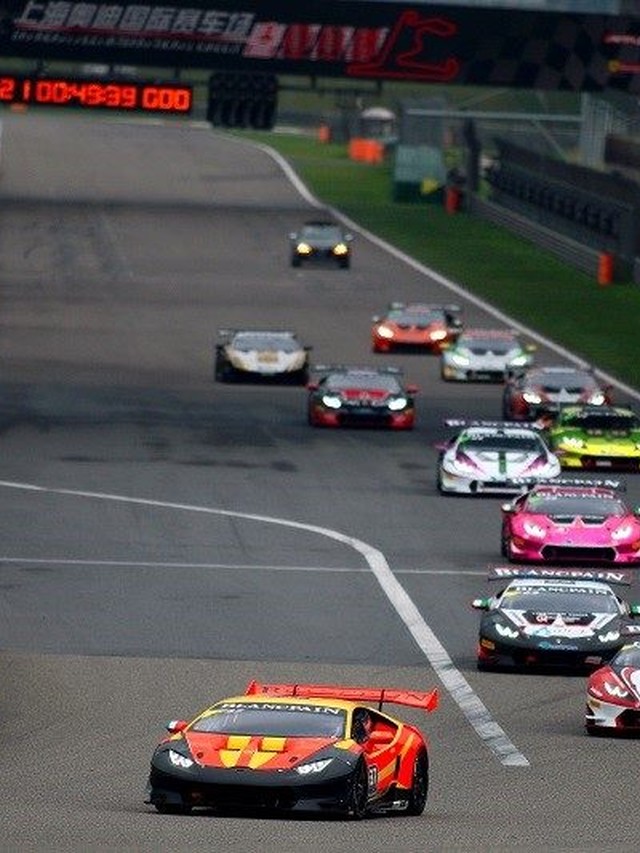
The second Shanghai stop of the Lamborghini Blancpain Super Trofeo Asia series carried more weight than a typical mid-season round. Staged as part of the inaugural China Speed Weekend, a Volkswagen Group initiative that also featured the Formula Masters China Series and Boss GP, the fifth round of the 2015 Asian championship delivered a rare generational overlap: the first competitive season for the Huracán LP 620-2 Super Trofeo running alongside the final campaign of the Gallardo, Lamborghini’s most commercially successful road car to date.
The timing was deliberate. The year 2015 marked Lamborghini’s 10th anniversary since entering the Chinese market, and staging that handover on one of Asia’s most prominent circuits gave the occasion a ceremonial quality no standard race weekend could match. The Shanghai International Circuit, with its 5.45km layout and the longest straight on the current F1 calendar, provided a suitably dramatic backdrop. Conditions cooperated, too. According to one competitor report, the weather was sunny and dry, a welcome contrast to an earlier Shanghai round where the Huracán race cars had to contend with a typhoon.
What made the weekend genuinely significant, though, was the way Lamborghini wove together racing, brand experience, and customer engagement into a single statement about its future in China and in motorsport. Every element, from the new car’s rear-wheel-drive architecture to anniversary celebrations off the track, pointed in the same direction: a company using a single-make series not merely to fill grids, but to build a deeper identity as a performance brand with staying power.
The Huracán LP 620-2 Super Trofeo: A Race Car Built to Teach
Lamborghini describes the Huracán LP 620-2 Super Trofeo as an all-new car, purpose-built for racing rather than adapted from a road-going shell. The naturally aspirated 5.2-liter V10 produces 620 horsepower, and Lamborghini claims a dry weight of 1,270 kg, yielding a power-to-weight ratio of 2.05 kg/CV. Those are the headline numbers, but the engineering philosophy underneath them tells a more interesting story.
Power goes exclusively to the rear wheels through a six-speed sequential gearbox. Most road-going Huracán models of the era used all-wheel drive, so stripping the front axle of power was a deliberate training exercise. Lamborghini says the rear-wheel-drive layout familiarizes Super Trofeo drivers with a traction configuration similar to that of the Huracán GT3, giving competitors a direct skill bridge to higher-tier professional racing. A driver who learns throttle management and rotation in the Super Trofeo car arrives at a GT3 cockpit with muscle memory that transfers.
The aerodynamic package, developed in collaboration with Dallara Engineering according to one detailed technical source, includes a ten-position adjustable rear wing, front and rear diffusers, and adjustable front air intakes. Brembo/PFC brakes with steel discs and a Bosch Motorsport ABS with 12 settings round out the hardware. The roll cage alone reportedly weighs just 43 kg while increasing torsional stiffness by 45 percent over the outgoing Gallardo Super Trofeo.
This philosophy mirrors what competitors like Ferrari and Porsche pursue with their own single-make series, each using controlled environments to develop talent that feeds into GT3 and beyond. Where Lamborghini differentiates itself is in the deliberate rear-wheel-drive architecture at the feeder level, a decision that prioritizes driver skill over all-wheel-drive safety nets. Whether that produces better GT3 pilots over time remains an open question, but the logic is clear: the Super Trofeo exists as a proving ground, and the Huracán was designed to make that function explicit.
The Gallardo’s Last Racing Season
The 2015 season marks the final outing of the Gallardo in the Super Trofeo series, closing a chapter that transformed Lamborghini from a company with no single-make racing program into one with a genuinely global motorsport presence spanning Europe, Asia, and North America. One source reports that the championship debuted in Europe in 2009, with the Asian series launching in 2012 and the North American series following in 2013. The Gallardo LP 570-4 Super Trofeo was the car that made all of that possible. Its relative accessibility, by Lamborghini standards, and the reliability of its V10 platform attracted a mix of gentleman drivers and aspiring professionals who kept grids full across three continents.
For the enthusiast community, the Gallardo Super Trofeo cars retain a particular appeal. Forum threads on Lamborghini-Talk reveal owners who collect both road-going Super Trofeo Stradales and the full race cars, treating them as artifacts from an era of pure naturally aspirated competition. As Autoblog noted in a later feature, the Super Trofeo lineage produces cars that occasionally cross into street-legal territory, blurring the boundary between race car and collector piece in ways that keep values strong.
Seeing the Gallardo and Huracán share a grid in Shanghai gave the farewell a tangible quality. The older car’s departure was not abstract; it was happening in real time, lap by lap, while its successor demonstrated exactly why the transition was necessary.
A Decade in China: Racing as Brand Building
Lamborghini’s 10th anniversary in China was more than a calendar milestone. The company used the occasion to launch three distinct initiatives aimed at deepening its relationship with Chinese customers, and the Super Trofeo round at Shanghai served as the most visible anchor.
The first was the Huracán Zhong, a China-specific model whose exact specifications Lamborghini did not detail in its event materials. The second was the China Giro, described as an adventurous road tour that began in July with a final leg scheduled for late October in and around Beijing. The third was a complementary maintenance service extended to all Chinese customers who purchased Lamborghini models before 2013.
That last initiative deserves attention. Offering free maintenance to owners of older cars is a retention play, not a sales tactic. It signals that Lamborghini views its existing Chinese customer base as a long-term asset worth investing in, rather than focusing exclusively on new-car transactions. For a brand that entered China only a decade earlier, that kind of after-sales commitment suggests confidence in the market’s maturity and in the loyalty of its buyers.
The China Giro, meanwhile, functions as a rolling brand experience, putting Lamborghini road cars on dramatic routes in front of prospective buyers and media. Combined with the Super Trofeo’s racing spectacle, the strategy creates multiple touchpoints: track, road, and service bay. Few competitors in the luxury performance segment were running all three simultaneously in the Chinese market at that time. Together, these programs reinforced the same message the Huracán race car delivered on track: Lamborghini was not passing through China. It was building something permanent.
From Shanghai to Sebring: What Comes Next
The Shanghai round was the penultimate stop for the 2015 Asian series. Lamborghini confirmed that the next destination would be Sebring in Florida, where the Asian Finals would merge with the European and North American champions for the World Finals. The structure, pitting continental winners against each other on a single weekend, gives the series a genuine competitive climax that many single-make championships lack.
For drivers in the Lamborghini Squadra Corse young drivers program, the stakes at Shanghai were immediate. The initial qualifying session placed two program participants in leading grid positions, with Chinese driver Yuan Bo and Italian teammate Eduardo Liberati starting from pole. Malaysian driver Afiq Yazid qualified second. Results showed Yazid taking the top finish in the Pro class, Bo and Liberati winning Pro-Am, and Andrew Haryanto with Mark Darwin securing the Am class.
The partnership roster supporting this infrastructure continues to expand. Blancpain remains the title sponsor, Pertamina joined as a new partner and supplier for 2015, and Pirelli, OMP, X-Bionic, Becker Carbon, and BMC all lend support. That breadth of commercial backing reflects the series’ growing appeal as a marketing platform, not just a racing calendar.
For LamboCars readers watching Lamborghini’s motorsport trajectory, the 2015 Shanghai weekend stands as a transitional moment. The Gallardo’s exit and the Huracán’s arrival established the pattern Lamborghini would follow through subsequent EVO and EVO2 updates, and eventually into the Temerario GT3 program, which Autoblog reported as Lamborghini’s first competition car fully designed and built in-house. The seeds of that ambition were planted here, on a sunny October afternoon in Shanghai, with a rear-wheel-drive V10 race car built to teach drivers how to handle what comes next.
Gallery


