Six Wins in Eight Races, and a Rolling Showroom in Virginia
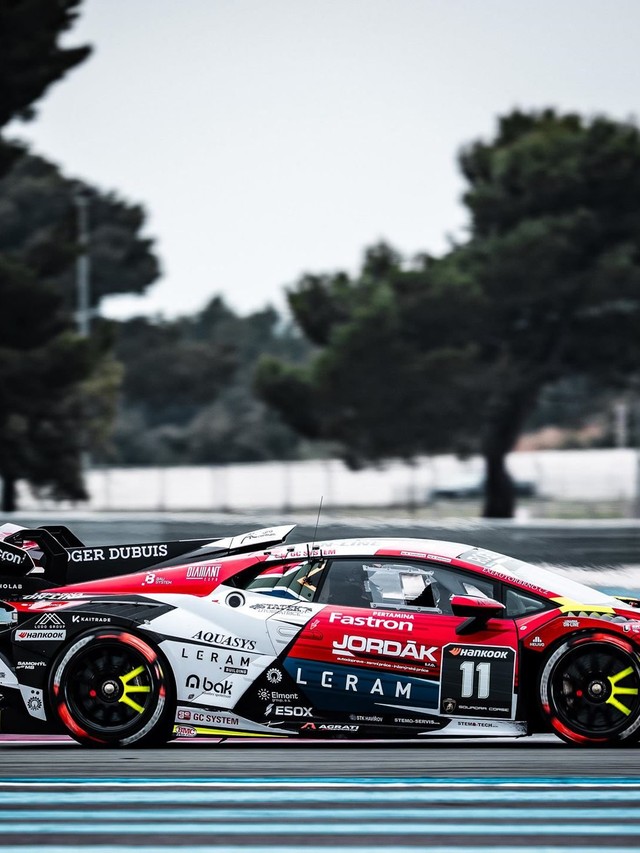
Shinya Michimi collected his sixth victory in eight starts at VIRginia International Raceway on August 28, leading a Prestige Performance 1-2 finish in the Lamborghini Blancpain Super Trofeo North America Round 8. The margin over teammates Trent Hindman and Craig Duerson was 1.457 seconds, a gap that barely hints at how contested the 50-minute race actually was. Three separate caution periods compressed the field, forced restarts, and gave Hindman a realistic shot at reeling in his teammate during the closing laps. He got within 0.790 seconds. It was not enough.
The race itself, though, only tells half the story of what Lamborghini staged in Danville, Virginia. While Michimi was threading through cautions and nailing pit windows in the No. 1 Huracán Super Trofeo LP 620-2, Lamborghini and co-sponsor Blancpain were hosting dealer clients and prospective buyers in a hospitality program that included high-speed hot laps around the same circuit. The Super Trofeo series, launched in 2009 and now spanning Europe, North America, and Asia, functions as something more deliberate than a racing championship. It is Lamborghini’s most carefully orchestrated intersection of motorsport credibility and luxury brand cultivation, and VIR offered a concentrated look at how every element works in concert.
The Hospitality Circuit: Why Lamborghini Puts Clients Trackside
Lamborghini says it provided “world-class hospitality” at VIR for clients and guests of its North American dealer network. That language is corporate, but the underlying program is anything but generic. Guests participated in the IMSA Hot Lap Experience, which put them in the passenger seat of a Lamborghini for full-speed laps of the 3.27-mile circuit. For a prospective buyer weighing a six-figure purchase, the difference between a showroom test drive and a hot lap at a professional racing venue is enormous. One sells a car. The other sells a lifestyle.
The integration matters. Lamborghini folds the hospitality directly into the race weekend rather than treating it as a separate, ticketed event. Dealer guests watch the same cars they might someday campaign, driven by professionals and gentleman racers alike, then climb into one themselves. The psychological effect is deliberate: you stop thinking of a Huracán as a car you park in your garage and start imagining it as one you bring to a grid. For Lamborghini’s dealer network, which fields entries under names like Lamborghini Paramus, Lamborghini Beverly Hills, and Lamborghini Palm Beach, the series doubles as a relationship-building tool that no amount of print advertising can replicate.
The practical takeaway for anyone considering Lamborghini ownership: ask your dealer about Super Trofeo hospitality access. These events are not widely advertised, and availability depends on your relationship with the dealership, but they represent one of the most compelling perks in the supercar ownership ecosystem.
Brand Strategy on a Racing Budget
The Super Trofeo series occupies a unique position in Lamborghini’s competitive architecture. It is a one-make championship organized by Squadra Corse, Lamborghini’s motorsport division, which means every car on the grid is a Huracán Super Trofeo LP 620-2. The format eliminates manufacturer rivalry and replaces it with something arguably more useful for the brand: a controlled environment where the car itself is never the variable. Every victory, every podium, every hot lap reinforces the same message. The Huracán works.
That philosophy differs fundamentally from open GT3 or GTE competition, where Lamborghini also competes but where a bad result can be attributed to the car as easily as the team. In a one-make series, the spotlight falls on drivers, teams, and preparation. Lamborghini absorbs no reputational risk from mechanical failure because the playing field is identical. It is, in the most literal sense, a controlled experiment in brand reinforcement.
The series also serves as a pipeline. Drivers who prove themselves in Super Trofeo can graduate to GT3 competition, and Lamborghini’s recent unveiling of the Temerario Super Trofeo at Lamborghini Arena signals that this ladder will continue into the hybrid era. The program connects amateur and gentleman racers to professional motorsport in a way that keeps them inside the Lamborghini ecosystem at every rung.
Porsche and Ferrari both operate their own customer racing championships and use similar hospitality frameworks to court high-net-worth buyers. What distinguishes Lamborghini’s approach is scale relative to brand size. Lamborghini produces far fewer cars annually than either rival, which makes each Super Trofeo participant a proportionally larger share of its customer base. The series does not need to fill 40-car grids to succeed. It needs to make every participant feel like they belong to something exclusive, and a compact field at a circuit like VIR accomplishes that more effectively than a crowded grid at a mega-event.
The Huracán LP 620-2: A Race Car That Teaches by Subtraction
The car at the center of the VIR weekend deserves its own examination, because the LP 620-2 designation tells you something important about Lamborghini’s racing philosophy. The “620” refers to 620 horsepower from the naturally aspirated 5.2-liter V10, and the “2” means rear-wheel drive. Most road-going Huracáns send power to all four wheels. The Super Trofeo strips away that safety net.
Rear-wheel drive in a mid-engine race car with 620 horsepower is a deliberate choice. It makes the car harder to drive, more responsive to throttle inputs, and more punishing of mistakes. For a customer racing series, that might sound counterintuitive. Why make the car more difficult? Because the difficulty is the point. Drivers who master a rear-drive Huracán on a circuit like VIR, with its elevation changes and high-speed compressions, develop skills that transfer directly to GT3 machinery. The Super Trofeo car is a teaching tool disguised as a race car, and that dual purpose ties back to the series’ broader role as a pipeline and a brand experience.
The weight savings over the road car are substantial. Carbon fiber bodywork, a stripped interior, a full roll cage, and competition-spec suspension from Öhlins transform the Huracán from a grand tourer into something that exists purely to go fast on a closed circuit. According to Autoblog, the Huracán Super Trofeo EVO is not street-legal, a distinction that occasionally gets tested when enterprising dealers attempt to title one for road use. That such attempts even occur speaks to the car’s desirability beyond the paddock.
Inside the Race: Cautions, Pit Strategy, and a Championship Taking Shape
Round 8 at VIR was a study in composure under pressure. Michimi led from the start, but the first caution arrived just six minutes in when Luis Rodriguez Jr. in the No. 29 Change Racing entry went off in the Esses. A second caution followed shortly after the restart when Yufeng Luo spun through Turn 17 and contacted the pit wall, collapsing the field with 38 minutes still on the clock.
The mandatory pit stop window became the decisive moment. Lamborghini says Michimi’s Prestige Performance crew executed his stop in 1:24.021, barely clearing the required 1 minute and 24 seconds for solo drivers. Hindman, benefiting from a shorter 1:21 requirement as part of a co-driver team with Duerson, emerged in second. Michimi then built a 3.053-second cushion before yet another caution bunched the field with under 11 minutes remaining.
On the final restart with 3:55 left, Michimi pulled away cleanly. Hindman closed to within eight-tenths of a second over three laps but could not find a way past. The result extended Michimi’s Pro driver points lead to 114-71 over Emmanuel Anassis with four rounds remaining.
“We started out with the goal to win the championship, and we’ve done what we need to do in the order we need to do it. I think a few more races, and we can hopefully clinch it.”
Elsewhere on the grid, the Pro-Am battle tightened considerably. Hindman and Duerson’s second-place overall finish gave them their fourth Pro-Am class win and a slim three-point lead (94-91) over Brandon Gdovic heading into the final stretch. Damon Ockey extended his Amateur championship lead with a fourth-place overall finish, and Ross Chouest ran his Lamborghini Cup win streak to eight consecutive races, a perfect season to that point in the No. 3 DXD Racing entry.
One-Make Racing as Luxury Marketing
Ferrari Challenge and Porsche’s various one-make cups both operate on similar principles: sell the car, support the racing, invite the clients, reinforce the brand. The differences lie in execution and emphasis.
Lamborghini’s Super Trofeo leans harder into exclusivity than either rival program, partly by necessity. Smaller production volumes mean fewer potential racers, which keeps grids intimate and the paddock atmosphere closer to a private club than a public sporting event. The hospitality component, with hot laps and dealer-curated guest lists, reinforces that feeling. You are not buying a ticket to a race. You are being invited into a world.
The strategic significance of this approach becomes clearer when you consider where Lamborghini’s motorsport program is heading. The Temerario Super Trofeo, recently unveiled at Lamborghini Arena, will eventually replace the Huracán-based car and bring hybrid powertrain technology into the one-make series. That transition will test whether the intimacy and rawness that define the current program can survive the added complexity of electrification. For now, the Huracán LP 620-2 remains a naturally aspirated, rear-wheel-drive race car that delivers an experience no hybrid can quite replicate. Owners and prospective entrants who value that purity should pay attention to the remaining rounds.
The series was scheduled to continue at Circuit of the Americas in Austin, Texas, for a September 14-16 weekend, part of the global championship calendar that also includes rounds in Europe and Asia.
What VIR Tells Us About Lamborghini’s Playbook
A race weekend in rural Virginia with a compact grid of identical Huracáns might not command the same headlines as a Le Mans entry or a new road car launch. That is precisely why it matters. The Super Trofeo series operates below the threshold of mainstream automotive media attention, which gives Lamborghini a space to do something genuinely difficult for a supercar brand: build long-term relationships with the people who actually write checks.
Michimi’s dominance validated the Huracán platform’s competitiveness in its seventh year of production, and the Prestige Performance team’s 1-2 finish demonstrated the kind of operational consistency that attracts new entrants to the series. Stefan Wilson and David Seabrooke scored their first podium of the season in the third Prestige Performance car, a result that matters more for team morale and future recruitment than for championship math.
The deeper signal from VIR is that Lamborghini treats its customer racing program as a core business function, not a marketing afterthought. Every dealer name on a car door, every client in a hot lap seat, every gentleman racer learning to manage a rear-drive V10 through VIR’s Esses represents a relationship that extends well beyond the race weekend. For a brand that sells exclusivity as much as performance, that network is worth more than any trophy.
Gallery


