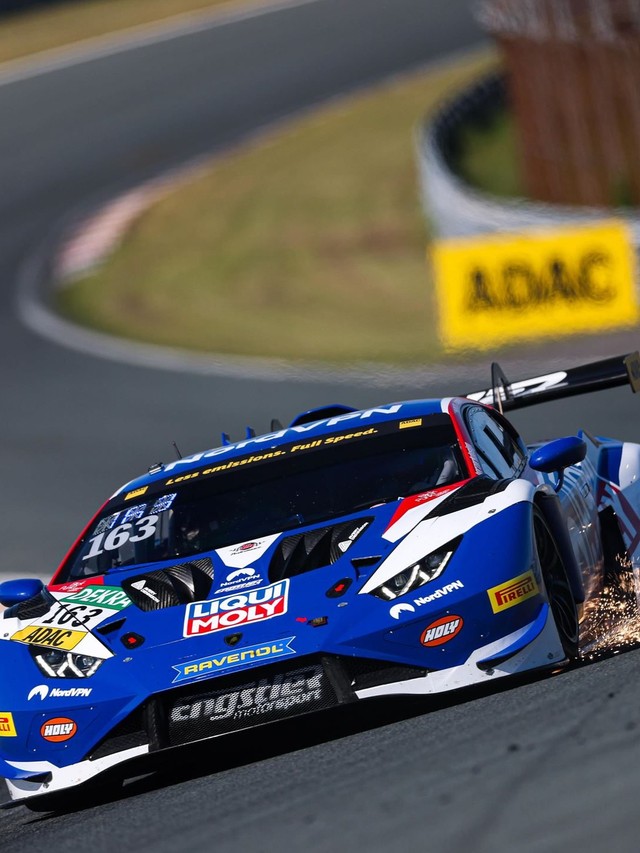
Pole, Every Lap, Checkered Flag: Lamborghini’s First IMSA Win
On August 28, 2016, the #48 Paul Miller Racing Lamborghini Huracán GT3 crossed the finish line at VIRginia International Raceway with a lead nobody in the GT Daytona field could close. It was Lamborghini’s first victory in the IMSA WeatherTech SportsCar Championship, and the manner of it told the story better than any statistic could: pole position, fastest practice times, and every single racing lap led across two hours and forty minutes of competition.
The tenth round of the 2016 IMSA season played out on VIR’s 3.26-mile circuit in Alton, Virginia, a track whose mix of elevation changes and high-speed sweepers rewarded aerodynamic balance and mechanical grip. Lamborghini says the layout proved “particularly favorable to the characteristics of the Huracán GT3,” and the results backed that up. During free practice, GT3 Junior Driver Corey Lewis posted the quickest GTD time in the #16 Change Racing Lamborghini. In qualifying, 21-year-old Madison Snow, another member of the Lamborghini Squadra Corse GT3 Junior Program, set a new GTD class track record of 1:44.956 to claim pole.
Snow drove a double stint covering more than ninety minutes before handing the car to veteran co-driver Bryan Sellers for the final hour. The Paul Miller Racing Huracán GT3 maintained a controlled gap over pursuing Audi R8 LMS GT3 entries from Stevenson Motorsport and Magnus Racing. Sellers managed the advantage to the flag. Complete domination, start to finish. Yet the significance of this result stretched far beyond a single Sunday afternoon in Virginia. It validated a young motorsport division, a junior driver pipeline, and a GT3 platform that would go on to reshape Lamborghini’s competitive identity for nearly a decade.
Why This Win Mattered More Than a Single Trophy
For most of its history, Lamborghini stayed away from factory-backed professional racing. The Miura never ran Le Mans. The Countach never contested Group C. Squadra Corse, the company’s dedicated motorsport division, was founded only in 2013, and the Huracán GT3 represented its first serious effort to compete in the global GT3 ecosystem against deeply entrenched programs from Porsche, Ferrari, Audi, and McLaren.
Winning at VIR proved the Huracán GT3 could do more than fill a grid. It could lead one. Carscoops noted at the time that the car had already collected victories in the British GT Championship, International GT Open, and ADAC GT Masters before this IMSA breakthrough. The American win, though, carried a different kind of validation. IMSA’s GTD class operates under intense Balance of Performance regulations and attracts factory-supported efforts from nearly every major manufacturer. Beating Audi’s well-funded R8 LMS GT3 teams on a circuit that rewarded aero efficiency and driver consistency demonstrated that Lamborghini’s engineering, not just its badge, belonged at the sharp end.
The other two Lamborghini entries that day, from Change Racing and Dream Racing, finished sixth and eleventh after unplanned pit stops disrupted their runs. Both had been competitive in the opening stints, reinforcing the idea that the Huracán GT3’s pace was genuine across multiple teams rather than a single-car anomaly. That breadth of competitiveness hinted at something more durable than a lucky weekend.
Junior Drivers as a Strategic Investment
Madison Snow was 21 years old when he set that track record at VIR, and his involvement in the Lamborghini Squadra Corse GT3 Junior Program was central to the weekend’s larger story. Lamborghini designed the program specifically to develop young drivers within its own racing ecosystem, feeding them through the Blancpain Super Trofeo series and into GT3 competition. Snow had raced in the fourth round of the Lamborghini Blancpain Super Trofeo North America on the same track just hours before qualifying the Huracán GT3 on pole.
That kind of dual-program commitment reveals how deliberately Lamborghini structured its driver pipeline. The Super Trofeo series acts as a proving ground: lower costs, spec machinery, intense competition. Drivers who excel graduate to GT3 seats with customer teams like Paul Miller Racing, where they race alongside experienced professionals like Bryan Sellers. At VIR, the model worked exactly as designed. A junior driver set the pole, ran the harder stint, and handed the car over in the lead. The veteran closed it out. The system that produced this result would prove just as important as the car itself in the years that followed.
From First Win to Championships and Beyond
What followed VIR confirmed that the 2016 breakthrough was a foundation, not a fluke. Paul Miller Racing and the Huracán GT3 went on to claim the 2018 IMSA GTD Driver, Team, and Manufacturer Championships, with Snow and Sellers joined by Andrea Caldarelli and Bryce Miller for endurance rounds. In 2020, the team won the Rolex 24 at Daytona and captured the Michelin Endurance Cup title. By the time Paul Miller Racing transitioned to a different manufacturer in 2022, the Huracán GT3 platform had accumulated over 200 race victories and 99 championship titles worldwide.
Those numbers represent sustained competitiveness across multiple regulatory cycles and Balance of Performance adjustments. Any GT3 car can win a race on a good weekend. Winning championships over multiple seasons, against evolving competition, requires a platform with genuine developmental headroom. The Huracán GT3 proved it had exactly that, evolving through EVO and EVO2 specifications while remaining competitive for nearly a decade.
For buyers who followed the Huracán road car through its own evolution, the racing program added a layer of credibility that no marketing campaign could replicate. When Lamborghini claimed the STO or STJ offered “race-derived” technology, the GT3’s track record gave those words actual meaning. The dynasty that began at VIR became inseparable from the Huracán’s identity.
The Temerario GT3 Picks Up Where the Huracán Left Off
Lamborghini now faces the challenge of replacing a proven winner. The Temerario GT3, revealed at the 2025 Goodwood Festival of Speed, represents the next chapter of the program that VIR launched. Road & Track reports that the Huracán GT3 served Lamborghini for a full decade, during which eleven other manufacturers introduced entirely new GT3 cars. Porsche alone released three different platforms in that span. Lamborghini kept refining the same basic architecture and kept winning. It is the company’s first clean-sheet GT3 design, and according to Car and Driver, it is also the first race car entirely designed and developed at Lamborghini’s Sant’Agata Bolognese facility.
The shift from the Huracán’s naturally aspirated V10 to the Temerario’s twin-turbocharged V8 (without the road car’s hybrid system, per GT3 regulations) means customer teams will need to adapt to a fundamentally different powerband and thermal management profile. For teams that built their programs around the Huracán’s characteristics over nearly a decade, this transition demands new expertise in turbo management during wheel-to-wheel racing.
Looking back at VIR in 2016, the strategic logic becomes clear. Lamborghini did not enter IMSA to collect a single trophy. It entered to build a racing ecosystem, complete with junior drivers, customer teams, and a platform capable of sustained development. The Temerario GT3 inherits that ecosystem. Whether it can match the Huracán’s extraordinary competitive longevity remains the open question, but the infrastructure that VIR’s first win helped prove is already in place.
Gallery


