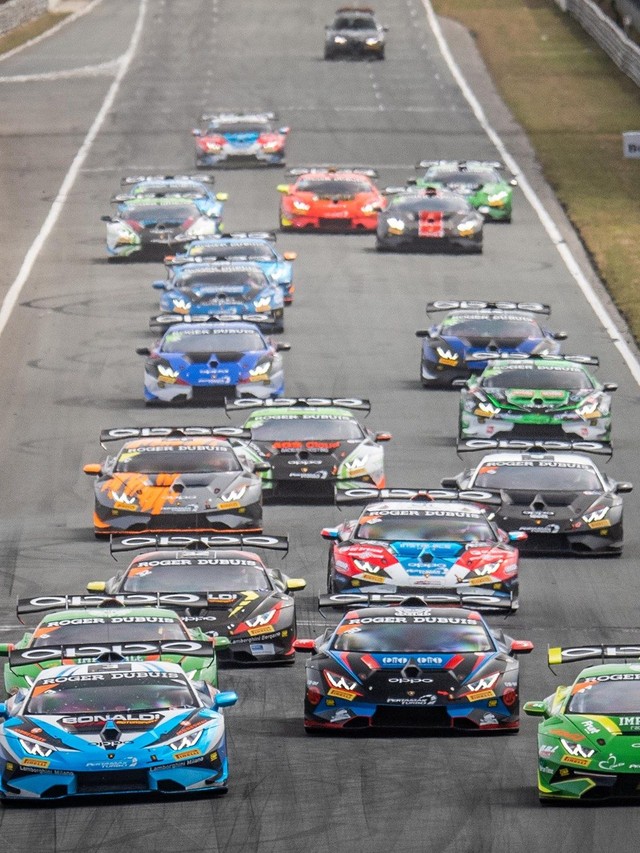
Three Continents, One Circuit, Four Days in Southern Spain
From October 24 through 27, 2019, Lamborghini’s Squadra Corse operation descends on the Circuito de Jerez de la Frontera to stage the most compressed weekend on its racing calendar. The former Formula 1 venue in Andalusia will host the season finales of the Super Trofeo Europe, North America, and Asia championships simultaneously, followed by the annual World Final that crowns a single global champion of the Huracán Super Trofeo Evo one-make series.
The format is deliberately excessive. Regional title fights play out on Thursday and Friday, with qualifying and two races apiece for each continental series. Saturday and Sunday belong to the World Final itself, where the top runners from all three regions combine for a pair of races in each class: Pro/Pro-Am, Am, and Lamborghini Cup. For fans and teams alike, it means four days of nearly continuous track action, all streamed live on the Lamborghini Squadra Corse website, Facebook, and YouTube channel.
What makes Jerez 2019 worth paying attention to is the convergence of several unresolved championship battles and a pair of guest drivers whose names carry weight far beyond GT paddocks. Every regional Pro title remains up for grabs heading into the final rounds, and the margins separating contenders range from razor-thin to functionally nonexistent. Lamborghini stages the World Final each year as the capstone of its customer racing ecosystem, and this edition delivers exactly the kind of drama the format was designed to produce.
Cairoli and Pirro: A Motocross King and a Le Mans Legend in Unfamiliar Territory
The headline guest entries at Jerez are nine-time FIM Motocross World Champion Antonio “Tony” Cairoli and five-time Le Mans 24 Hours winner Emanuele Pirro, both making their Lamborghini Super Trofeo debuts. The pairing is deliberate and slightly mischievous: Cairoli, whose entire competitive career was spent on two wheels in dirt, will share a Huracán Super Trofeo Evo with Pirro, a man who spent decades mastering endurance racing prototypes and single-seaters.
For Cairoli, the transition from motocross to a closed-cockpit, rear-wheel-drive GT car on a paved circuit represents a genuinely steep learning curve. Motocross rewards explosive reflexes and physical aggression; a Super Trofeo Evo rewards precision braking, smooth inputs, and the ability to manage tire degradation over a stint. Pirro, by contrast, knows circuits intimately but is adapting to a car and series format he has never raced in. The Huracán Super Trofeo Evo is not a prototype or a Formula car. It demands a different kind of trust from a driver accustomed to far more downforce.
Their presence serves the broader story Lamborghini wants to tell about this weekend. Cairoli brings a massive following in southern Europe, particularly Italy and Spain, audiences who might never otherwise tune into a GT one-make series. Pirro brings credibility and a direct connection to the top tier of endurance racing. Both names signal that the Super Trofeo is a serious racing platform, not a gentleman-driver parade. Neither will likely threaten for outright victory, and that is almost beside the point. Their debut reinforces the idea that the Huracán Super Trofeo Evo is a car worth driving regardless of your motorsport pedigree, while drawing fresh eyes to the championship battles unfolding around them.
European Pro Title: Five Points Separate Glory from Frustration
The tightest championship fight heading into Jerez belongs to the European Pro class, where Bonaldi Motorsport’s Danny Kroes and Sergey Afanasiev lead on 121 points. Imperiale Racing’s Kikko Galbiati and Vito Postiglione sit just five points behind at 116, close enough that a single bad qualifying session or a first-lap incident could flip the standings entirely. Bonaldi teammates Stuart Middleton and Jack Bartholomew remain mathematically alive at 105 points, though they need significant help from the cars ahead.
Five points in a series with two races remaining is functionally nothing. The points swing from a single race can be larger than that, which means Kroes and Afanasiev cannot afford a conservative weekend. They need to qualify well, race clean, and hope their Imperiale rivals do not find a pace advantage on a circuit that may suit either team.
The Pro-Am and Am categories are closer to settled. Shota Abkhazava holds a 16-point Pro-Am lead over Harald Schlegelmilch, with the added wrinkle that both will share the same ArtLine Team Georgia car. Schlegelmilch would need to drive solo in at least one race and win the class outright to have any mathematical chance, a scenario that borders on implausible. In the Am class, AGS Events’ Nico Gomar carries a 32-point cushion over GT3 Poland’s Robert Zwinger. Even if Zwinger swept both races and Gomar scored zero, Gomar would still win on countback. The Lamborghini Cup is more interesting: Benoît and François Semoulin lead on 120 points, but Joseph Collado (109) and Gerhard van der Horst (107) are close enough to make the final two races genuinely unpredictable.
These varied margins illustrate the one-make format at work. Where the machinery is identical, consistency and racecraft accumulate over a full season, and the gaps entering the finale reflect exactly how well each crew managed that long campaign.
Asia and North America: Razor-Thin Margins and One Title Already Settled
If the European Pro gap of five points seems slim, the Asian championship arrives at Jerez with something even more precarious. FFF Racing’s Juuso Puhakka and Takashi Kasai lead Gama Racing’s Chris van der Drift and Evan Chen by just two points. In a series where contact, mechanical issues, or a slow pit stop can cost a driver far more than that, the Asian Pro title is genuinely anyone’s to take.
North America presents a slightly wider but still compelling picture. Change Racing’s Richard Antinucci and Corey Lewis lead on 124 points, six clear of Precision Performance’s Brandon Gdovic. The Prestige Performance/Wayne Taylor Racing entry of Andrea Amici and Sandy Mitchell lurks just six points behind Gdovic in third. A strong weekend from either chasing crew could rearrange the entire podium.
One North American title is already decided. Damon Ockey wrapped up the Pro-Am championship at Laguna Seca before the series even reached Spain, a dominant run built on nine wins from ten races. The Am category and Lamborghini Cup remain contested, with McKay Snow, teenager Steven Aghakhani, and Cameron Cassels separated by just 15 points in the Am fight.
Across all three regions, the common thread is parity. The Huracán Super Trofeo Evo’s one-make format is doing exactly what it is supposed to do: keeping the machinery equal enough that driver skill, team strategy, and consistency determine championships rather than engineering budgets. That parity is precisely what makes the World Final, where regional champions collide on neutral ground, a meaningful test rather than a ceremonial lap.
More Than a Race: The Strategic Logic Behind the Super Trofeo
One-make racing series serve a specific commercial and strategic purpose for every manufacturer that operates one, and Lamborghini’s Super Trofeo is no exception. Launched in 2009 with the Gallardo and transitioned to the Huracán platform, the series functions as the entry ramp to Lamborghini’s entire motorsport ecosystem. It gives wealthy enthusiasts a structured, professionally managed environment to race identical machinery, and it gives promising young drivers a proving ground where results translate directly into opportunities in higher-tier GT3 and GT World Challenge competition.
This pipeline matters more than it might seem. Several drivers who graduated from Super Trofeo seasons went on to race Lamborghini’s Huracán GT3 Evo in international endurance and sprint series. The World Final, by combining all three regional championships into a single weekend, creates a direct comparison that would otherwise require teams and scouts to follow three separate calendars across three continents. When Cairoli and Pirro line up alongside teenagers like Aghakhani and seasoned Am drivers like Gomar, the full breadth of the series’ purpose becomes visible in a single grid.
The competitive context is worth noting. Ferrari runs the Ferrari Challenge as its own one-make customer series, and Porsche operates the Carrera Cup and Supercup programs. All three manufacturers use these series for the same blend of brand engagement, customer loyalty, and talent identification. Lamborghini’s version distinguishes itself partly through the World Final format, which forces regional champions to race each other on neutral ground, and partly through the car itself. The Huracán Super Trofeo Evo, with its naturally aspirated V10 and rear-wheel-drive layout, delivers a driving experience that rewards bravery and precision in equal measure.
The Huracán Super Trofeo Evo: The Machine Behind the Grid
Every car on the Jerez grid is a Lamborghini Huracán Super Trofeo Evo, the track-only variant built exclusively for this series. It shares its 5.2-liter naturally aspirated V10 with the road car but strips away everything that does not serve lap time. Carbon fiber bodywork, a full roll cage, racing-specification Öhlins dampers, competition brakes, and a significant weight reduction over the road-legal Huracán define the package. The car runs rear-wheel drive only, which in a one-make context puts a premium on driver talent through slow corners and under acceleration.
For Lamborghini enthusiasts more familiar with the road-going STO or Performante, the Super Trofeo Evo sits in a different universe. It is not street-legal, not designed for comfort, and not particularly forgiving. The cockpit is a racing environment: stripped, caged, and fitted with a single racing seat, harness, and fire suppression system. Collectors have begun to notice these cars, too. According to Autoblog, low-mileage examples of the Super Trofeo Evo Collector edition occasionally surface on auction platforms, appealing to buyers who want a piece of Lamborghini’s naturally aspirated racing history without necessarily planning to race it.
The practical reality for anyone considering entry into the Super Trofeo series is that the car is the easy part. The series provides equal machinery, professional logistics, and global infrastructure. The harder question, one Lamborghini does not publicize in detail, is the full-season cost of entry, which includes the car, spares, team fees, travel, and race entries across a multi-round calendar. Forum discussion among enthusiasts suggests these costs are substantial, though specific figures vary widely depending on the team and region.
How to Watch the Jerez Weekend
Lamborghini confirms that all races from the Jerez weekend will be streamed live through the Squadra Corse website, Facebook page, and YouTube channel. European Super Trofeo qualifying begins Thursday at 17:00 CET, with the first European race on Friday at 11:50 CET. Asia and North America share Thursday practice and qualifying sessions, with their races on Friday morning and afternoon. The World Final races occupy Saturday and Sunday, with the Pro/Pro-Am finale scheduled for Sunday at 15:00 CET.
For anyone following the European Pro title fight specifically, the two Friday races are the ones to prioritize. That five-point gap between Kroes/Afanasiev and Galbiati/Postiglione will be resolved before the World Final even begins.
Gallery


