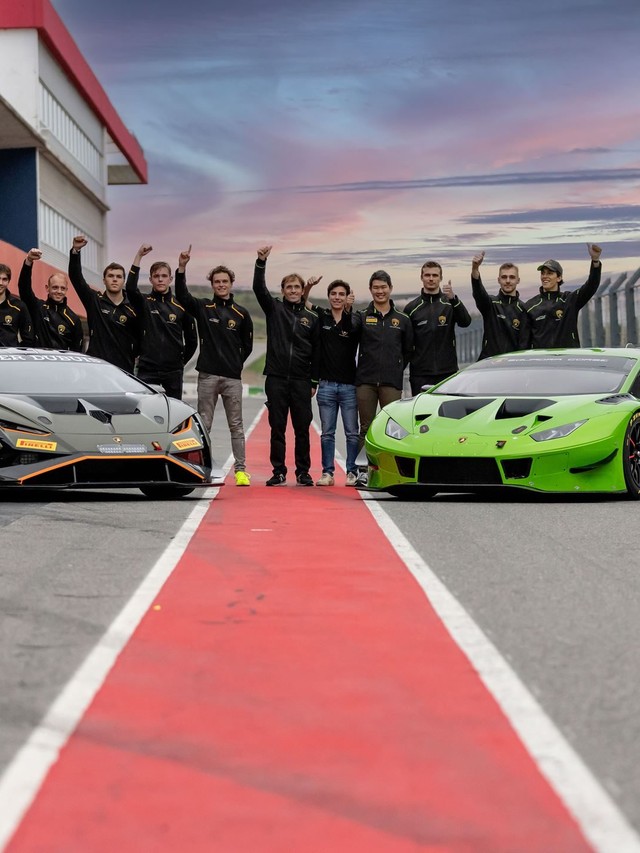
Forty-Five Names, One Factory Ladder
Lamborghini Squadra Corse selected 45 drivers for its 2023 Young Driver Programs, splitting the intake between 26 Super Trofeo Junior candidates and 19 GT3 Juniors. The names span 20 nationalities, three continental racing series, and ages as young as 16. Every one of them entered a season-long evaluation built around a single question: who deserves factory backing?
The answer would not come from a single open audition or a pay-to-play academy. Squadra Corse runs two parallel tracks. The Super Trofeo Junior Drivers Program targets competitors aged 25 or under who race in one of the three regional Lamborghini Super Trofeo championships. The GT3 Junior Drivers Program draws from a more experienced pool: drivers already contesting international GT3 series at the wheel of a Huracán GT3 EVO2. Both streams feed into the same endpoint, but they measure different things along the way.
With the Temerario platform on the horizon and a new generation of GT3 machinery approaching, the 2023 intake carried extra weight. The drivers selected for this cohort would be among the first to bridge the gap between the Huracán era and whatever comes next. That makes the class list more than administrative bookkeeping. It is the first chapter of a transition story, and the ladder these 45 drivers climbed tells you how Lamborghini intends to write the rest of it.
The Ascent to Factory Status: Understanding the Pathway
The ladder works in clearly defined steps, and every rung is designed to test something the previous one could not. A strong Super Trofeo Junior season can earn a driver a place in the end-of-year shootout. Winning the shootout earns factory backing. Excelling with factory backing can lead to the Young Professional Driver roster, and from there, full Factory Driver status.
Leonardo Pulcini demonstrated that progression: after winning the GT3 Junior Program the prior year and claiming the International GT Open title alongside Chilean co-driver Benja Hites, Pulcini became a Lamborghini Factory Driver. Danny Formal, meanwhile, won the Young Driver shootout and joined Yuki Nemoto and Maximilian Paul on the Young Professional Driver roster. These are not abstract career goals. They are documented outcomes from the same pipeline these 45 drivers entered.
Program Supervisor Raffaele Giammaria oversaw the selection process, evaluating candidates throughout the entire season. The criteria went well beyond single-lap pace: average race speed, consistency across a full weekend, experience level, professionalism, quality of technical feedback, and attitude both at and away from the circuit. That last criterion is worth pausing on. Plenty of manufacturer programs evaluate raw speed. Fewer explicitly score how a driver communicates with engineers or conducts themselves in a paddock. The most impressive performers would earn an invitation to the decisive shootout at Vallelunga in Italy, scheduled to follow the 2023 Lamborghini Grand Finals.

A Lamborghini Squadra Corse driver and team member share a handshake on the race track.
Beyond the Lap Time: What Lamborghini Actually Measures
Speed is table stakes. What separates Lamborghini’s program from a simple championship standings review is the breadth of evaluation. Squadra Corse’s coaches track consistency over an entire race weekend, not just qualifying heroics. A driver who qualifies third and finishes every stint within half a second of their personal best tells the team something different from one who puts it on pole and fades.
Technical feedback quality matters because a factory driver is, in part, a development tool. When Lamborghini builds its next GT3 contender, the drivers shaping that car’s setup and communicating tire behavior or aero balance to engineers will directly influence competitiveness. Selecting for that skill at the junior level means the factory is not just finding fast hands but building a roster of drivers who can contribute to the engineering loop. With the transition to a Temerario-based racer approaching, the ability to develop a new car rather than simply drive a mature one becomes even more critical.
The programs also include hands-on training in media management and physical preparation at Lamborghini’s Sant’Agata Bolognese headquarters. The gym facilities and classroom sessions might lack the drama of a hot lap, but they reflect a practical reality of modern GT racing: factory-supported drivers represent the brand at press events, sponsor functions, and on social media. Squadra Corse clearly wants drivers who can handle a microphone as competently as a steering wheel.

Lamborghini Squadra Corse drivers and staff participate in a briefing session indoors.
The Vallelunga Shootout: Where Careers Are Made
The top performers from the season-long assessment would be invited to Vallelunga for the decisive shootout, held after the 2023 Grand Finals. Vallelunga is a fitting venue: compact, technical, and unforgiving of inconsistency. A circuit that rewards precision over outright power puts the emphasis exactly where Squadra Corse’s evaluation criteria point.
The format compresses months of observation into a concentrated test. Drivers who survived the full-season filter still needed to prove themselves in a direct, back-to-back comparison against their peers, on the same day, in equivalent machinery. The funnel is steep by design. From 45 candidates in the 2023 intake to roughly 20 finalists at a shootout to two winners per year, the numbers thin dramatically at each stage. According to one source, 37 drivers were assessed by Squadra Corse’s technical staff in 2024, suggesting the pool fluctuates but remains substantial enough to ensure genuine competition for factory seats.
The program continued to evolve in subsequent years. Enzo Geraci and Jacopo Guidetti were announced as winners of the 2024 season’s Young Driver Programs, earning factory support for 2025. One report indicates the 2024 shootout moved to Jerez de la Frontera in Spain, while the 2025 edition took place at Misano Adriatico with a field of 16 Super Trofeo and four GT3 drivers. Each iteration refines the process, but the core logic remains the same: compress a season of data into one final, unambiguous test.
The 2023 Global Grid
The geographic spread of the 2023 intake illustrates how broadly Lamborghini casts its net, and why the pipeline produces such varied talent. The 19 GT3 Juniors drew from series including the Italian GT Championship, International GT Open, GTWC Endurance and Sprint, DTM, IMSA, Le Mans Cup, and Asian Le Mans Series. Drivers ranged from 19-year-old Daan Arrow of the Netherlands and Mateo Llarena of Guatemala to veterans like Brendon Leitch of New Zealand, competing across Le Mans Cup and GTWC.
The Super Trofeo Junior side skewed younger and leaned heavily toward the European championship, though the program also included drivers from the North American and Asian series. Douglas Bolger (Japan/UK) and Riccardo Ianniello (Italy) entered at just 16, while the roster stretched across Denmark, Brazil, New Zealand, Australia, China, and several other nations. American representation came from Wesley Slimp, Jake Walker, and Carter Williams in the North American Super Trofeo.
| Program | Drivers Selected | Age Range | Key Series |
|---|---|---|---|
| GT3 Junior | 19 | 19-27 | Italian GT, GT Open, GTWC, DTM, IMSA |
| Super Trofeo Junior | 26 | 16-24 | ST Europe, ST North America, ST Asia |
For enthusiasts tracking the next generation, names like Mattia Michelotto (already a proven quantity in Italian GT at 20) and Jaden Conwright (competing in IMSA at 24) stood out as drivers with existing momentum. Whether any of them ultimately earned factory backing through the 2023 shootout, the roster itself confirmed that Lamborghini’s scouting operation spans well beyond the Italian peninsula.

A vibrant green Lamborghini Huracan Super Trofeo EVO2 speeds past the pit lane on the race track.
How Lamborghini’s Program Compares to Rival Pipelines
Every serious GT manufacturer runs some version of a young driver program, and Lamborghini’s structure invites direct comparison. Ferrari operates its Driver Academy, which funnels talent primarily toward its single-seater and hypercar programs. Porsche runs the Junior Programme through its Supercup and GT series. Both are well-established, well-funded, and produce results.
Lamborghini’s distinguishing feature is the two-tier intake that mirrors its own racing ecosystem. The Super Trofeo series functions as a controlled proving ground: identical cars, standardized regulations, a global footprint across three continents. Drivers who excel there graduate into GT3 consideration, where the variables multiply. Rival programs sometimes compress these stages or recruit from external feeder series without an equivalent in-house one-make championship. It gives Squadra Corse a proprietary dataset on every junior driver before they ever touch a GT3 car.
The practical buyer angle matters, too. Lamborghini’s customer racing operation depends on gentlemen drivers and professional co-drivers sharing cockpits in endurance events. The quality of the professional driver pool directly affects how competitive those customer entries are, which in turn affects whether wealthy amateurs choose to race a Lamborghini or defect to a rival brand. Investing in junior talent is not charity. It is a commercial strategy that keeps the customer racing business healthy.
What This Means for Lamborghini’s Racing Future
The 2023 intake of 45 drivers represents the largest publicly documented cohort in the program’s recent history. By 2024, according to one report, the assessed pool dropped to 37. The 2025 shootout at Misano featured 20 finalists. American Colin Queen won the Super Trofeo shootout for the 2025 season, securing factory support for 2026, a detail that underscores how the pipeline continues to produce results year after year.
The real significance of the 2023 class, though, is structural. Squadra Corse built a system that identifies, trains, and promotes talent on a repeatable cycle. The drivers change. The ladder stays. As Lamborghini transitions from the Huracán to the Temerario across its racing programs, the institutional knowledge embedded in that ladder becomes more valuable, not less. A driver who earned factory support in 2024 would be in the system precisely when development and early competition with the Temerario-based racer ramps up. That continuity is the whole point of running a structured pipeline rather than hiring freelancers season by season.
The financial details of participation remain opaque. Lamborghini does not publicly disclose what drivers or their backers pay to compete in Super Trofeo, nor the precise value of “factory support” in contractual terms. What the company does make clear is the career outcome: a path from regional one-make racing to factory-backed GT3 competition to, potentially, a seat in Lamborghini’s highest-profile endurance entries. For a 16-year-old showing up at a Super Trofeo round with talent and ambition, that clarity of progression is the program’s strongest selling point.
Gallery


