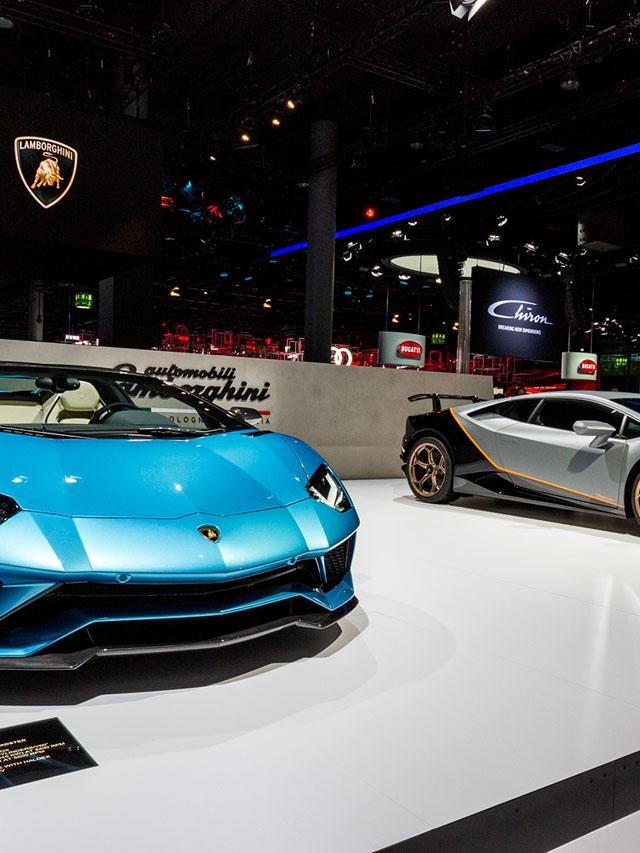
A New Home for Lamborghini in Zürich, and the Huracán EVO’s Swiss Debut
Five Lamborghini showrooms in a country smaller than West Virginia sounds aggressive until you look at the sales figures. Switzerland consistently ranks among Lamborghini’s top ten markets worldwide, and when the brand opened Lamborghini Zürich in Kloten in May 2019, it was doubling down on a region whose appetite for super sports cars shows no sign of plateauing.
Chief Commercial Officer Federico Foschini flew in from Sant’Agata Bolognese for the occasion, joining more than 250 guests inside the 1,000-square-meter facility. The evening also served as the local debut of the Huracán EVO, which had premiered globally at the Geneva International Auto Show only two months earlier. Operated by Hirsch AG, the Kloten showroom is Switzerland’s fifth official Lamborghini location and the second for Hirsch, which opened a St. Gallen dealership earlier that same year. Foschini framed the expansion around two converging forces: the broadening audience drawn in by the Urus, and the established super sports car clientele eager to see the latest evolution of the V10 platform.
Switzerland’s Outsized Role in Lamborghini’s Global Strategy
The numbers behind the Kloten investment are striking. Lamborghini says 160 vehicles were delivered to Swiss customers in 2018, a 48% jump over the prior year. For a country with roughly 8.7 million people, that per-capita penetration is remarkable, and it explains why Sant’Agata Bolognese keeps investing in physical retail here rather than consolidating.
Zürich sits at the epicenter of that demand. Supercars are a common sight on the city’s streets, a reflection of high average salaries, competitive vehicle pricing relative to neighboring countries, and a deep-rooted appreciation for precision engineering. Owners in the region tend to favor mountain passes for handling enjoyment over outright speed, given Switzerland’s strict traffic enforcement. That behavioral pattern matters because it aligns perfectly with what the Huracán EVO was designed to sharpen: chassis balance and driver engagement at real-world speeds.
With 2019 bringing a full year of Urus sales alongside the start of Huracán EVO deliveries in summer, Lamborghini was positioning itself to push well past that 160-unit figure. Aventador sales continued in parallel, giving Swiss customers the rare luxury of choosing across three distinct product lines at a single dealership.
The Huracán EVO: Predictive Dynamics in a Naturally Aspirated Package
A quiet appearance on the showroom floor would not have done the Huracán EVO justice. Its defining advance is an electronics architecture Lamborghini calls Lamborghini Dinamica Veicolo Integrata (LDVI), the first predictive vehicle dynamics system in the company’s history. Rather than simply reacting to driver inputs, LDVI anticipates them, coordinating all-wheel drive and all-wheel steering to deliver what Foschini described as a car that is “remarkably easy to drive” while remaining deeply engaging.
The engine carries over from the Huracán Performante: a naturally aspirated 5.2-liter V10 producing 640 hp and 600 Nm of torque. Pairing that screaming powertrain with predictive chassis management is the real trick. Lamborghini wanted the EVO to feel more accessible without dulling the sensory experience that separates it from a competent but clinical rival. A new infotainment system with advanced connectivity rounded out the updates, and the model was also offered as the Huracán EVO Spyder for open-air devotees.
For Swiss buyers specifically, the EVO’s accessible character carries practical weight. Pass roads reward a car that communicates clearly and rotates predictably at legal speeds, not one that only comes alive at triple digits on a runway.
Urus and Aventador SVJ: The Full Range Under One Roof
The Zürich showroom also featured the Urus and the Aventador SVJ, giving visitors a complete cross-section of Lamborghini’s lineup. Placing these two models side by side illustrated the brand’s dual identity more vividly than any press release could.
The Urus, powered by a 4.0-liter V8 twin-turbo producing 650 hp and 850 Nm, accelerates from 0 to 100 km/h in 3.6 seconds and tops out at 305 km/h. Active torque vectoring, four-wheel steering, carbon ceramic brakes, adaptive air suspension, and up to six driving modes (plus the customizable EGO mode) made it the volume driver behind Switzerland’s 48% sales growth. At the opposite end of the spectrum sat the Aventador SVJ, a limited-production V12 flagship (900 Roadster units worldwide) with 770 hp from a naturally aspirated engine, a 2.9-second sprint to 100 km/h, and the production car lap record at the Nürburgring-Nordschleife. Its ALA 2.0 active aerodynamics and four-wheel steering made it a rolling technology showcase. The brand could sell you a school-run SUV and a Nürburgring record holder from the same building, and that breadth is precisely what justified a fifth Swiss location.
Inside the Ad Personam Studio and the Ownership Experience
Dealership openings rarely merit much editorial attention unless the facility itself changes the ownership equation. Lamborghini Zürich makes a case by incorporating an Ad Personam studio directly into the showroom. Rather than ordering a car from a catalog and hoping the color swatch matches reality, Swiss buyers can configure materials, finishes, and color combinations in a dedicated space designed to feel more like a private atelier than a sales floor.
The broader facility follows Lamborghini’s updated corporate design language and includes a reception area, merchandise boutique, VIP lounge, offices, and a full workshop for aftersales service. That last detail matters more than the champagne at the opening party. Owners who can drop off a car for maintenance at the same location where they spec their next one tend to stay loyal, and loyalty in a market where Ferrari, Porsche, and McLaren all compete for the same wallets is the real strategic game.
By consolidating sales, personalization, and service under one roof in Kloten, Lamborghini reduced the friction of ownership and built a more complete competitive offering against rivals whose Swiss retail networks may separate those functions across multiple locations. In a top-ten global market already growing at 48% year over year, that integration is not a luxury. It is the infrastructure required to keep pace with demand.
Gallery


