Dennis Lind Owns Silverstone from Friday to the Chequered Flag
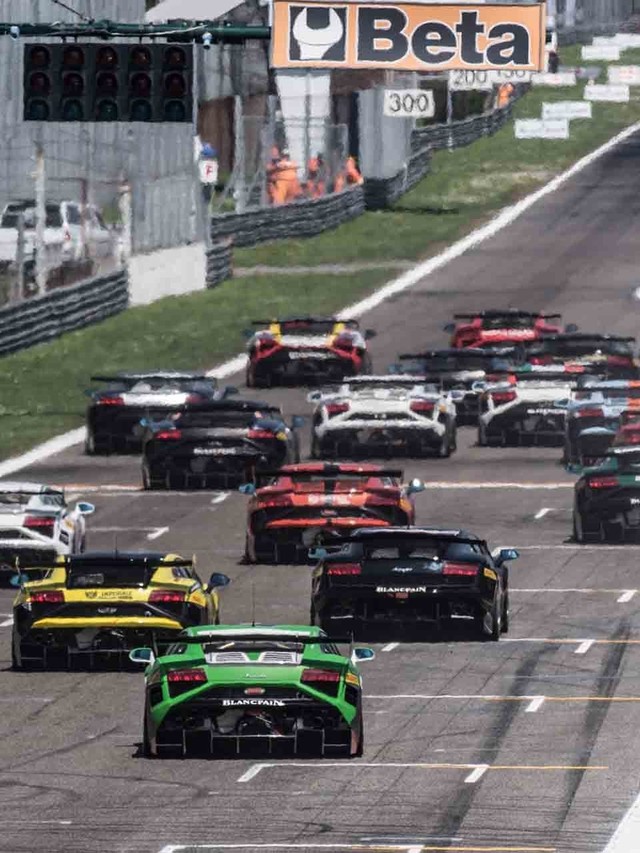
Dennis Lind did not merely win Race 1 at Silverstone. He controlled the entire weekend. Representing Raton Racing, the Dane topped both free practice sessions on Friday, secured his first pole position of the Lamborghini Blancpain Super Trofeo Europe campaign, then pulled away in the race itself to claim his second victory of the season. His earlier win came at Monza, and the consistency across two very different circuits suggests a driver who understands the Huracán Super Trofeo at an unusually deep level. He now leads the PRO class championship.
Behind him, the race played out on a knife edge. Loris Spinelli and Enrico Fulgenzi ran second for most of the 50-minute contest, only to receive a 10-second penalty for an irregular starting procedure that dropped them to sixth. Vito Postiglione of Imperiale Racing inherited a podium spot, joined by 18-year-old Martin Kodric of Bonaldi Motorsport. Nicola Larini, the veteran whose career stretches back to Formula One, qualified eleventh and carved his way forward to fourth, a reminder that experience still counts when the cars are identical.
“Initially, I only thought to push to earn some margin over the others, because it is very difficult to overtake on this track. During the first laps, I struggled with Loris Spinelli, but from mid-race onwards I had no problems whatsoever.”
Lind’s own assessment was characteristically understated. Silverstone rewards precision over bravado, and his ability to build a gap early, then manage it, looked more like the racecraft of a seasoned GT professional than a young driver still climbing the ladder.
Teenagers on Podiums: Kodric and Breukers Announce Themselves
Lind’s dominance told one story. The results sheet told another, and it read like a scouting report for Lamborghini’s racing future. Kodric, just 18, stood on the overall podium in only the second round of the season. In the AM class, 17-year-old Rik Breukers of GDL Racing claimed his second consecutive victory, strengthening his class championship lead after also winning at Monza. Breukers admitted to spinning during the race, then switching to a more measured approach that still proved fast enough to win.
Patrick Kujala and Adrian Amstutz finished fifth overall and first in the PRO-AM class for Bonaldi Motorsport. Kujala noted he deliberately chose not to risk an overtake on Postiglione, prioritizing the class result over a higher overall position. That kind of strategic restraint is exactly what one-make series are designed to teach. Tim Richards of Toro Loco completed the class winners by taking the Lamborghini Cup at his home circuit for the third year running.
One of the weekend’s most compelling drives belonged to Marco Mapelli. In his first Super Trofeo outing, driving for Vincenzo Sospiri Racing, Mapelli started 41st after a poor qualifying session and climbed to seventh in 50 minutes. The one-make format strips away any equipment advantage, so a charge like that is pure driver ability and race intelligence on display.
Why the Super Trofeo Functions as Lamborghini’s Racing Academy
One-make series exist across the supercar landscape. Porsche runs its Carrera Cup, Ferrari fields its Challenge. What distinguishes the Lamborghini Blancpain Super Trofeo, which launched in 2009 and expanded to Asia in 2012 and North America in 2013, is how deliberately Squadra Corse uses it as a development pipeline. Identical Huracán Super Trofeo machinery eliminates the variable of car performance, placing the entire competitive burden on driver skill, team preparation, and strategic decision-making.
For aspiring professionals like Lind, Kodric, and Breukers, the series functions as an audition. Strong performances here historically feed into Lamborghini’s GT3 programs, where the stakes, the budgets, and the competition all increase dramatically. The series also serves a commercial purpose: gentleman drivers compete alongside professionals, and the AM and Lamborghini Cup classes keep the grids full and the customer base engaged. Blancpain CEO Marc Hayek was himself a participant in the inaugural 2009 season, a detail that speaks to the series’ original vision as something more personal than a typical corporate sponsorship.
The one-make format also controls costs relative to open GT racing, though Lamborghini does not publicly detail the full financial commitment. The trade-off is clear: drivers get seat time in a competitive, well-organized championship with global visibility, while Lamborghini gets a proving ground that feeds its broader motorsport ambitions.
From Huracán to Temerario: The Next Chapter in Lamborghini Customer Racing
The Huracán Super Trofeo replaced the Gallardo-based car in 2015 and evolved through the EVO and EVO2 specifications, each iteration sharpening aerodynamics and braking. But the platform’s future is finite. The road-going Huracán gave way to the Temerario, and Lamborghini’s competition department is following the same trajectory. The Temerario GT3, which Autoblog reported as Lamborghini’s first competition car to be fully designed, developed, and built in-house, represents a fundamental shift in how Squadra Corse approaches racing.
Previous Lamborghini GT3 cars relied on external partners for significant portions of their development. The Temerario GT3 changes that equation entirely, and the implications for the Super Trofeo series are worth watching. If Lamborghini eventually transitions its one-make championship to a Temerario-based platform, the drivers currently cutting their teeth in Huracán machinery will need to adapt to a twin-turbocharged V8 with different power delivery characteristics. For teams and drivers who built their programs around the Huracán’s naturally aspirated V10 behavior, that transition means learning a new powerband, different weight distribution, and the complexities of turbo management in close racing.
Lamborghini has not confirmed a timeline for any Super Trofeo platform change. What the Silverstone results demonstrate is that the current Huracán-based series continues to produce exactly the kind of competitive drama and talent identification that justifies the program’s existence.
What Silverstone Tells Us About the Championship Fight
With Lind now leading the PRO class standings after two victories from two rounds, the championship picture is beginning to sharpen. Spinelli and Fulgenzi’s penalty cost them dearly in a season where points margins between the top contenders tend to be narrow. Kodric’s podium suggests Bonaldi Motorsport could become a consistent factor, and Breukers’ AM class dominance, two wins from two, looks increasingly difficult to disrupt.
The Super Trofeo’s double-header format means a single penalty or poor qualifying session can reshape the standings overnight. Mapelli’s 41st-to-seventh drive proved that recovery is possible, but it also illustrated how much qualifying position matters on a circuit like Silverstone where overtaking opportunities are limited. Race 2 was scheduled for the following day, and replays of both races were made available on Automobili Lamborghini’s official YouTube channel.
For Lamborghini enthusiasts who view the brand primarily through the lens of road cars, the Super Trofeo deserves closer attention. Silverstone showed a series that identifies genuine talent, punishes mistakes without mercy, and produces the kind of wheel-to-wheel competition that no amount of road-car engineering can replicate. Lind’s sweep was the headline, but the teenagers chasing him may turn out to be the real story of this season.
Gallery


