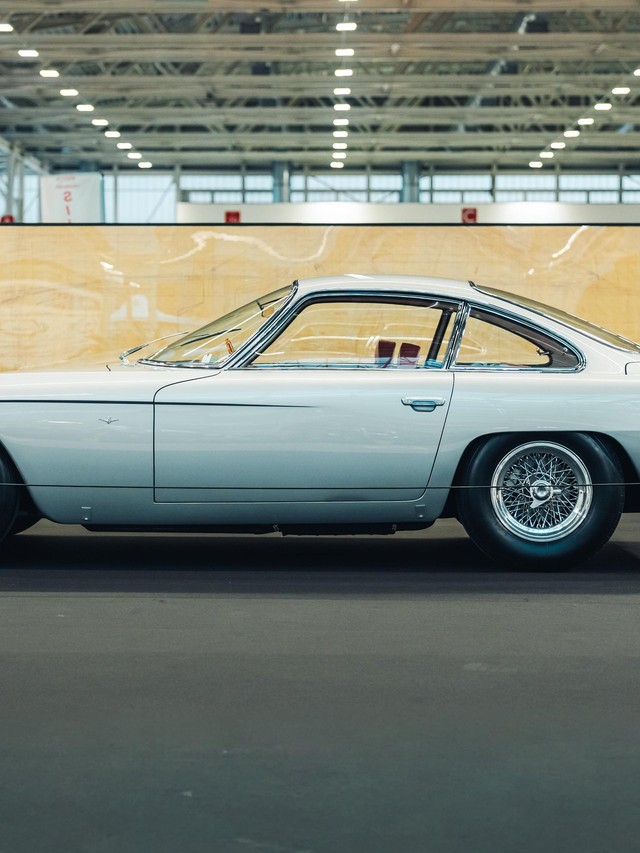
Chassis 0121 Goes Public at Rétromobile 2017
Lamborghini Polo Storico brought its first fully restored 350 GT to Rétromobile 2017 in Paris, marking the heritage division’s debut at the prestigious classic car exhibition held from 8 to 12 February. The car, chassis number 0121, is one of the first fifteen 350 GTs ever produced by Automobili Lamborghini, and the first example of the model to receive a complete factory restoration. For a brand whose identity now revolves around mid-engined exotics, choosing to lead with the 350 GT sent a deliberate message: the origin story matters as much as the current chapter.
The choice of subject was anything but arbitrary. The 350 GT represents the moment Ferruccio Lamborghini‘s ambition became tangible, the car that proved a tractor manufacturer could build a grand tourer sophisticated enough to challenge Maranello on its own terms. Displaying chassis 0121 in Paris, surrounded by the world’s most discerning classic car collectors and dealers, was Lamborghini’s way of staking a claim in the heritage market with the most symbolically loaded car it could possibly choose. And the restoration itself, nearly 2,000 hours of painstaking work governed by a philosophy of uncompromising originality, reveals just how seriously Polo Storico takes the responsibility of defining what “factory authentic” actually means.
1,150 Hours of Bodywork, 780 Hours of Mechanical Verification
The bodywork and interior restoration alone required 1,150 hours of dedicated craftsmanship. An additional 780 hours went into checking mechanical and electrical functions, bringing the total investment to nearly 2,000 hours of specialist labor. Those numbers reflect a philosophy that goes far beyond stripping and refinishing. Every system received individual attention, with particular focus on reworking the engine cooling system, the braking system, and the fuel system to ensure the car could be driven safely without compromising its period character.
Polo Storico’s guiding principle is maintaining originality to the greatest extent possible. The restoration process exclusively utilizes original Lamborghini parts, with some components reconstructed where originals could not be salvaged. Parts reconstruction involves collaborating with historical suppliers and referencing original technical drawings from the factory archive. The original rims, for instance, were restored and authenticated by their original supplier, Ruote Borrani of Milan. The vehicle was equipped with Pirelli Cinturato 205 R15 tires, matching its original specification.
The details that separate a factory restoration from even the best independent shop work emerge in the small decisions. The car was repainted using the original nitroacrylic paint techniques and formula, a process that produces a subtly different depth and texture compared to modern basecoat-clearcoat finishes. The black leather interiors were refurbished using period-correct procedures. In a touch that reveals Polo Storico’s understanding of what collectors actually value, the wooden steering wheel and original pedals were restored with care, preserving their subtle signs of wear rather than polishing them to a falsely new appearance. The car’s original radio remains in perfect working order, just as it was in 1964 when the car was delivered to its first owner.
Following restoration, a track test demonstrated the car’s excellent balance, precise gear changes, and reliable braking performance. That final step matters: a concours-quality restoration that cannot be driven confidently is a sculpture, not a car. Polo Storico clearly intended this 350 GT to be both, and the track validation underscores the same commitment to authenticity that governed every preceding hour of work.

The iconic white Lamborghini 350 GT, a masterpiece of automotive history, is showcased in a dimly lit studio.
Why the 350 GT Still Defines Lamborghini’s Identity
The production Lamborghini 350 GT officially debuted at the 1964 Geneva Motor Show, one year after the 350 GTV prototype was first unveiled at the Turin Motor Show in 1963. Carrozzeria Touring redesigned the body for production while preserving the elegant yet aggressive lines of Franco Scaglione’s original GTV concept.
Beneath that bodywork sat a 3,464 cc, 12-cylinder aluminum alloy engine producing 270 horsepower. A five-speed ZF gearbox, a Salisbury differential, independent four-wheel suspension, and Girling brakes completed the mechanical package, all housed within the car’s lightweight aluminum body. According to Hemmings, Giotto Bizzarrini designed the competition-worthy V12, with Paolo Stanzani adapting it for road use, while Giampaolo Dallara was responsible for the chassis and frame. That roster of engineering talent reads like a founding myth, and in many ways it is exactly that. Dallara, Bizzarrini, and Stanzani went on to shape decades of Italian automotive engineering, but their earliest collaboration produced this car.
Early models used a dry-sump lubrication system, which was later changed to a wet-sump system for its road-focused application. That practical adaptation acknowledged what Ferruccio Lamborghini always insisted upon: his cars were built for the road, for wealthy clients who wanted sophistication and performance without the compromises of a racing machine. The 350 GT is often regarded by enthusiasts as one of Lamborghini’s most elegant designs, and it established a grand touring philosophy that the brand would carry forward even as its visual language grew more extreme through the Miura, Countach, and beyond. Polo Storico’s decision to restore this particular model first, rather than one of those more famous successors, reinforces the factory’s conviction that the 350 GT’s significance to the brand’s identity has only deepened with time.
Polo Storico’s Broader Mission: Archive, Certification, and Parts
The 350 GT marks the fourth complete restoration project for Polo Storico, following previous work on a Miura, an LM002, and a Countach. Each tackled a different era and engineering challenge, from the Miura’s mid-engine complexity to the LM002’s military-derived architecture. Yet the 350 GT restoration crystallizes the division’s broader purpose more clearly than any of its predecessors, because it reaches back to the very foundation of the marque.
Polo Storico’s operations encompass four core areas: restoration, archive management, vehicle certification, and the supply of original spare parts. Lamborghini maintains a spare parts warehouse covering over 70 percent of its classic models, with additional components available upon request through the aftersales department and dealer network. For owners of early cars like the 350 GT, where parts scarcity can make independent restoration a years-long scavenger hunt, factory access to original technical drawings and historical supplier relationships represents a genuine competitive advantage. The ability to reconstruct a component using the same tooling philosophy, or even the same supplier, that produced the original part in the 1960s is something no independent restoration shop can replicate.
The certification element deserves particular attention from prospective buyers. In a market where provenance and documented authenticity increasingly separate six-figure cars from seven-figure cars, a factory-backed certificate of restoration carries weight that independent documentation cannot match. Collectors who plan to show, sell, or insure classic Lamborghinis at the highest level will find that Polo Storico’s involvement adds a layer of credibility that directly affects desirability. The 350 GT restoration, with its exhaustive documentation and original-supplier partnerships, sets the standard by which future Polo Storico projects will be measured.
Factory Heritage Programs: How Polo Storico Stacks Up
Lamborghini is not the only Italian manufacturer investing in its past. Ferrari Classiche, established in 2006, operates from Maranello and centers its program around the Certificate of Authenticity, a rigorous evaluation process that examines every major component against original factory records. One report describes Classiche’s certification as a four-step process covering chassis, engine, gearbox, bodywork, and interior. Porsche Classic, meanwhile, leverages its enormous production volumes to maintain a vast parts catalog and offers factory restorations at its Zuffenhausen facility.
Polo Storico occupies a different position in this landscape. Relaunched in 2015, it operates from Sant’Agata Bolognese and benefits from the relative intimacy of Lamborghini’s production history. Lamborghini built far fewer cars than Ferrari or Porsche during its early decades, which means the archive records, supplier relationships, and institutional memory surrounding each model are more concentrated. When Polo Storico restores a 350 GT, it draws on a smaller, more traceable body of documentation than Ferrari Classiche would need to navigate for a comparable 1960s model produced in larger numbers. That concentration of knowledge is precisely what makes the 350 GT restoration so compelling as a demonstration of factory authenticity: every hour of the 1,930-hour process was informed by records and relationships that exist nowhere else.
For classic Lamborghini owners considering whether to pursue a factory restoration or commission independent work, the question comes down to what matters more: flexibility and potentially lower cost from a specialist shop, or the provenance and parts authenticity that only the factory can guarantee. For cars with significant collector value, particularly early models like the 350 GT where originality commands a premium, the factory route increasingly looks like the stronger long-term investment.
What This Means for Classic Lamborghini Collectors
Lamborghini has not disclosed what a full Polo Storico restoration costs, and the company has not published pricing for its certification services in the way Ferrari Classiche’s fee structure is occasionally discussed in collector circles. What the source does confirm is the scale of the commitment: nearly 2,000 hours of labor, original supplier partnerships, period-correct materials, and a track validation process. For a car as historically significant as chassis 0121, the investment is clearly substantial.
The more interesting question is what Polo Storico’s growing restoration portfolio signals about the classic Lamborghini market. When a manufacturer invests this visibly in its heritage, it validates the collectibility of models that might otherwise be overshadowed by more famous siblings. The 350 GT will never generate the auction headlines of a Miura SV or a Countach LP400, but Polo Storico’s decision to restore one before tackling any number of more commercially obvious candidates suggests the factory sees long-term value in anchoring the brand’s narrative at its true beginning.
For current 350 GT owners, the existence of a factory restoration pathway, combined with Polo Storico’s spare parts coverage and archive access, provides a level of support that simply did not exist a decade ago. For prospective buyers evaluating early Lamborghinis, the calculus now includes a factory that actively wants to help preserve these cars rather than treating them as relics of a different company. That shift in institutional attitude, quiet as it may seem compared to a new model launch, could prove just as consequential for the long-term health of the brand’s collector ecosystem. Chassis 0121, gleaming under the lights at Rétromobile, is the proof.


