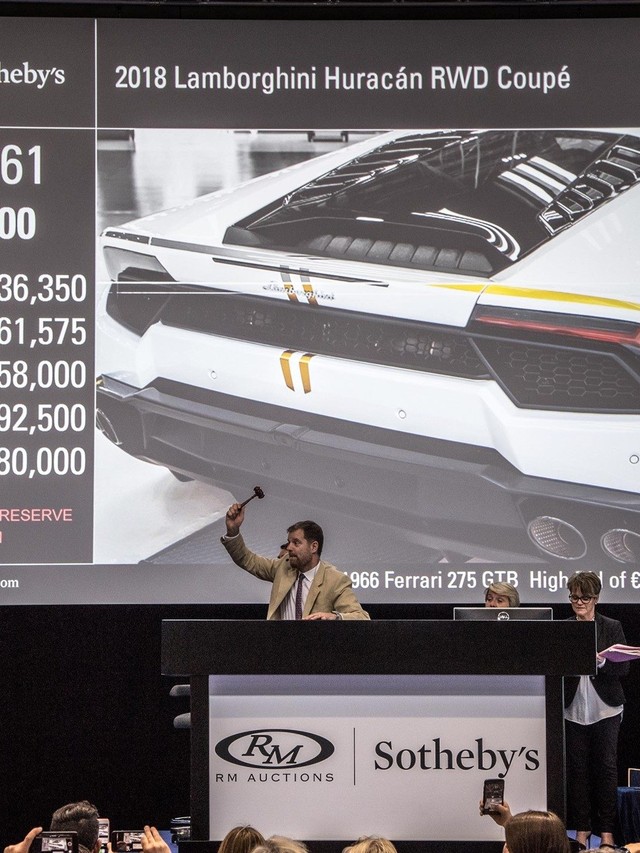
€715,000 for a Huracán RWD: The Auction Result and What It Bought
A one-off Lamborghini Huracán RWD, built specifically for Pope Francis and signed on the bonnet by the pontiff himself, sold for €715,000 at RM Sotheby’s Monte Carlo auction on May 12, 2018. Every euro of the hammer price goes directly to charitable projects selected by the Pope, spanning humanitarian work from Iraq to Central Africa. RM Sotheby’s lists the final transaction, including buyer’s premium, at €809,375.
The car was originally presented to Pope Francis at the Vatican on November 27, 2017, in a ceremony where the pontiff blessed it and added his autograph to the hood. It was never intended for papal commuting. The purpose was always philanthropic: create something extraordinary through Lamborghini’s bespoke program, attach the most singular provenance imaginable, and convert it into funding for causes that matter.
One report suggests a standard Huracán RWD typically sells for approximately €180,000. This particular example commanded roughly four times that figure, a gap that reveals how profoundly provenance, exclusivity, and the Ad Personam treatment can rewrite a car’s value proposition. That multiplier is the thread running through this entire story: Lamborghini’s customization division did not simply paint a car in Vatican colors. It manufactured a cultural artifact whose worth far exceeded its mechanical specification, then channeled that worth into philanthropy.
Inside the Ad Personam Creation: Vatican Colors on a Sant’Agata Canvas
Lamborghini’s Ad Personam department handled the build, and the brief was unlike anything the customization team would normally receive. The exterior wears Bianco Monocerus, a crisp white, accented by Giallo Tiberino stripes tracing the Huracán’s sharp body lines. Together the colors replicate the Vatican City flag. Inside, Bianco Leda Sportivo leather covers the cabin, with Lamborghini crests embossed into the headrests.
Ad Personam exists to let buyers push beyond the standard configurator, selecting unique paint codes, interior materials, stitching patterns, and trim combinations that would never appear in a showroom brochure. For most clients, the result is a deeply personal car reflecting individual taste. For this project, the personality belonged to an institution, and the execution had to be tasteful enough for a papal audience while remaining unmistakably Lamborghini.
The Huracán RWD was a smart platform choice. As the purist’s entry point in the lineup, the rear-wheel-drive variant strips away the all-wheel-drive system’s safety net, delivering a more direct connection between driver and road. Enthusiasts prize the RWD for exactly this quality: less electronic intervention, more driver responsibility, a chassis that rewards skill. Wrapping that mechanical honesty in Vatican livery created a genuinely unusual collision of worlds.
The department operates within Lamborghini’s Sant’Agata Bolognese headquarters, working alongside the production line but with a mandate to deviate from it. Paint-matching to a national flag, for instance, requires custom mixing and validation against Lamborghini’s own quality standards. The result is a car that meets every production specification while looking like nothing else on the road. That tension between factory rigor and bespoke ambition is precisely what allowed Ad Personam to transform a €180,000 sports car into a €715,000 philanthropic instrument.
The Power of Provenance: Why a Pope’s Signature Quadruples a Car’s Value
Collector cars trade on three currencies: rarity, condition, and story. This Huracán RWD scores on all three. It is a one-of-one build, delivered with zero miles driven in anger, and its provenance traces to the most recognized religious leader on the planet. The Pope’s signature on the bonnet is not a dealer accessory. It documented, photographed, and authenticated moment from a Vatican ceremony.
The supercar collector market places enormous premiums on unique provenance. Cars owned by celebrities, royalty, or historical figures routinely outperform comparable models at auction. What makes this example particularly interesting is that the provenance was not accidental. Lamborghini engineered it from the start. The company donated the car knowing it would be auctioned, knowing the papal association would amplify its value, and knowing the charitable outcome would reflect well on the brand. It is philanthropy by design, executed with the precision of a marketing campaign but directed toward genuinely impactful causes.
For collectors considering the long-term trajectory of this car’s value, the combination of factors is difficult to replicate. One-off Ad Personam builds already command premiums in the secondary market. A papal signature adds a layer of cultural significance that transcends automotive collecting entirely. Whether the buyer treats it as an investment, a conversation piece, or both, the provenance is bulletproof. The identity of the buyer, however, remains undisclosed.
Where the Money Goes: Four Charitable Projects Across Three Continents
Lamborghini says all proceeds go directly to Pope Francis for allocation across four specific projects. The largest beneficiary is the reconstruction of the Nineveh Plain in Iraq, managed by the Pontifical Foundation “Aid to the Church in Need.” That project aims to rebuild homes, public buildings, and places of worship to enable the return of the Christian community displaced by conflict.
Funds also support the Pope John XXIII Community’s “Pope Francis House Project,” which provides assistance to women who are victims of trafficking and abuse. The timing coincided with the 50th anniversary of the community’s founding and the tenth anniversary of the passing of its founder, Father Oreste Benzi.
Two additional Italian associations, GICAM and “Friends for Central Africa,” receive proceeds for their work supporting women and children in Africa, focusing on long-term development initiatives rather than emergency relief.
The breadth of the charitable portfolio underscores the project’s ambition. Rather than directing the full sum toward a single cause, the Pope distributed it across humanitarian, reconstruction, anti-trafficking, and development programs spanning Iraq, Italy, and Central Africa. A car that started life on a production line in Sant’Agata Bolognese ended up funding reconstruction in Nineveh and shelters for trafficking survivors, a geographic and moral reach that only makes sense because Ad Personam’s craftsmanship inflated the car’s value far beyond its mechanical worth.

A white Lamborghini Huracán RWD Coupé is displayed on a large screen during an RM Sotheby's auction event.
Lamborghini’s Halo Strategy: Philanthropy as Brand Architecture
Supercar manufacturers understand that brand perception operates on multiple frequencies. Performance specifications sell cars to enthusiasts. Design sells them to aesthetes. Cultural relevance, the sense that a brand participates meaningfully in the world beyond racetracks and concours lawns, sells the idea of the brand itself. The papal Huracán project operates squarely on this frequency.
What distinguishes Lamborghini’s approach is the directness of the gesture. The company built the car, donated it outright to the Pope, and let the Vatican determine the charitable recipients. No co-branding with a foundation, no percentage split, no corporate overhead skimming the proceeds. That simplicity made the story easy to tell and difficult to criticize.
The payoff for Lamborghini extends well beyond a single auction result. Ad Personam gains visibility as a department capable of executing culturally sensitive, one-of-one commissions. The brand associates itself with global humanitarian causes without appearing to exploit them. And the collector market receives a clear signal that Lamborghini can create objects whose value transcends their mechanical specification.
Lamborghini’s willingness to pursue “crazier” special projects, as sales and marketing chief Federico Foschini described the company’s direction in a Car and Driver report, suggests that one-off creations and limited allocations will continue to define the brand’s exclusivity strategy. The papal Huracán was an early, and arguably the most culturally ambitious, expression of that philosophy.
The Huracán generation itself has since given way to the Temerario as Lamborghini’s V8-powered sports car platform. But Ad Personam endures, and its capability to transform a production car into a cultural artifact remains one of Sant’Agata’s quieter competitive advantages. No configurator can replicate what happened when a supercar from Emilia-Romagna met a pontiff from Buenos Aires and the result ended up on the block at Monte Carlo’s Grimaldi Forum. That kind of alchemy requires a brand confident enough to give the car away in the first place.


