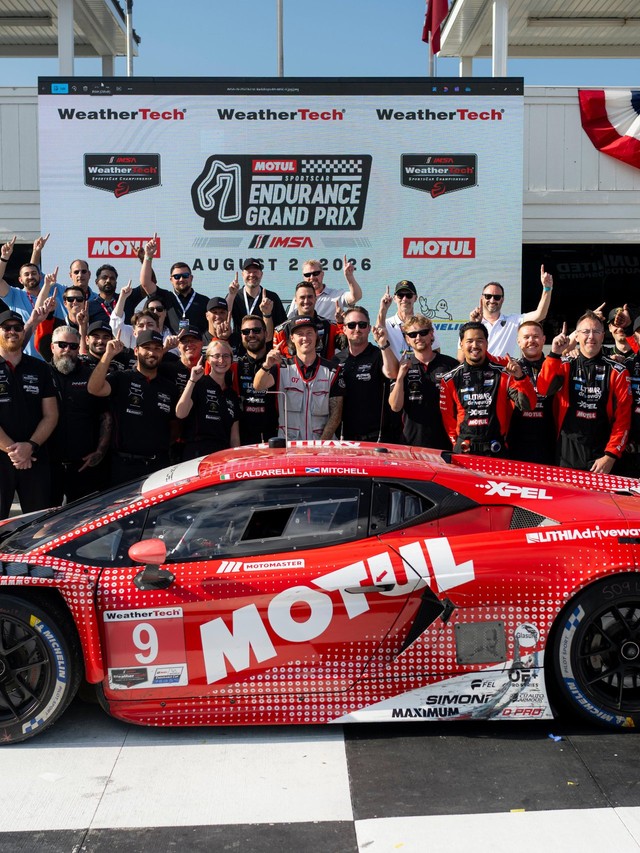
A Win in France, a Championship Lead in Thailand
On May 13, 2018, Petri Corse’s number 23 Lamborghini Huracán GT3 won Race 2 of the Italian GT Championship at the Paul Ricard circuit in Le Castellet, France. Drivers Giacomo Barri and Andrea Palma started fifth on the grid and carved forward through the field for the team’s first victory of the season. Antonelli Motorsport’s number 63 car, with Daniel Zampieri and Giacomo Altoé aboard, finished right behind in second, completing a Lamborghini lockout of the top two positions. That same Antonelli pairing had already taken a third-place podium in Race 1 the day before, while their teammates Martin Vedel and Lorenzo Veglia brought the number 19 Huracán home in second.
On the other side of the world at Thailand’s Buriram International circuit, the FFF Racing team’s Huracán GT3 delivered a second-place finish in Race 2 of the Blancpain GT Series Asia. Dennis Lind and Martin Kodric, both GT3 Junior Drivers in Lamborghini Squadra Corse‘s development program, used that result to consolidate their lead in the Asian Championship standings: 54 points, four clear of their nearest Mercedes AMG-GT3 rival.
Two continents, one weekend, and a consistent message: the Huracán GT3 was no longer simply competitive. It was winning, and doing so through the kind of team depth and driver development that separates a serious customer racing program from a vanity exercise.
Why These Early Wins Mattered More Than the Trophies
Lamborghini’s motorsport operation was still relatively young in 2018. Squadra Corse, the dedicated racing division based in Sant’Agata Bolognese, builds and sells customer race cars, but its GT3 program only began with the Huracán GT3’s unveiling in January 2015. Compared to the decades of factory GT racing experience at Porsche, Ferrari, and Mercedes-AMG, Lamborghini was the new entrant proving it belonged.
GT3 is the dominant class of customer sports car racing worldwide. A Balance of Performance system adjusts power and weight across manufacturers to keep competition close, which means you cannot simply out-engineer the field with raw horsepower. Winning consistently requires a well-sorted chassis, strong driver development, and effective team support. The Le Castellet and Buriram results demonstrated that Squadra Corse was delivering on all three fronts. For buyers considering a customer racing Huracán, a significant investment by any measure, these results served as practical proof that the manufacturer’s support infrastructure actually works at the sharp end of a grid, not just in a sales brochure.
The V10’s Competitive Edge Under BoP Constraints
The Huracán GT3 platform runs a naturally aspirated 5.2-liter V10, tuned and restricted to comply with GT3 regulations. Under Balance of Performance rules, the V10’s peak output gets dialed to match turbocharged rivals from Mercedes-AMG, Audi, and others, so the advantage is never about outright power. It is about how that power arrives.
A naturally aspirated engine delivers torque in a linear, predictable curve. For drivers threading through traffic at Paul Ricard’s long straights and technical chicanes, or managing tire degradation in Buriram’s tropical heat, that predictability translates into confidence on corner exit. The throttle does exactly what the driver’s right foot asks, with no turbo lag to manage mid-corner. Dallara Engineering, the Italian chassis specialist, partnered on the Huracán GT3’s body development, contributing aerodynamic know-how that complemented Squadra Corse’s mechanical package.
The combination of linear V10 response and a well-balanced aluminum and carbon fiber hybrid chassis gave customer teams a car they could set up and trust without needing deep expertise in turbo mapping. For smaller outfits like Petri Corse, which do not carry the engineering budgets of factory-backed squads, that accessibility was precisely what turned a fifth-place grid slot into a race win.
Lind, Kodric, and the Junior Driver Pipeline
Dennis Lind and Martin Kodric leading the Blancpain GT Series Asia standings was not an accident of circumstance. Both were part of Lamborghini Squadra Corse’s GT3 Junior Driver program, a structured effort to identify and develop young talent through competitive seats in real championships. By placing junior drivers in FFF Racing’s Huracán and supporting them with factory engineering resources, Lamborghini was investing in a pipeline that would pay dividends for years.
The approach mirrors what Ferrari and Porsche run through their own junior academies, but Lamborghini’s version carried a particular urgency in 2018. Building a roster of proven, brand-loyal drivers meant that as the Huracán GT3 evolved into the EVO and later the EVO2, experienced pilots would already understand the platform’s character and help accelerate development. A four-point gap over the Mercedes AMG-GT3 in the Asian standings was a small margin in absolute terms, but it represented a young program outperforming an established rival on unfamiliar circuits. For a growing motorsport division still earning its reputation, that kind of validation carried weight far beyond the points table.
From 2018 Podiums to a Global GT3 Legacy
Looking back from today, the May 2018 results at Le Castellet and Buriram sit at a pivotal point in Lamborghini’s racing arc. Zampieri and Altoé, the Antonelli Motorsport pairing who took second and third-place finishes that weekend, went on to secure the 2018 Italian GT Championship GT3 class title by season’s end. The Huracán GT3 platform continued evolving through the EVO and EVO2 generations, each building on the aerodynamic and mechanical lessons learned in races exactly like these.
By 2020, the Huracán GT3 EVO swept the IMSA WeatherTech SportsCar Championship driver and team titles for Paul Miller Racing and secured Lamborghini’s first British GT title with Barwell Motorsport. The trajectory from a scrappy comeback win at Paul Ricard to global championship dominance took only two years. Lamborghini now prepares to transition its customer racing program to the Temerario GT3, a twin-turbo V8 platform that represents a fundamental philosophical shift away from natural aspiration. The Huracán GT3’s competitive record, built brick by brick through weekends like May 2018, is the foundation that gives customer teams confidence to follow Lamborghini into that next chapter.
Gallery


