Lamborghini Puts Its Biggest F1 ‘What If’ on Display at Sant’Agata
Automobili Lamborghini has opened an Ayrton Senna exhibition at its museum in Sant’Agata Bolognese, and the centerpiece tells a story most F1 fans know only in fragments. In September 1993, Senna drove a McLaren MP4/8 fitted with a Lamborghini V12 engine at Portugal’s Estoril circuit. He reportedly loved it. McLaren chose a different path. And Lamborghini’s brief, tantalizing brush with the pinnacle of motorsport ended before it truly began.
Chairman and CEO Stefano Domenicali officially opened the exhibition, which runs daily from April 12 to October 9 (9:30 am to 7 pm, Sundays included). Among the guests were Mauro Forghieri and Daniele Audetto, both of whom were present at that 1993 test, alongside Ercole Colombo and Giorgio Terruzzi, curators of the accompanying photographic record. That Lamborghini brought together the actual people who witnessed Senna’s reaction to their engine says something about how seriously the company treats this particular chapter of its history.
This is not a routine museum refresh. It is Lamborghini deliberately claiming a connection to the greatest driver of the modern era, anchored by a story where the company’s engineering was, by most accounts, genuinely impressive enough to earn Senna’s endorsement. Every element of the exhibition circles back to a single, stubborn question: what might have happened if Lamborghini’s F1 engine had been given its chance?
The ‘McLambo’ Test: What Actually Happened at Estoril
The details of the 1993 test make the story far more interesting than the usual “Senna tried a car” summary.
By that season, McLaren was struggling with its Ford-Cosworth V8 and actively searching for a competitive engine supplier. Chrysler, which owned Lamborghini at the time, saw an opportunity to prove the LE3512 V12 at the sport’s highest level. The engine had been competing in F1 since 1989, primarily with smaller teams like Larrousse and Minardi, where limited chassis development obscured its true potential. Designed by Mauro Forghieri, the same engineer who had built championship-winning engines at Ferrari, the LE3512 was a naturally aspirated 3.5-liter, 80-degree V12 with 48 valves, direct fuel injection, and a dry sump oiling system. One source indicates it produced approximately 750 horsepower by 1993, roughly 70 hp more than the Ford unit McLaren had been running.
Senna tested the modified McLaren MP4/8B, a chassis specifically adapted for the larger Lamborghini V12, at Estoril, and reports indicate he also ran sessions at Silverstone and Pembrey. Multiple accounts describe him as genuinely enthusiastic about the engine, finding it more powerful, more stable, and easier on tires than the Ford. He reportedly urged Ron Dennis to switch to the Lamborghini unit for the final three races of the 1993 season. Mika Häkkinen, serving as McLaren’s test driver, was also reportedly significantly faster with the Lamborghini engine than with the Ford.
Forum discussion around this episode remains passionate decades later. The consensus among enthusiast communities is that Senna’s endorsement was real and that the Lamborghini V12 represented a genuine step forward for McLaren.
Why the Partnership Collapsed
Despite what reports describe as a “handshake agreement” between Chrysler and Ron Dennis, the deal fell apart. McLaren opted instead for a free engine supply from Peugeot for the 1994 season, a decision driven by financial and political considerations rather than engineering merit. The consequences cascaded quickly: Chrysler abandoned its motorsport ambitions and eventually sold Lamborghini, ending the F1 engine program entirely.
The counterfactual is irresistible. Senna left McLaren for Williams in 1994, partly because he lacked confidence in the Peugeot engine McLaren had chosen. If McLaren had run the Lamborghini V12, Senna might have stayed. The 1994 season might have unfolded very differently. Lamborghini might have established itself as a serious F1 engine supplier, reshaping the company’s trajectory for decades.
None of that happened. But the fact that Lamborghini’s engine earned genuine praise from arguably the most talented driver in F1 history is not a small thing. It validates the engineering ambition that has always run through Sant’Agata, even when the company lacked the resources or corporate stability to sustain a top-tier motorsport program. Ferrari’s continuous F1 presence tends to overshadow Lamborghini’s brief foray, but the Senna test proves the engineering capability was real, not aspirational. That proof is exactly what the exhibition puts on the wall.
Every Car Senna Raced, Under One Roof
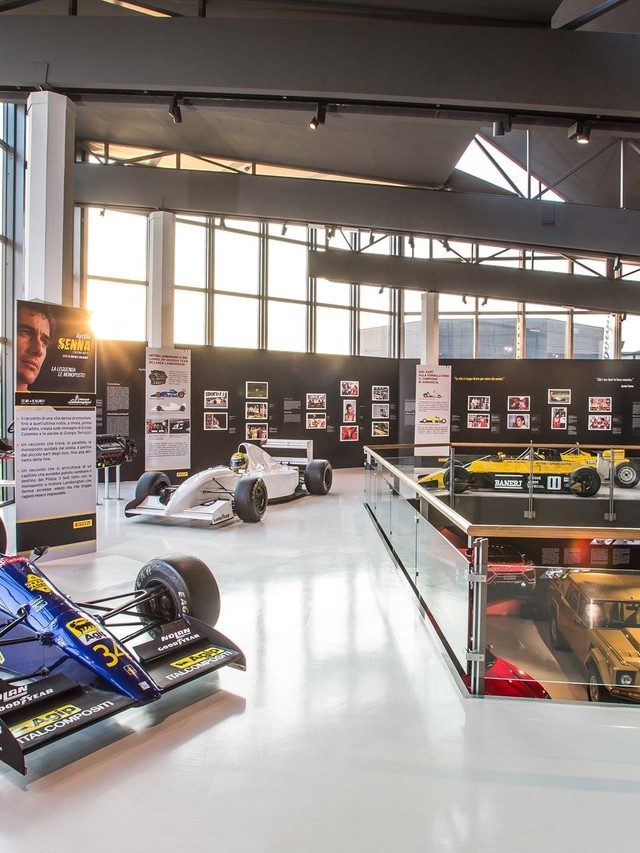
The exhibition extends well beyond the McLaren-Lamborghini connection. Every single-seat race car Senna drove throughout his career is on display, spanning from his debut outing to his final race. A white McLaren MP4/8, identical to the car tested at Estoril, sits alongside the actual Lamborghini engine that powered it.
The photography exhibition, titled “Ayrton Senna. The last night,” adds an emotional dimension curated by Colombo and Terruzzi. Visitors can experience this alongside the Lamborghini Museum‘s permanent collection, which, judging from exhibition imagery, includes the yellow LM002 and other heritage models illustrating the breadth of Lamborghini’s history beyond supercars.
For anyone planning a trip to Emilia-Romagna’s Motor Valley (Ferrari’s museum in Maranello and the Ducati factory in Bologna are both within easy driving distance), this exhibition adds a compelling reason to make Sant’Agata a stop. It also marks the beginning of a permanent partnership between the Lamborghini Museum and Pirelli, signaling that the museum is positioning itself as a more significant cultural destination rather than a simple factory showroom.

Historic racing cars and a classic SUV are displayed in a spacious exhibition hall with large windows.
What This Exhibition Tells Us About Lamborghini’s Motorsport Identity
Lamborghini’s relationship with top-level motorsport has always been more complicated than Ferrari’s or McLaren’s. Ferruccio Lamborghini famously wanted nothing to do with racing. The company’s competitive efforts have come in waves, often driven by external ownership or the ambitions of individual engineers rather than a continuous corporate commitment.
The Senna exhibition acknowledges that complexity and turns it into a strength. When Lamborghini did build an F1 engine, it was good enough to impress the best driver on the planet. The LE3512 V12 was not some vanity project bolted into backmarker cars for publicity. It was a serious engineering effort, led by one of the most respected engine designers in racing history, that produced competitive power from a naturally aspirated architecture. That philosophy, building naturally aspirated engines that punch above expectations, defined Lamborghini’s road cars for decades afterward.
The timing carries its own significance. Lamborghini’s current motorsport portfolio includes Squadra Corse’s customer racing programs and the SC63 LMDh prototype competing at the highest level of endurance racing. Hosting an exhibition that connects the brand to Senna and F1 reinforces the idea that Lamborghini belongs in elite motorsport, even if its path there looks nothing like Ferrari’s unbroken lineage. For prospective buyers, that motorsport credibility matters. It is the difference between a supercar brand that races and one that merely looks fast.
Whether you can visit Sant’Agata before the October 9 closing date or simply appreciate the history from afar, the core takeaway endures. In 1993, Lamborghini built an engine that made Ayrton Senna call Ron Dennis in the middle of the night to say he wanted it. The partnership never materialized, but the engineering spoke for itself. This exhibition makes sure the story does too.


