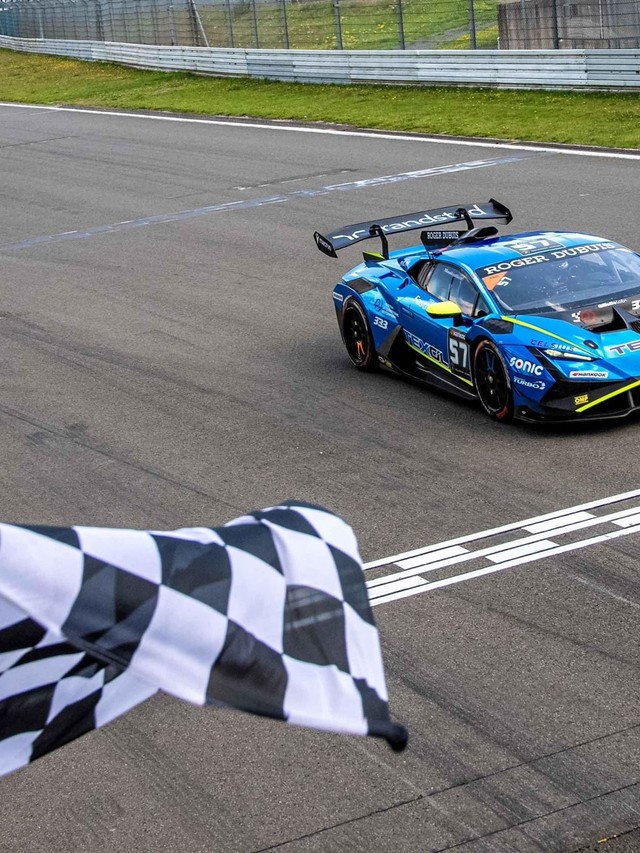
From the Grandstands to the Top Step in Twelve Months
In 2017, Sheena Monk watched her first Lamborghini Super Trofeo North America race from the spectator areas at VIRginia International Raceway. By September 2018, she arrived at WeatherTech Raceway Laguna Seca carrying the momentum of a first career LB Cup class victory and sitting second in the championship standings, trailing the leader by 16 points with four rounds remaining.
That compression of timeline tells a specific story about how Lamborghini structures its one-make series. Monk credits the Squadra Corse Pilota program for opening the door to competitive racing, and her trajectory suggests the program functions as a genuine accelerator rather than a branding exercise. She competes in the Wayne Taylor Racing, Lamborghini Paramus No. 7 Prestige Performance Lamborghini Huracán Evo Super Trofeo, a car and team combination that places a first-year driver inside a professional operation with real infrastructure. The Laguna Seca weekend represented rounds nine and ten of the North America championship, the penultimate event before the series finale in Italy that November. For Monk, who had only visited the California circuit as a spectator, the challenge was immediate: learn a demanding, unfamiliar layout quickly enough to protect a championship position.
Why the Super Trofeo Ladder Works as a Development Tool
Lamborghini’s Super Trofeo structure operates across three continental series, with Europe established in 2009, Asia running since 2012, and North America debuting in 2013. All three feed into an annual World Final where drivers from every region compete head to head. Six double-race weekends per series, with 50-minute races, give developing drivers consistent seat time without the logistical sprawl of a full international calendar.
The class system is central to why the ladder works for someone like Monk. The LB Cup sits alongside Pro, Pro-Am, and Am categories, creating a tiered environment where newer drivers race wheel to wheel against competitors at a comparable stage. Her four consecutive second-place finishes before the breakthrough win illustrate how competitive even the entry-level class can be. She was not coasting to podiums. She was grinding through a sequence of near-misses that demanded the kind of mental resilience professional racing eventually requires.
The Huracán Evo Super Trofeo itself reinforces that development. A rear-wheel-drive, naturally aspirated V10 race car, it rewards precision and punishes laziness. Driving that power delivery through the rear axle alone, without the safety net of all-wheel drive, teaches throttle management and car placement in ways that translate directly to higher categories. For aspiring GT drivers, the skills built in a rear-drive V10 race car are more transferable than those learned in a more forgiving configuration.
Katherine Legge and the Value of Professional Mentorship
None of Monk’s rapid progress happened in isolation. Her driver coach is Katherine Legge, a veteran of the IMSA WeatherTech Championship with deep experience across multiple racing disciplines. Wayne Taylor Racing introduced the two before Monk’s first Super Trofeo event weekend in Imola, Italy, during the final round of the 2017 season. The pairing was deliberate: a first-year driver matched with a coach who understood the specific demands of professional sports car racing.
Monk described Legge as central to her development, and the coaching relationship points to something competitor one-make series do not always provide with the same intentionality. Ferrari Challenge and Porsche’s single-make programs offer structured racing environments, but the specific pairing of a developing driver with an active IMSA-level professional through the team itself adds a layer of mentorship that goes beyond data review and track walks. Legge brings current, real-world race craft to the coaching role, not retired expertise.
For the Laguna Seca weekend, that relationship carried particular weight. The circuit’s elevation changes and the Corkscrew section demand precise commitment points that no amount of simulator time fully replicates. Monk planned to lean on Legge and the Wayne Taylor Racing engineering staff to compress her learning curve on a track she had only observed from the outside. The pattern is consistent with everything else in her story: surround yourself with the right infrastructure, trust the process, and close the gap faster than anyone expects.
The Bigger Picture: From LB Cup to GTD
Monk’s stated ambition is to compete in GTD, the professional GT class within the IMSA WeatherTech SportsCar Championship. She anticipated racing another season of Super Trofeo in 2019, supplemented by testing in other car types to broaden her experience base. The approach is methodical rather than rushed: build a foundation in the one-make series, develop the racecraft and consistency that professional teams evaluate, then step up.
This pathway is exactly what Lamborghini designed the Super Trofeo to enable. The series functions as a proving ground where Squadra Corse can identify and develop talent that may eventually compete in Lamborghini’s GT3 programs. Every driver who progresses from Super Trofeo into higher-level GT racing extends Lamborghini’s competitive presence without requiring the company to fund every seat directly. Drivers, teams, and dealer networks invest in the ecosystem because the pathway is credible, and Monk’s year-one results are the most vivid proof of that credibility in action.
Championship Battles Heading Into the Penultimate Round
Monk’s LB Cup fight was only one of several tight championship contests entering the Laguna Seca weekend. In the Pro Class, Taylor Proto and Edoardo Piscopo (No. 50 US RaceTronics, Lamborghini Beverly Hills) held a single-point advantage over Corey Lewis and Madison Snow (No. 29 Change Racing, Lamborghini Charlotte). JC Perez and Loris Spinelli (No. 71 P1 Motorsports, Lamborghini Broward) led the Pro-Am Class by a substantial margin and aimed to clinch their title that weekend. Ryan Hardwick (No. 2 Dream Racing, Lamborghini Atlanta) carried a nine-point cushion over Damon Ockey (No. 09 US RaceTronics, Lamborghini Calgary) in the Am Class.
The concentration of competitive battles across every class, with multiple championships potentially decided in a single weekend, underscored the health of the North America series five years after its 2013 debut. The grid was producing the kind of multi-class drama that keeps teams, sponsors, and dealer networks invested. Monk’s story, from grandstand to podium in twelve months, sat at the center of it all: concrete evidence that the Super Trofeo ladder delivers real competition, professional infrastructure, and a genuine pathway upward for drivers willing to do the work.
Gallery


