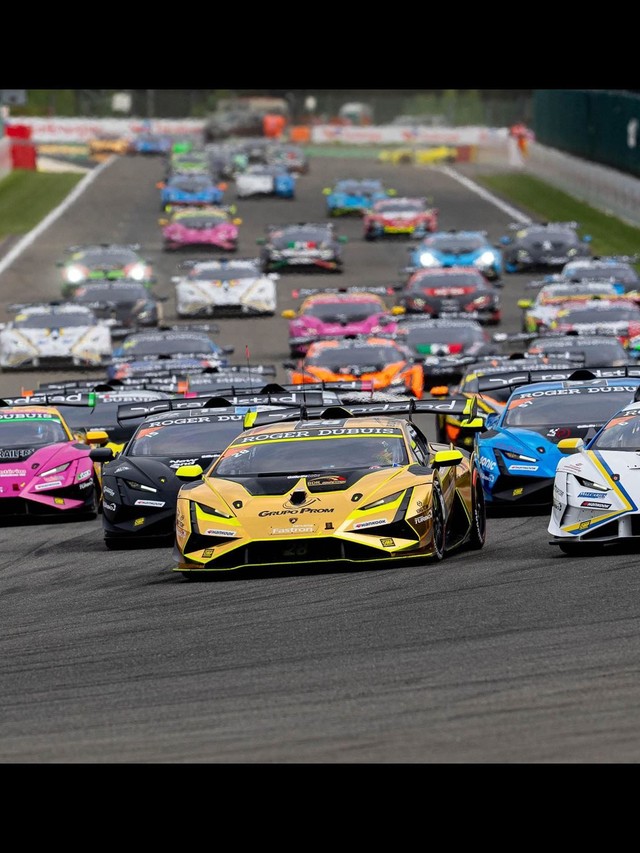
The Laguna Seca Showdown: A Dramatic North American Finale
The marine fog over WeatherTech Raceway Laguna Seca lifted just in time Sunday morning to reveal a 50-minute contest that proved, once again, why the Lamborghini Super Trofeo works: when every car is identical, the racing comes down to the humans inside them. Conor Daly and Brandon Gdovic completed a weekend sweep in the No. 46 Precision Performance Motorsports, Lamborghini Palm Beach entry. Jake Eidson and Damon Ockey clinched the ProAm season championship. And between those two headline results, the final domestic round of the 2019 season delivered enough penalties, on-track contact, and last-lap drama to fill a weekend twice its length.
Daly started from pole and built a two-second gap almost immediately, while positions two through five ran nose-to-tail for most of the opening stint. Eidson, Lewis, Sbirrazzuoli, and Amici spent lap after lap within striking distance of each other, and it took until Lap 10 for Corey Lewis to find an inside line past Eidson at Turn 2. One lap later, contact between LB Cup points leader Mel Johnson and Justin Price ended Price’s race with right-rear wheel damage. The race was barely halfway old, and the stewards were already busy.
Lamborghini says the victory was Daly and Gdovic’s third of the season, following a win at the opener at Barber Motorsports Park. Gdovic extended a personal streak to three consecutive victories, having also won with Shinya Michimi at VIRginia International Raceway the previous month. That consistency across different co-drivers suggests a racer who adapts quickly to changing car balance and tire conditions, a quality that matters enormously in a series where every car rolls out of the same technical specification.
The Huracán Super Trofeo EVO: Why the Spec Matters
Strip away the engineering arms race that defines most professional motorsport, and what remains is the purest test of driver and team. That is the premise behind the Lamborghini Super Trofeo, and the Huracán Super Trofeo EVO is the tool built to deliver on it. Every team fields an identical car, so the differentiators become talent, pit strategy, tire management, and execution. Laguna Seca proved the point: the race was decided by seconds lost in pit lane, not by horsepower advantages.
The EVO itself sits at the top of Lamborghini’s customer racing ladder. It shares the Huracán’s naturally aspirated 5.2-liter V10 but little else with its road-going siblings. According to Lamborghini’s technical documentation, the EVO produces 620 CV at 8,250 rpm, sends power exclusively to the rear wheels through an X-Trac six-speed sequential gearbox, and rides on Öhlins TTX 36 two-way adjustable dampers. The aerodynamic package, co-developed with Dallara Engineering and Lamborghini Centro Stile, includes a distinctive rear fin and upper air intake that distinguish it visually from any road Huracán.
For context, the road-legal Huracán STO and Performante share the same V10 architecture but retain all-wheel drive and road-oriented electronics. The Super Trofeo EVO deletes those compromises entirely: rear-wheel drive, a racing clutch with a lightweight flywheel, dry sump lubrication, and steel racing brakes from Brembo with 380mm front and 355mm rear discs. Lamborghini designed it as the ideal entry point for drivers aspiring to a career in GT racing, and the series’ alumni list supports that claim.
Strategy, Penalties, and the 84-Second Rule
If the opening stint was about raw pace, the second half was about pit lane discipline, and several teams failed the test. The Super Trofeo series enforces an 84-second minimum pit stop time, measured from pit-lane entry to exit. The rule equalizes driver changes and prevents teams from gaining advantages through faster crew work. It also creates a unique strategic pressure: teams must balance speed with precision, knowing that even a fraction of a second can trigger a penalty.
The No. 29 Change Racing entry learned this the hard way. Richy Antinucci, who replaced Corey Lewis during the pit window, first made light contact with Gdovic’s No. 46 at pit exit, earning an order to cede position. Then the team was assessed a drive-through penalty for missing the 84-second minimum by more than one second. That sequence, improper exit followed by a timing violation, effectively destroyed a potential podium run.
Gdovic’s No. 46 also missed the minimum pit time, but by less than a second. The difference in penalty was significant: instead of a drive-through, the team received a post-race time addition of just 0.234 seconds, calculated as double the actual shortfall. That margin proved irrelevant to the final result, but it illustrates how precisely the series calibrates its enforcement. A team that misses the minimum by 1.1 seconds serves a drive-through during the race. It misses by 0.117 seconds gets a time addition after the checkered flag. The distinction between those two outcomes was, in this case, the difference between a race win and a recovery drive.
Antinucci, to his credit, charged back through the field after serving his drive-through to claim third place overall and in the Pro class. Sandy Mitchell, running second in the No. 1, knew his car faced a five-second post-race penalty for an improper race start and chose to hold position rather than risk an aggressive pass on Gdovic. That kind of calculated restraint, knowing the penalty math and racing accordingly, is the strategic layer that makes the Super Trofeo more interesting than its spec-series label might suggest.
“I knew the 29 was supposed to give me the lead and he was supposed to let me by. I then let him go back by and I knew he had that drive-through he had to serve. I made sure to pace myself to keep the tires on the car.”
, Brandon Gdovic
Gdovic’s post-race comments reveal a driver managing information as much as managing the car. He knew the penalty was coming for his rival, adjusted his pace to preserve tires, and let the stewards do the work. That awareness separates consistent front-runners from one-race wonders in customer racing.
Class Battles: Am, ProAm, and LB Cup
The overall Pro result tends to grab the headlines, but the class fights at Laguna Seca were equally compelling, and they reinforced the same lesson: in identical machinery, composure wins.
James Sofronas in the No. 14 GMG Racing entry and Steven Aghakhani in the No. 6 US RaceTronics car staged a fierce closing-lap duel for the Am class win for the second consecutive day. Sofronas held on both times. McKay Snow leads the Am standings by 13 points over Aghakhani heading into the World Finals.
In ProAm, Eidson handed the No. 9 US RaceTronics car to Damon Ockey, who drove comfortably to the class win and sealed the season championship. The pair had been the class benchmark all year, and Ockey’s post-race comments pointed forward rather than backward.
“It’s great to win the championship but we still have two more races to go, and we want to go to Spain and continue to race hard and make overall podiums.”
, Damon Ockey
The final-straight drama belonged to the ProAm podium battle: Dani Clos in the No. 69 rolled out of the last turn and passed teammate Dean Baker on the straight to the checkered flag, stealing the final podium spot in what amounted to a drag race between identical cars. In LB Cup, Randy Sellari spun at the top of the famous Corkscrew while leading, recovered to finish second, and watched Mel Johnson and Thomas Lovelady take the class victory in the No. 08 despite the earlier contact that ended Justin Price’s race. Johnson holds a 14-point lead in LB Cup standings heading to Spain.
The Road to Jerez: What the World Finals Mean
Laguna Seca was the end of the North American calendar but not the end of the championship math. Lamborghini says the season’s climactic round, the Super Trofeo World Finals, is scheduled for October 24-25 at Jerez de la Frontera in Spain, bringing together competitors from the North American, European, and Asian series for a combined showdown. For drivers like Antinucci and Lewis, who lead Gdovic by six points in the Pro standings, the domestic title remains undecided. The World Finals rounds count toward the overall championship.
That format is what elevates the Super Trofeo beyond a regional club series. Pitting North American, European, and Asian competitors against each other on the same weekend creates a genuine international benchmark, and for aspiring GT drivers, a strong World Finals result can open doors to factory programs and higher-tier racing categories.
This matters for Lamborghini’s broader motorsport narrative. The Temerario GT3, which represents a significant milestone as Lamborghini’s first entirely in-house designed and built competition car, will eventually need a pipeline of proven customer-racing talent. The Super Trofeo series is that pipeline. Drivers who cut their teeth managing tire degradation and pit-stop timing in identical Huracáns are the same drivers who will fill GT3 grids in the coming years. The series functions as both entertainment and recruitment, which is why Lamborghini invests in making it competitive and visible.
For buyers and collectors watching from outside the paddock, the Huracán Super Trofeo EVO occupies an increasingly interesting position. As Autoblog reported, at least one Michigan dealer has offered a Super Trofeo titled for road use, a quirk of state-level registration that underscores the car’s crossover appeal. Autoblog also highlighted an 84-mile example listed on Bring a Trailer, noting its appeal to collectors drawn to its rarity and naturally aspirated motorsport pedigree. As Lamborghini transitions its competition efforts toward the twin-turbocharged Temerario platform, the V10-powered Super Trofeo EVO increasingly looks like the final expression of a particular era of Lamborghini customer racing: naturally aspirated, mechanically direct, and built exclusively for the track.
What Enthusiasts Should Take Away
The Laguna Seca finale demonstrated something raw spec sheets never capture: the quality of racing in the Super Trofeo series depends entirely on its constraints. The 84-second pit stop rule, the identical cars, the multi-class structure, these regulations create the conditions for strategic, wheel-to-wheel competition that justifies the series’ existence. Fractions of a second in pit lane carry consequences that reshape entire race results, and the drivers who thrive are the ones who internalize that reality.
Gdovic’s weekend sweep came not from heroic overtakes but from clean execution and letting penalties sort out the competition. Eidson and Ockey clinched their championship the same way. In a paddock full of identical Huracáns, the car that wins is almost always the one that makes the fewest mistakes.
Lamborghini has not disclosed specific costs for participating in the Super Trofeo series, and the financial barrier for privateers remains one of the most common questions in enthusiast forums. What the Laguna Seca weekend does confirm is that the series continues to attract a mix of professional drivers, gentleman racers, and ambitious amateurs, all competing under the same technical rules and all feeding into a global championship structure that culminates at Jerez. For Lamborghini, that combination of accessibility and prestige is the entire point.
Gallery


