Chaos at the Corkscrew: A Race Compressed Into Twelve Minutes
Most races are decided by pace. Round 9, Race 1 of the 2018 Lamborghini Super Trofeo North America series at WeatherTech Raceway Laguna Seca was decided by a clock that barely had time to run. Loris Spinelli, in the No. 71 P1 Motorsports entry backed by Lamborghini Broward, led the 18-car field cleanly off the line. Six minutes later, Sheena Monk, piloting the No. 7 Wayne Taylor Racing Huracán Super Trofeo for Lamborghini Paramus, went off course at the top of the famous Corkscrew and into the tire barrier.
The red flag came out four minutes after the incident. Lamborghini confirmed Monk was awake and alert before being transported to a local hospital for evaluation, a reassuring outcome given the severity of the impact at one of North American motorsport’s most unforgiving corners. When the field finally reformed, only 12 minutes of green-flag racing remained, and the mandatory pit window opened the instant the cars went back to speed. Every strategic calculation that teams had planned for a full race distance was suddenly compressed into a frantic sprint, and the team that read that compression best would win.
The Gamble: US RaceTronics Bets Everything on Staying Out
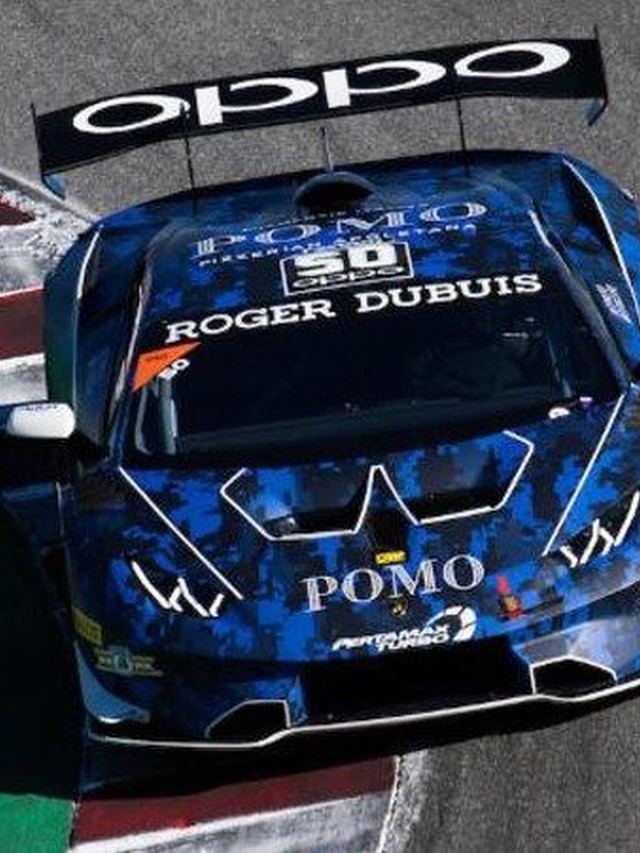
The restart created an immediate dilemma. Teams still had to complete a mandatory pit stop with a driver change, but the window for that stop now overlapped almost entirely with the remaining race time. Most front-runners dove straight into the pits. Edoardo Piscopo, driving the No. 50 US RaceTronics Huracán Super Trofeo for Lamborghini Beverly Hills, did the opposite. He stayed out.
The logic was simple in theory, brutal in execution. Every lap Piscopo ran while his rivals sat in pit lane was a lap of free real estate, track position that no amount of raw pace could have delivered under normal racing conditions. The risk was obvious: if the race ran green to the finish, he would still need to pit, hand the car to co-driver Taylor Proto, and rejoin without losing the lead. Piscopo pushed the window to its absolute limit, finally ducking into pit lane with just over two minutes on the clock.
Proto described the aftermath with dry humor: after exiting the pits in the lead, he circled Laguna Seca at 60 kph, taking in the scenery. The strategy had worked. It still needed one more stroke of luck to hold.
A Spin in Turn 5 Seals the Result
That luck arrived almost immediately. Cameron Cassels, in the No. 33 Wayne Taylor Racing entry, spun in Turn 5, and race control deployed a full-course yellow. Proto was already leading when the caution flew. Under yellow, nobody could improve their position, and the race ended under the caution flag. Proto took the checkered flag without ever needing to defend at racing speed.
Piscopo acknowledged the bittersweet nature of the result. He called the car and strategy great, but added that the victory felt like “a sorrow victory” given Monk’s earlier incident. Spinelli, whose No. 71 car had led the opening laps before the red flag scrambled the order, offered similar sentiments.
For US RaceTronics, the win represented their third victory in four races, extending their class lead to seven points. The gap between brilliance and disaster in one-make racing often comes down to a single strategic call, and this was a textbook example. Piscopo and Proto’s team read the compressed race clock correctly, bet that track position would outweigh the risk of a late stop, and then watched as an unrelated incident froze the order in their favor.
Class Winners and a Championship Clinched
Brandon Gdovic and Shinya Sean Michimi brought the No. 46 PPM entry for Lamborghini Palm Beach home second overall, with Corey Lewis and Madison Snow finishing third in the No. 29 Change Racing car representing Lamborghini Charlotte.
The PRO-AM class delivered the weekend’s biggest championship story. Spinelli and co-driver JC Perez won their class and, in doing so, clinched the 2018 PRO-AM title outright. Their 122-point total gave them a 57-point cushion over the second-place pairing of Randy Sellari and Stevan McAleer, whose No. 10 Wayne Taylor Racing entry retired from the race following their teammate Monk’s accident.
Brian Thienes won the AM class for US RaceTronics and Lamborghini Beverly Hills, his second victory in three races. Class leader Ryan Hardwick finished second to preserve his championship advantage heading into Sunday’s finale. In the LB Cup, Mark Proto and Parris Mullins claimed their fifth win of the season in the No. 88 US RaceTronics car for Lamborghini La Jolla. Mullins, racing at his home track (he grew up in Marin County and learned to drive at Laguna Seca through Skip Barber), noted that the late yellow played directly in their favor.
| Class | Winners | Car Number | Team / Dealer |
|---|---|---|---|
| Overall | Piscopo / Proto | No. 50 | US RaceTronics, Lamborghini Beverly Hills |
| PRO-AM | Spinelli / Perez | No. 71 | P1 Motorsports, Lamborghini Broward |
| AM | Brian Thienes | No. 17 | US RaceTronics, Lamborghini Beverly Hills |
| LB Cup | Proto / Mullins | No. 88 | US RaceTronics, Lamborghini La Jolla |
What One-Make Racing Reveals About Lamborghini’s Motorsport Pipeline
Races like this one illustrate why manufacturer-backed one-make series remain so valuable for brands like Lamborghini. The Super Trofeo format, built around identical Huracán Super Trofeo race cars that are purpose-built and not street-legal, strips away equipment advantages and forces the competition to hinge on driver skill, team strategy, and the kind of split-second decisions that defined this Laguna Seca round. The multi-class structure (Pro, Pro-Am, Am, LB Cup) keeps the grid diverse, mixing seasoned professionals with gentleman drivers developing their craft in a controlled, manufacturer-supported environment.
For anyone considering what it costs to compete at this level, Lamborghini does not publish a single entry price, and the total outlay for a full season (car lease or purchase, transport, crew, tires, spares) varies widely depending on the team structure. Forum discussions among Lamborghini owners reflect genuine interest but also acknowledge that the commitment is substantial. The reward, beyond trophies, is access to Squadra Corse’s engineering support and a direct connection to Lamborghini’s racing ecosystem.
The Huracán Super Trofeo served as the backbone of this series for nearly a decade. The road-going Huracán has since been replaced by the plug-in hybrid Temerario, and the Temerario GT3, which marks Lamborghini’s first competition car fully designed, developed, and built in-house, signals the next chapter. Looking back at a race like this 2018 Laguna Seca round, the strategic drama and human stakes feel timeless regardless of the platform. The cars will change. The gambles, the yellow flags, and the split-second calls that separate a winner from the field will not.
Gallery


