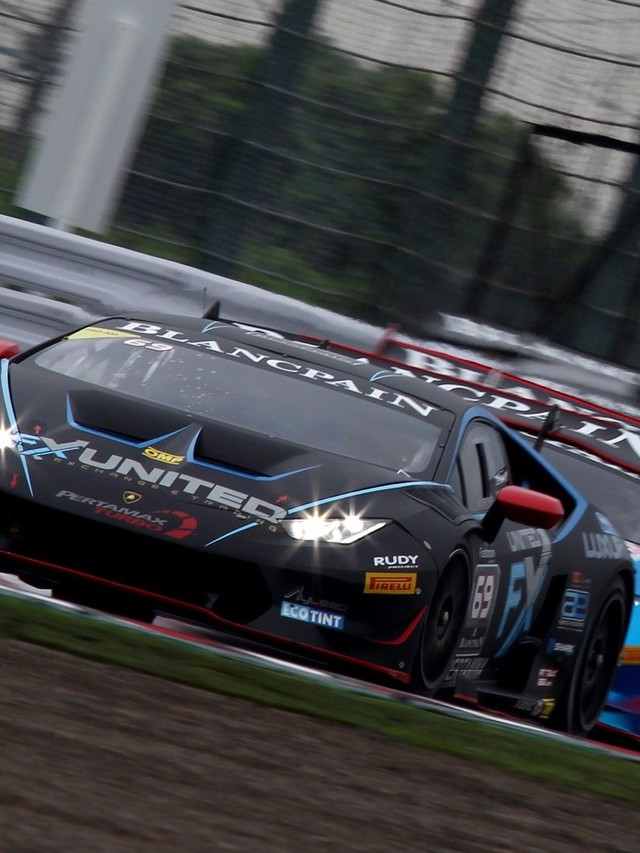
Suzuka’s Super Trofeo Debut: A Race Worth the Wait
Suzuka separates serious racers from tourists. Its figure-eight layout, elevation changes, and the infamous 130R corner demand commitment that few tracks in Asia can match, so when the 2016 Lamborghini Blancpain Super Trofeo Asia series brought its grid here for the first time on June 12, the circuit delivered exactly the kind of unpredictable, lead-swapping drama that justified the move. Four different pairings led Race 2 across 25 laps, proof that Squadra Corse had chosen the right venue to test whether its Asian customer racing program was ready for a world-class stage.
Overnight rain had soaked the track, but conditions dried enough for slick tires by race time, creating a surface that rewarded bravery and punished hesitation in roughly equal measure. The Super Trofeo Asia series had visited Japan every year since its inception, though previous rounds used other venues. Bringing the grid to Suzuka in 2016 signaled that Lamborghini considered the program mature enough for one of the world’s most technically demanding circuits.
Local Japanese teams clearly relished the home advantage. Lamborghini says five of the top seven qualifying positions for Race 2 belonged to Japanese entries, a dominance that set the stage for a 25-lap contest where the lead changed hands multiple times and the eventual winners started from fourth on the grid.
Race 2: Four Lead Changes and a Late-Race Ambush
Yudai Uchida and Jono Lester, the Race 1 winners, started from pole but lost it almost immediately. Akira Mizutani and Hajime Noma, the Japanese PRO-AM duo who had qualified seventh, surged into the lead on the opening lap. That advantage lasted three laps before Zen Low and Max Wiser took over at the front.
By lap eighteen, Uchida and Lester had fought back into the lead, and for a few laps it looked like they might complete a weekend sweep. Toshiyuki Ochiai and Afiq Yazid had other plans. The pair, who had qualified a somewhat uncharacteristic fourth, mounted a late charge that carried them past Uchida and Lester with enough authority to hold the position through the checkered flag.
The final order told a story of patient racecraft over raw qualifying speed:
| Position | Drivers | Class |
|---|---|---|
| 1st | T. Ochiai / A. Yazid | PRO-AM |
| 2nd | Y. Uchida / J. Lester | PRO-AM |
| 3rd | Z. Low / M. Wiser | PRO-AM |
In the AM class, Andrew Haryanto of Indonesia took first, followed by Takeshi Kimura in second and the pairing of Samson Chan and George Chou in third. Larry De George and Cedric Sbirrazzuoli, who had qualified second and looked strong early, were again held off the podium, a frustrating weekend for a pair that clearly had the pace but not the race-day fortune.
That Ochiai and Yazid won from fourth on the grid, on a drying track, at a circuit none of these teams had raced before, underlines a truth about customer racing at this level: it rewards the teams that read conditions fastest, not just the ones with the best single-lap speed.
The Huracán Super Trofeo at Suzuka: Right Car, Right Circuit
Close, multi-lead-change racing on a circuit as demanding as Suzuka does not happen by accident. It requires a car with enough performance headroom to reward skill and a series format tight enough to prevent any single team from running away with it. The Huracán Super Trofeo is a purpose-built, track-only race car that shares its basic silhouette with the road-going Huracán but little else in terms of mission. Stripped interiors, full roll cages, race-specification suspension, and an aggressive aerodynamic package transform it into a machine designed for exactly the kind of high-speed, high-commitment corners Suzuka specializes in.
What makes the Super Trofeo format valuable for Lamborghini is its accessibility relative to full GT3 competition. One source suggests the series offers world-class performance at a relatively accessible price point for entry into GT3-style racing, which explains why the grid attracts such a diverse mix of nationalities and experience levels. The field at Suzuka included drivers from Japan, New Zealand, the United States, Monaco, Malaysia, Sri Lanka, India, and Indonesia. Few racing series outside Formula 1 can claim that kind of geographic spread.
For enthusiasts watching from the outside, the Super Trofeo car represents the most extreme factory-developed version of the Huracán that private teams can purchase and race directly. The Huracán Super Trofeo EVO, a later evolution of the platform, is widely reported to be not street-legal, underlining just how far removed these machines are from their road-car origins. According to Autoblog, at least one example has surfaced with a road title in Michigan, though that appears to be the exception that proves the rule.
Why Asia Matters for Lamborghini’s Racing Ambitions
Running a one-make racing series across Asia is expensive and logistically complex. Lamborghini does it because customer racing programs serve a dual purpose: they build brand loyalty among wealthy enthusiasts who want more than a showroom experience, and they generate visibility in markets where supercar sales are growing fastest. The quality of racing at Suzuka, where the lead changed four times and drivers from eight countries fought for position, validates that investment in ways a static car show never could.
The 2016 calendar illustrates the strategy clearly. Japan, a mature and deeply knowledgeable car culture, anchors the series with a prestigious venue. The next round, scheduled for July 23 at Thailand’s Buriram United International Circuit, pushed the series into entirely new territory. Lamborghini says Buriram is Thailand’s first FIA Grade 1 and FIM Grade A circuit, a facility built to international standards that gives the series credibility in Southeast Asia’s expanding motorsport landscape.
For context, rival one-make series from Ferrari and Porsche run similar regional programs, but Lamborghini’s willingness to add new circuits each season keeps the calendar fresh and forces teams to adapt rather than rely on accumulated track knowledge. Suzuka in 2016 was a first. Buriram was a first. That pattern of deliberate expansion suggests Squadra Corse views Asia not as a secondary market for its racing program, but as a primary growth region.
The long-term payoff of this approach became clearer years later when Lamborghini committed to building the Temerario GT3 entirely in-house, a move Autoblog reported as a significant departure from the brand’s previous practice of outsourcing competition car development. The customer racing infrastructure built through programs like Super Trofeo Asia, including the relationships with teams, drivers, and circuits across the region, forms the commercial foundation that justifies that kind of factory investment.
Looking Ahead: Buriram and the Season’s Second Half
With the Suzuka weekend complete, the 2016 Super Trofeo Asia season turned toward Thailand and a circuit that most competitors had never seen. Buriram presented a fresh challenge, and the series’ willingness to race at unfamiliar venues kept the competitive order fluid in a way that benefits viewers and participants alike.
Ochiai and Yazid’s victory earned them a result that mattered well beyond the points table. Winning the series’ inaugural race at one of Japan’s most storied circuits is the kind of achievement that sticks in the record books long after the championship standings are forgotten. More broadly, the Suzuka round demonstrated that the Lamborghini Blancpain Super Trofeo Asia grid is genuinely international and genuinely competitive, not a parade of wealthy amateurs circulating at seven-tenths. On one of the most technically demanding circuits in Asia, the Huracán Super Trofeo proved capable of producing the kind of close, unpredictable racing that turns a customer series into something worth watching on its own terms.
Gallery


