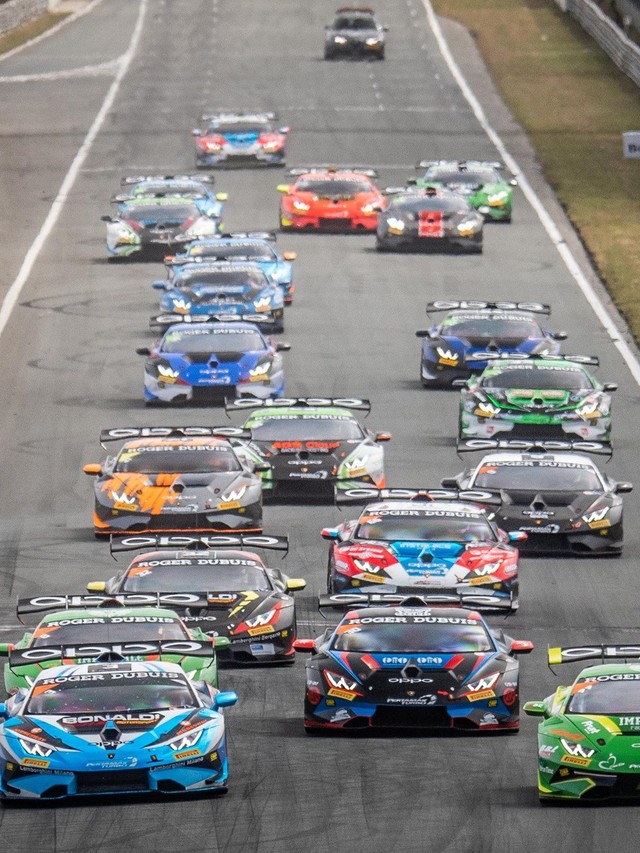
Pole-Sitter Out on Lap One: How Rain Rewrote Race 2 at Dubai
Marco Antonelli lined up on pole for Race 2 of the Lamborghini Huracán Super Trofeo Middle East at the Dubai Autodrome on February 18, and everything pointed to a straightforward front-running affair. Rain before the start had other plans. Tricky conditions on a damp surface caught Antonelli out on the opening lap, sending him off the circuit and out of the race entirely. One moment of lost grip, and the complexion of the entire weekend changed.
With Antonelli sidelined, GDL Racing’s Rik Breukers and Jefferies in the #7 car inherited the lead and controlled the race from there, banking a second consecutive victory after their Race 1 win the previous day. Behind them, FFF Racing by ACM’s Carrie Schreiner and Richard Goddard replicated their own Race 1 result: third overall, second in the PRO class. That kind of consistency, in conditions that punished the pole-sitter, tells you something about the composure of that pairing.
The PRO class standings now read Breukers and Jefferies at the top, but the margin over Schreiner and Goddard sits at a single point. For a series that rewards consistency as much as outright pace, that gap could evaporate at the next round. What Dubai delivered, across every class, was a weekend that scrambled the championship picture and revealed which drivers thrive when conditions turn hostile.
PRO-AM and AM Classes Get New Leaders After a Decisive Weekend
Antonelli’s retirement did not just rearrange the PRO class. Because Antonelli and co-driver Roda collected zero points, the AM category produced a new championship leader: Andrew Haryanto of GDL Racing. Haryanto’s Dubai weekend was the kind of result that builds real confidence in customer racing. Two second-place overall finishes and two AM class victories, achieved through what Lamborghini described as steady, session-by-session improvement. For a gentleman driver competing against more experienced pairings, that trajectory matters more than any single result.
The Polish duo of Teodor Myszkowski and Andrej Lewandowski from GT3 Poland backed up Haryanto’s pace with a second place in the AM class and an impressive fourth overall, a result that demonstrates the depth of competition even outside the professional ranks.
In PRO-AM, Hendrik Still and Paul Scheuschner took over the standings lead after scoring two class victories across the weekend in Konrad Motorsport’s #26 car. Steven Liquorish and George Richardson of GDL Racing earned a PRO-AM podium in Race 2, while Costantino Bertuzzi and Nigel Farmer finished third in class and moved to second in the championship, buoyed by strong earlier results at Abu Dhabi. The standings across every category shifted over a single weekend, which is exactly the kind of volatility that keeps customer racing compelling and rewards the drivers who stay composed when conditions deteriorate.
Schreiner, Haryanto, and Murroni: The Driver Stories Worth Watching
Carrie Schreiner’s presence on the Super Trofeo grid is worth noting beyond the results sheet. The young German driver paired with American Richard Goddard already appeared in the 2018 Middle East series, co-driving with Axcil Jefferies for Konrad Motorsport. Returning to the region with FFF Racing and immediately establishing herself as part of the PRO class title fight suggests a driver whose development within Lamborghini’s ecosystem is accelerating. In a series designed to cultivate talent, that kind of multi-season arc is the program working as intended.
Andrew Haryanto’s story reads differently but carries its own weight. A gentleman driver taking overall second-place finishes against professional and semi-professional competition does not happen by accident, particularly on a rain-affected weekend where conditions punished even the pole-sitter. Haryanto now leads the AM standings, and the manner in which he got there, through progressive improvement across every session, is the clearest illustration of what the Super Trofeo offers drivers who invest time in the platform.
Gabriele Murroni’s Lamborghini Cup victory with Petri Corse’s #88 car deserves attention for a simpler reason: this was his first racing experience. The Lamborghini Cup class exists precisely for drivers at this stage, offering a competitive environment calibrated to build skills rather than expose deficiencies. Murroni improved throughout the weekend and took the win. Whether he progresses through the Super Trofeo ranks or remains a Cup-class competitor, the series gave him a structured way to learn racecraft in a proper racing car. All three stories point to the same conclusion: Dubai rewarded the drivers who adapted fastest, regardless of their experience level.
Why the Super Trofeo Still Matters in Lamborghini’s Motorsport Architecture
Results like these gain additional meaning when you consider the broader structure they feed into. One report indicates the Super Trofeo launched in 2009 with the Gallardo, and the series now spans Europe, Asia, North America, and the Middle East. That geographic footprint makes it one of the most accessible single-make championships in the supercar segment, and accessibility is the point. The series functions as the entry ramp for Lamborghini’s entire motorsport ladder.
According to one report, the Huracán Super Trofeo Evo runs a naturally aspirated 5.2-liter V10 producing 620 horsepower, mounted in a carbon-and-aluminum frame stripped to a dry weight of 1,270 kg. The car’s 12-position racing ABS, 9-position traction control, and adjustable brake bias, as one source notes, let drivers learn setup philosophy without drowning in complexity. That balance between genuine racing performance and manageable learning curves defines the series’ role. Drivers who master the Super Trofeo’s tools can progress to GT3 machinery with a real understanding of how setup changes affect car behavior, not just lap times.
One publication suggests that winning the Super Trofeo World Final earns more than a trophy: it provides visibility within Squadra Corse’s network of factory-supported teams and a pathway toward GT3 competition. Several drivers who competed in early Super Trofeo seasons went on to race Huracán GT3s in the Blancpain Endurance Series and other international championships, according to available reporting. The pipeline is real, and the Middle East series feeds into it just as the European and Asian rounds do. When Schreiner returns for another title push or Murroni lines up for his next race, they are not just chasing trophies at a regional round. They are building the credentials that open doors further up the ladder.
The Huracán’s Last Chapters and What Comes Next
Every Super Trofeo race weekend now carries an additional layer of significance because the Huracán is being replaced by the plug-in hybrid Temerario as Lamborghini’s entry-level supercar. The Temerario GT3, which debuted at the Goodwood Festival of Speed, represents a fundamental shift: Lamborghini’s first competition car to be fully designed, developed, and built in-house by Squadra Corse.
For current Super Trofeo competitors, the transition raises practical questions that Lamborghini has not yet fully answered. Teams and drivers who built their programs around the Huracán’s naturally aspirated V10 characteristics will eventually need to adapt to an entirely different powerband, different weight distribution, and the complexities of hybrid management in wheel-to-wheel racing. Yet the skills the Super Trofeo teaches, reading conditions, managing tire degradation, understanding setup tools, transfer regardless of powertrain architecture. That is precisely why a weekend like Dubai matters: Breukers reading a damp track better than the pole-sitter, Haryanto improving session by session, Murroni learning racecraft in real time. Those abilities do not expire when the V10 does.
One analysis suggests the Super Trofeo became the proving ground where Squadra Corse earned its operational reputation before Lamborghini committed to full GT3 and, eventually, LMDh competition with the SC63. If that reading is correct, the Huracán-era Super Trofeo did not just develop drivers. It developed the organization that now builds factory race cars.
For anyone considering entry into the Super Trofeo while the Huracán still anchors the grid, the practical takeaway is straightforward: these cars represent the final chapter of Lamborghini’s naturally aspirated customer racing era. Autoblog recently featured a near-new 2020 Super Trofeo EVO listed with just 84 miles, describing it as embodying “Lamborghini’s golden era of pure, naturally aspirated racing.” Low-mileage examples are already attracting collector attention, and the cars still actively racing in series like the Middle East championship carry that same mechanical DNA. The V10 Super Trofeo will not be around forever, which makes results like Breukers and Jefferies’ double victory, Haryanto’s championship lead, and Murroni’s debut win part of a story that is winding toward its conclusion.
Gallery


