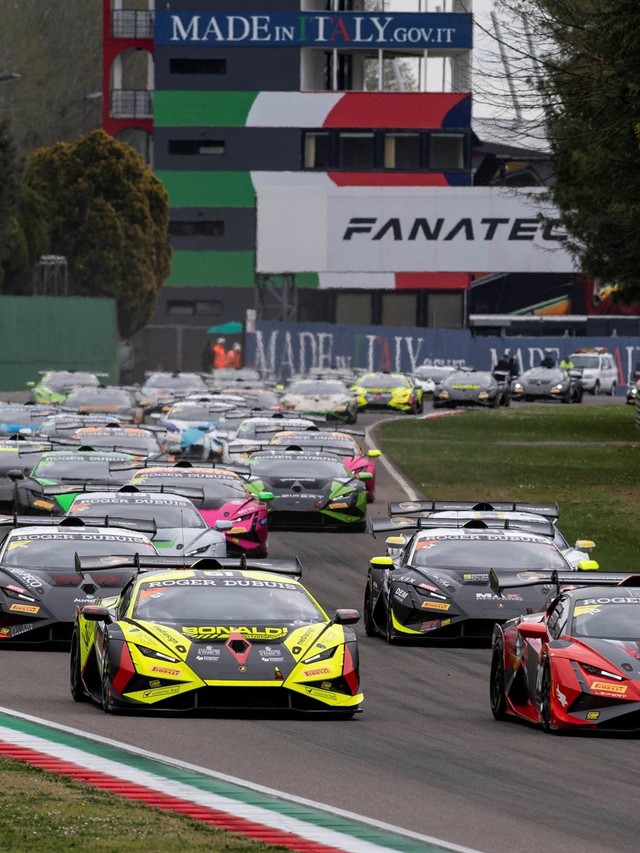
A Weekend That Delivered Two Stories at Once
Laguna Seca’s 2.238-mile ribbon of asphalt, famous for its blind-crest Corkscrew and relentless elevation changes, served as the final domestic round of the 2017 Lamborghini Super Trofeo North America season. What unfolded across Rounds 9 and 10 produced a weekend worth remembering for one overarching reason: the Super Trofeo proved it could generate genuine competitive chaos while simultaneously pointing toward its own future.
Austin Versteeg, a Pro-Am competitor driving the No. 7 DXDT Racing entry for Lamborghini Dallas, claimed overall victories in both races to complete a clean sweep. An Amateur driver landed on the overall podium. And away from the racing surface, Lamborghini chose this same event to give North American audiences their first look at the 2018 Huracán Super Trofeo EVO, the car that would reshape the series the following spring. Twenty-one Huracáns took the green flag for Race 1 on Friday morning. By the time the checkered flag fell, the result sheet told a story that no pre-race prediction would have scripted, and the EVO reveal signaled that Lamborghini saw its one-make platform not as a static hospitality exercise but as a machine worth continuously developing.
How Versteeg Won Race 1: Strategy, Patience, and a Rival’s Mistake
Pole position belonged to Trent Hindman in the No. 1 Prestige Performance car, which he shared with Pro co-driver Riccardo Agostini. Lamborghini says Versteeg started fourth but dropped to seventh in opening-lap traffic, a deficit that on Laguna Seca’s narrow, low-grip surface could easily become permanent. Instead, he worked his way back through the field before the mandatory pit window and emerged from his stop locked onto Agostini’s rear wing.
The decisive moment arrived on Lap 25 of the 50-minute sprint. A full-course caution, triggered when the No. 57 Amateur entry of Pippa Mann and Shea Holbrook lost a wheel and retired, compressed the field with roughly five minutes remaining. Officials called a Green and White flag restart, turning a race that Agostini appeared to control into a single-lap shootout.
Versteeg described the situation plainly:
“I knew if it went green we had to get it done right away because Agostini is a great driver. This track is very hard to pass on, especially when the tire is at the end of its life. We had a great restart, but then he had a little bobble on the brakes and we were able to take advantage of it.”
Agostini’s braking error on the restart cost him dearly. He and Hindman ultimately finished 12th. Versteeg’s victory marked his fourth consecutive Pro-Am class win and his second overall triumph of the season. According to one report, he followed it up by winning Race 2 on Sunday as well, completing a sweep that kept his championship challenge alive.
Laguna Seca punishes aggression with its lack of overtaking zones, and tire degradation in the closing laps narrows the window for clean passes even further. Versteeg’s approach, conserving enough tire life to be quick on a restart while staying close enough to exploit any error, is the kind of racecraft that separates consistent winners from occasional podium visitors. That a Pro-Am driver executed it against outright Pro entries speaks directly to the competitive structure Squadra Corse built into this series.
The 2018 Huracán Super Trofeo EVO: Lamborghini’s Next Chapter for Customer Racing
The race results were only half the weekend’s significance. One report confirms that the 2018 Huracán Super Trofeo EVO made its North American public debut during pre-race ceremonies at Laguna Seca, timed to coincide with the IMSA WeatherTech SportsCar Championship event at the same venue. Lamborghini chose its audience carefully: the paddock was full of team principals, prospective customer racers, and the kind of motorsport insiders who would evaluate the car with professional eyes.
The EVO featured entirely redesigned aerodynamics, new safety devices, and improvements to both its mechanical and electronic systems. Specific technical details beyond those broad categories remain limited in the available material, but the direction was clear. Lamborghini was signaling that the Huracán racing platform, already competitive enough to produce the kind of close, multi-class battles seen at Laguna Seca, would receive a meaningful mid-cycle evolution rather than a cosmetic refresh. The car was slated to make its competitive track debut across all three continental Super Trofeo series (Europe, Asia, and North America) in spring 2018.
For teams already running the LP 620-2 Super Trofeo, the EVO announcement carried practical weight. Revised aerodynamics typically change braking points and corner-entry behavior, meaning teams would need to recalibrate their setups and driver coaching. The safety improvements also mattered: one-make series attract gentlemen drivers alongside professionals, and any enhancement to crash protection lowers the barrier for new entrants who might otherwise hesitate. Revealing the car at the very event where a Pro-Am driver and an Amateur had just upended the expected order was, intentionally or not, the strongest possible argument for the platform’s accessibility.
Amateur Podiums and the Competitive Ecosystem That Produces Them
Versteeg’s overall win overshadowed another result that reinforced the same thesis. Amateur competitor Yuki Harata, driving the No. 55 for Dream Racing Motorsport and Lamborghini Las Vegas, used the same chaotic final-lap restart to vault from sixth to third overall, winning the Amateur class in the process. Lamborghini says Harata was genuinely surprised by the result: “I didn’t know about being on the overall podium but it was just an amazing race.”
An Amateur driver finishing on the overall podium, ahead of multiple Pro and Pro-Am entries, is not common in any one-make series. The Super Trofeo’s class structure (Pro, Pro-Am, Amateur, and Lamborghini Cup) creates separate competitive ecosystems within a single grid, but the overall classification still rewards raw pace regardless of category. Harata’s result illustrates why the late-race restart format can be both controversial and compelling: it compresses gaps earned over 25 laps into a single braking zone, rewarding opportunism as much as outright speed.
In the Lamborghini Cup, JC Perez continued a dominant 2017 campaign with his sixth class victory, building a 123-point championship lead in his No. 71 P1 Motorsports entry. Perez described a calculated approach: he built a gap of roughly 20 seconds to second place and then managed his pace rather than pushing further. The series also welcomed Toro Loco by MTech, a European Super Trofeo team making its North American debut, which secured a third-place LB Cup finish with Peter Aaronson on its first outing. From Versteeg at the top to Aaronson on his debut, the grid told a consistent story about a series that rewards participation across every level of experience.
The Huracán Super Trofeo’s Engineering and What It Means for Close Racing
The car underneath all 21 entries at Laguna Seca, the Huracán LP 620-2 Super Trofeo, uses the road car’s 5.2-liter V10 direct-injection engine managed by a MoTeC control unit. Lamborghini says it produces 620 horsepower. The chassis is a hybrid carbon-fiber and aluminum construction with modified geometry to accommodate a larger front radiator and a racing gearbox at the rear, changes that also improve aerodynamic efficiency.
One-make series live or die on parity. If the cars are too different, the racing becomes processional; if they are identical but fragile, reliability decides championships rather than talent. The Huracán Super Trofeo sits in a productive middle ground. The V10 provides enough power to make Laguna Seca’s elevation changes genuinely challenging (Versteeg noted the track’s low grip and the difficulty of managing rear tires), while the spec nature of the car ensures that driver skill, pit-stop execution, and strategic decisions determine outcomes. That balance is precisely what allowed a Pro-Am driver to beat the Pros outright and an Amateur to reach the overall podium on the same afternoon.
Ferrari’s Challenge series and Porsche’s various one-make championships serve similar functions as customer-racing entry points and brand-loyalty tools. What distinguished the Laguna Seca weekend was the combination of competitive unpredictability with a forward-looking product reveal. Lamborghini was simultaneously demonstrating that its current car produced compelling racing and previewing the machine that would raise the standard further.
Super Trofeo as Brand Strategy: From Laguna Seca to the Temerario GT3
The 2017 Laguna Seca event represented the final U.S. stop before the season’s World Final at Imola, and Lamborghini treated it as a stage for both competitive drama and commercial messaging. VIP hospitality in the Lamborghini Village remained part of the weekend’s fabric, connecting dealer networks and prospective buyers to the racing program in a way that pure motorsport events rarely achieve.
Viewed from a broader perspective, the Super Trofeo series functions as the bottom rung of a customer-racing ladder that Squadra Corse continues to build. The Huracán’s progression from the original LP 620-2 to the EVO (and later the EVO2) mirrored the road car’s own evolution, creating a feedback loop between track development and showroom product. That same philosophy now extends to the Temerario GT3, which Autoblog reports is Lamborghini’s first competition car fully designed, developed, and built in-house.
The Laguna Seca weekend offered a useful data point for anyone weighing entry into customer racing with a Lamborghini. The grid attracted 21 cars across four classes, the racing produced genuine drama rather than predetermined outcomes, and the EVO reveal confirmed that Lamborghini intended to keep investing in the platform. The cost of competing remains a question the official material does not address, but the competitive product and the series infrastructure are clearly being treated as long-term commitments. When a Pro-Am driver can sweep an entire weekend and an Amateur can stand on the overall podium, the series is doing exactly what Squadra Corse designed it to do: making the racing close enough that talent, not budget, writes the headlines.
Gallery


