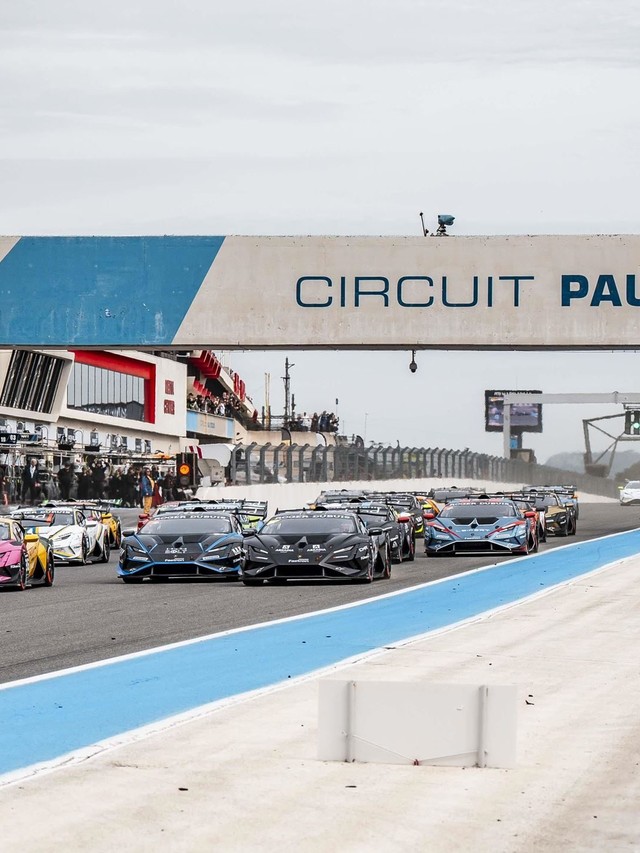
The 2019 Super Trofeo North America Finale: A Look Back at Jerez
Three of the four class championships still hung in the balance when the 2019 Lamborghini Super Trofeo North America season reached its final two 50-minute races at Spain’s Circuito de Jerez. Across the 13-turn, 2.751-mile circuit, consistency mattered more than outright heroics, and the results would determine which teams carried momentum into the Super Trofeo World Finals held on the same track just days later.
Six years on, the 2019 finale reads as more than a tidy conclusion to a regional championship. It captured the Huracán Super Trofeo EVO at the peak of its competitive life, a car that gave Lamborghini’s Squadra Corse division the credibility and operational knowledge it needed to pursue something far more ambitious: building a GT3 car entirely in-house. The champions crowned at Jerez that weekend were products of a customer racing ecosystem Lamborghini had spent a decade constructing, one that continues to define the brand’s motorsport identity.
Champions Crowned: The Teams and Drivers Who Dominated
Corey Lewis and Richy Antinucci, driving the No. 129 Change Racing entry backed by Lamborghini Charlotte, clinched the Pro Class championship with a third-place finish in the second race. They didn’t need a flashy victory to seal it. They needed to survive, and they did. “This was a total team effort,” Lewis said afterward. “We were able to keep the points where they needed to be, and it came down to the wire. Richy did a great job today, and all season long.” Antinucci echoed the sentiment: “I tried to stay focused my entire stint. There was a lot to manage while I was in the car.” The No. 127 Dream Racing, Lamborghini Dallas car, co-driven by Cedric Sbirrazzouli and Paolo Ruberti, took the Race 2 win from start to finish, but the championship math favored Lewis and Antinucci.
The Pro Class fight carried real tension. Sandy Mitchell and Andrea Amici, representing Prestige Performance and Wayne Taylor Racing under the Lamborghini Paramus banner, won Race 1 by nearly ten seconds after a brilliant pit stop sequence vaulted them ahead. Their Race 2 effort collapsed before it started: an oil pressure issue forced the No. 101 car off the grid and into the paddock for repairs. They recovered to finish fourth but could not close the points gap.
McKay Snow locked up the Am Class title in Race 1 with a second-place finish in the No. 163 Change Racing, Lamborghini Charlotte car. Mel Johnson, racing the No. 108 for GMG Racing and Lamborghini Newport Beach, secured the LB Cup crown after a fourth-place result. The Pro Am Class was already settled before anyone arrived in Spain: Damon Ockey and Jacob Eidson, in the No. 109 US RaceTronics, Lamborghini Vancouver entry, had wrapped up the title earlier in the season. They won their eleventh race by over a minute from their nearest class rival, just to underline the point.
Steven Aghakhani, then just 16 years old, swept both Am Class races at Jerez for his fourth and fifth wins of the season. For anyone tracking the pipeline of young talent Lamborghini’s customer racing program feeds, Aghakhani’s 2019 results were an early signal.
The Dealer-Backed Racing Model That Made It Work
More than any single result, the 2019 finale showcased the dealer-backed team structure that underpins the entire Super Trofeo series. Change Racing and Lamborghini Charlotte didn’t just take the Pro and Am driver titles. They also earned the Team and Dealer championships, a clean sweep that demonstrated how deeply the dealership network was embedded in Lamborghini’s competition strategy.
Lamborghini Charlotte’s involvement through Change Racing was not a passive sponsorship arrangement. It was an operational commitment: cars, logistics, engineering support, and the kind of continuity that lets drivers build confidence across a full season. Prestige Performance, aligned with Wayne Taylor Racing, offers another example. The team entered the Super Trofeo North America series in 2015 and, according to multiple reports, achieved a historic sweep of all four available championships in the 2016 season. By 2019, they remained a front-running operation, with Mitchell and Amici’s Race 1 victory at Jerez proving the team’s depth even when mechanical gremlins struck in Race 2.
For prospective buyers considering a Super Trofeo program, this dealer-team relationship is the practical takeaway. You are not buying a race car and figuring it out alone. You are buying into a support network that Lamborghini has refined over more than a decade.
The Huracán Super Trofeo EVO: The Machine Behind the Results
Every car on the 2019 grid was a Huracán Super Trofeo EVO, Lamborghini’s dedicated one-make racer built around the naturally aspirated V10 platform. In a one-make series, the car becomes the constant, and the variables are the teams, the drivers, and the preparation. The EVO’s role was to deliver a consistent, predictable platform that rewarded driver skill and team execution over engineering arms races.
That philosophy proved itself at Jerez. The margins between winners and losers were often measured in pit stop strategy, tire management, and racecraft rather than raw mechanical advantage. Sbirrazzouli’s Race 2 win came from managing tire degradation early to build a gap before the pit window. Mitchell’s Race 1 triumph was decided by a faster pit stop that leapfrogged the No. 127.
The Huracán Super Trofeo EVO2 race car later debuted in North America in 2022, carrying forward the platform’s core philosophy with aerodynamic and safety refinements. One listing spotted a 2020 Huracán Super Trofeo EVO with only 84 miles on the odometer, a reminder that some of these machines barely saw competitive use before the next evolution arrived.
From Regional Glory to the World Finals Stage
All 16 Super Trofeo North American entries at Jerez were set to compete in the World Finals immediately following the regional finale, also at the same circuit. The World Finals represent the culmination of Lamborghini’s regional series across North America, Europe, and Asia, bringing together the strongest teams from each continent for a global showdown.
Jacob Eidson’s comments after the finale captured the mindset: the regional title was secured, but the real test was the next two days. For teams like US RaceTronics, the World Finals offered a chance to measure themselves against international competition, a proving ground that regional success alone cannot replicate.
A Foundation for the Temerario GT3 and What Comes Next
The 2019 season sits at a meaningful inflection point in Lamborghini’s motorsport timeline. The Huracán Super Trofeo EVO gave Squadra Corse a decade of operational experience running a global customer racing series, managing hundreds of privateer teams, and refining the logistics of dealer-backed competition. That institutional knowledge is now being channeled into something new.
Lamborghini’s first fully in-house designed and built competition car, the Temerario GT3, was unveiled at the 2025 Goodwood Festival of Speed. The all-new Temerario Super Trofeo is slated for its global track debut in 2027. Where the Huracán era relied on Dallara for chassis construction, the Temerario program represents Lamborghini building its own racing future from the ground up.
The connection to 2019 is direct. The teams, the dealer relationships, the driver development pathways, and the competitive infrastructure that crowned Lewis, Antinucci, Snow, Johnson, Ockey, and Eidson as champions are the same structures that will support the Temerario’s competition debut. Lamborghini’s customer racing program did not begin with the Temerario GT3, but seasons like 2019 are the reason it can exist at all.
Gallery


