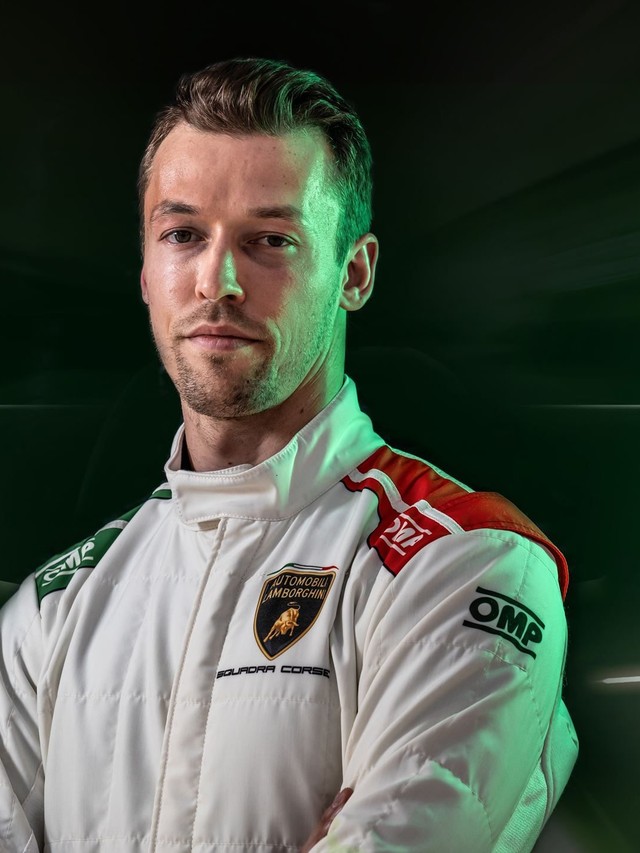
Kvyat Joins Lamborghini’s LMDh Factory Driver Roster
Lamborghini Squadra Corse has named former Formula 1 driver Daniil Kvyat an official factory driver, recruited specifically to accelerate development of the brand’s LMDh prototype. His 2023 program centers on extensive testing of the car that will become the SC63, with a competitive race debut planned for 2024 in both the FIA World Endurance Championship and the IMSA WeatherTech SportsCar Championship alongside the Lamborghini Iron Lynx operation.
Kvyat slots into a factory lineup that already includes Mirko Bortolotti, Andrea Caldarelli, and Romain Grosjean. Two of those four names are former F1 drivers, a ratio that reveals how Lamborghini views the talent required to bring a brand-new prototype up to speed against manufacturers who already know their way around the Hypercar class. This roster is being assembled to compress a learning curve, not simply to fill seats.
Parallel to his prototype testing duties, Kvyat competes in the 2023 WEC season with PREMA Racing in the LMP2 class, sharing the car with fellow factory driver Bortolotti and Iron Dames driver Doriane Pin. The LMP2 campaign serves a dual purpose: race sharpness in endurance conditions and direct exposure to the WEC paddock’s operational rhythms before the prototype arrives on the grid.
Why F1 Experience Translates to Prototype Development
Whenever a former single-seater driver moves to sportscars, the obvious question surfaces: does sprint racing experience actually help develop a prototype? The short answer is yes, though not for the reasons most people assume.
Kvyat accumulated 110 F1 starts across six seasons, from his promotion to Scuderia Toro Rosso through stints at Red Bull Racing and back again. He finished second at the 2015 Hungarian Grand Prix and took third at the 2019 German Grand Prix. Those results matter less here than what produced them. F1 drivers operate in an environment where the feedback loop between cockpit and engineering room is relentlessly detailed. Every session generates gigabytes of data, and the driver’s ability to articulate what the car is doing, in precise engineering language, determines how quickly the team finds performance.
That skill is exactly what a new LMDh program needs most. When a prototype is still being homologated, the engineers are not chasing tenths in qualifying trim. They are mapping the car’s behavior across a wide operating window: fuel loads from full to empty, tire degradation curves across multiple stints, hybrid deployment strategies under varying track conditions. A driver who can describe understeer onset at turn entry versus mid-corner versus exit, and correlate that to specific setup changes, compresses months of development into weeks. Giorgio Sanna, Head of Motorsport at Lamborghini Squadra Corse, framed it directly:
“Daniil’s main role with us will be working closely with our engineers and mechanics on the prototype car which will debut next year and given his vast experience in other racing categories, I have no doubt that he will play a crucial part in us hitting the ground running in 2024.”
The phrase “hitting the ground running” is doing real work in that sentence. Lamborghini knows the 2024 grid will include manufacturers with years of Hypercar-class experience already banked.

Daniil Kvyat stands confidently in his racing suit, flanked by the striking silhouette of the Lamborghini SC63.
Competing Against Ferrari and Porsche in the Hypercar Class
Lamborghini’s LMDh entry does not arrive into a vacuum. Ferrari returned to the top class of endurance racing with the 499P and promptly won Le Mans. Porsche fields the 963 LMDh across both WEC and IMSA with multiple factory-backed entries. Toyota, Peugeot, and Cadillac round out a Hypercar/GTP grid that represents the most competitive era of prototype racing in decades.
What separates the established programs from newcomers is institutional knowledge. Ferrari’s endurance racing operation benefits from decades of accumulated data and relationships. Porsche’s customer racing infrastructure feeds directly into its factory prototype effort. Lamborghini, by contrast, built its modern motorsport reputation primarily through GT3 racing with the Huracán platform. The jump from customer GT3 to factory LMDh prototype is enormous: different regulations, different tire suppliers, different hybrid architectures, and a Balance of Performance system that rewards consistency and efficiency as much as raw pace.
Recruiting drivers with F1-caliber technical communication skills is one of the clearest ways to close that institutional gap quickly. Ferrari’s 499P program also draws on drivers with single-seater backgrounds, and Porsche’s lineup blends Le Mans veterans with younger talent developed through its own junior programs. Lamborghini’s approach of pairing established GT specialists like Bortolotti and Caldarelli with F1 graduates like Kvyat and Grosjean mirrors the competitor playbook, but the mix leans more heavily on F1 pedigree than most rivals.
The competitive question for anyone following this program is straightforward: can Lamborghini’s combination of Ligier chassis partnership, Iron Lynx team operations, and F1-trained driver feedback produce a car capable of fighting at the front within its first two seasons? Nobody knows yet, but the driver talent assembled suggests the ambition is genuine.
The Iron Lynx Partnership and Team Architecture
The operational structure behind Lamborghini’s LMDh effort deserves attention because it differs from how most people picture a factory racing program. Lamborghini designs and develops the SC63 (reportedly in conjunction with Ligier Automotive, according to Motorsport.com), but the race team itself is Iron Lynx, the Italian outfit that previously campaigned Ferraris in GT racing before becoming Lamborghini’s chosen partner for the prototype class.
One source notes that PREMA Racing, where Kvyat competes in LMP2 during 2023, is majority-owned by Iron Lynx’s parent company, DC Racing Solutions. PREMA also reportedly serves as a technical partner for the LMDh development and race program. The corporate connections create a tighter operational ecosystem than the public-facing team names suggest. Kvyat racing LMP2 with PREMA while testing the LMDh prototype for Lamborghini is not a coincidence of scheduling; it is an integrated development pathway where endurance racing experience and prototype testing feed the same engineering pipeline.
Kvyat himself acknowledged the personal dimension of the move. Having spent much of his youth in Rome, Lamborghini says, he will compete under an Italian racing license. For a brand that trades on Italian identity as a core part of its appeal, that detail carries more weight than it might appear on paper.

Daniil Kvyat walks through a vibrant Lamborghini showroom, surrounded by an impressive collection of supercars.
What Comes Next for Kvyat and the SC63 Program
The 2023 testing calendar represents the quiet, unglamorous phase of any new racing program. Kvyat will spend the balance of the year accumulating laps, refining setup baselines, and stress-testing systems that need to survive 24-hour races. His podium at Sebring during his WEC debut with PREMA already demonstrated that the transition from sprint to endurance racing suits his driving style.
The competitive debut in 2024 across both WEC and IMSA will be the first real benchmark. Running a new prototype in two of the world’s most demanding championships simultaneously is an aggressive strategy that maximizes data collection and exposure but also doubles the logistical burden and the risk of public teething problems. Enthusiast forum discussion around the SC63 reflects genuine excitement about Lamborghini’s commitment, with multiple fans on Lamborghini-Talk describing the car as impressive while acknowledging the scale of the challenge ahead.
For buyers and brand followers, the LMDh program matters beyond the racetrack. Lamborghini’s hybrid road car strategy, from the Revuelto’s V12 hybrid powertrain to the Temerario’s twin-turbo V8 system, runs parallel to the hybrid technology being developed for the SC63. Racing validates engineering under the most punishing conditions imaginable, and the lessons learned at Le Mans and Daytona will eventually filter into the cars sitting in dealer showrooms. Kvyat’s role in that process is specific and measurable: make the SC63 faster, more reliable, and more competitive through the kind of precise technical feedback that only 110 Grands Prix can teach a driver to deliver.

Daniil Kvyat, a new Lamborghini factory driver, poses for a portrait amidst the brand's iconic vehicles.
Gallery


