Bologna Honors the Mind Behind Modern Lamborghini
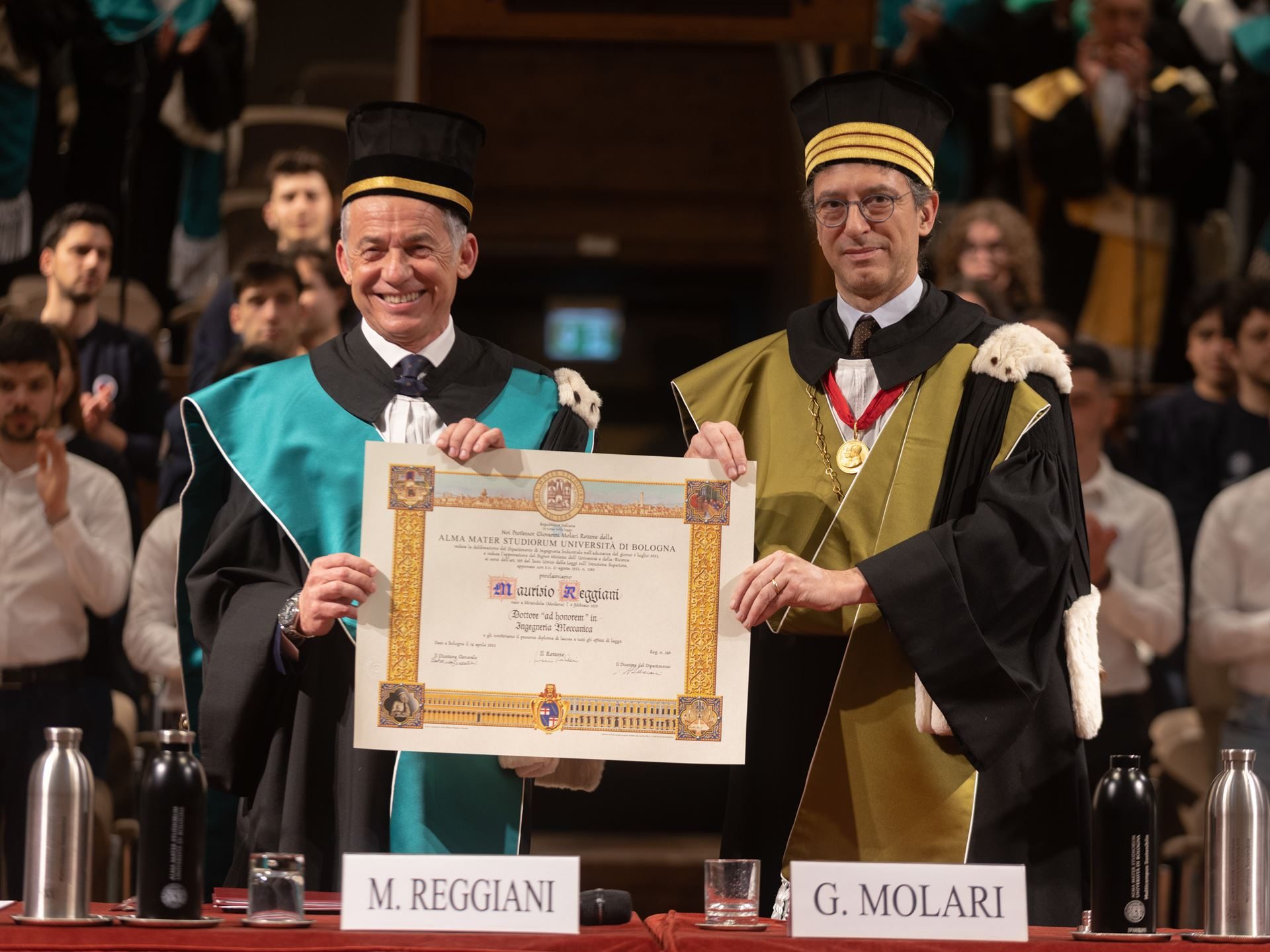
On April 14, 2023, the University of Bologna awarded Maurizio Reggiani an honorary degree in Mechanical Engineering, recognizing a forty-year career that transformed Lamborghini from a charismatic but financially precarious supercar maker into a technically formidable engineering house. The ceremony, held in the Santa Lucia auditorium before nearly 500 guests, carried a detail most coverage overlooked: this was the first time the university conferred this specific distinction in mechanical engineering since honoring Enzo Ferrari 62 years earlier.
That comparison tells you something about how Italian academia views Reggiani’s contribution. Lamborghini Chairman and CEO Stephan Winkelmann attended the ceremony, framing the degree not as a retirement gift but as acknowledgment of a still-active career. Reggiani served fifteen years as Lamborghini’s Chief Technical Officer before transitioning to his current role as Vice-President of Motorsport in 2022. The degree celebrates both chapters, and the thread connecting them is a singular obsession with composite materials and structural innovation that gave Lamborghini an engineering identity distinct from its rivals.
From 60 Engineers to 300: Building the R&D Machine That Made the Patents Possible
Reggiani arrived at Lamborghini in 1995 as Head of the Technical Mechanical Department, when the company was still finding its footing after years of ownership turmoil. He took an active part in Lamborghini’s transition under Audi’s control in 1998, and by the time he was named CTO and Board of Management member in 2006, the groundwork for a genuine engineering transformation was in place.
The scale of that transformation is easy to understate. Lamborghini says Reggiani grew the R&D department from 60 people to more than 300 during his tenure. That is the difference between a boutique operation relying on supplier partnerships for core development and an in-house engineering center capable of designing proprietary powertrains, chassis architectures, and materials science programs. Rivals like Ferrari and McLaren invested in similar internal capabilities, but Reggiani’s expansion happened during a period when Lamborghini still needed to prove it could stand alongside those names on technical merit, not just theatrical presence.
Critically, he built the academic partnerships that fed his composite material ambitions. In 2008, he helped establish the Advanced Composite Structures Laboratory (ACSL) at the University of Washington in Seattle, creating a research partnership between Lamborghini and Boeing. Collaborations with MIT followed in 2017, focused on future super sports car technologies. These were not vanity affiliations. The ACSL work fed directly into Lamborghini’s composite material programs, and the MIT partnership explored energy storage and material concepts that inform the hybrid era the company now inhabits.

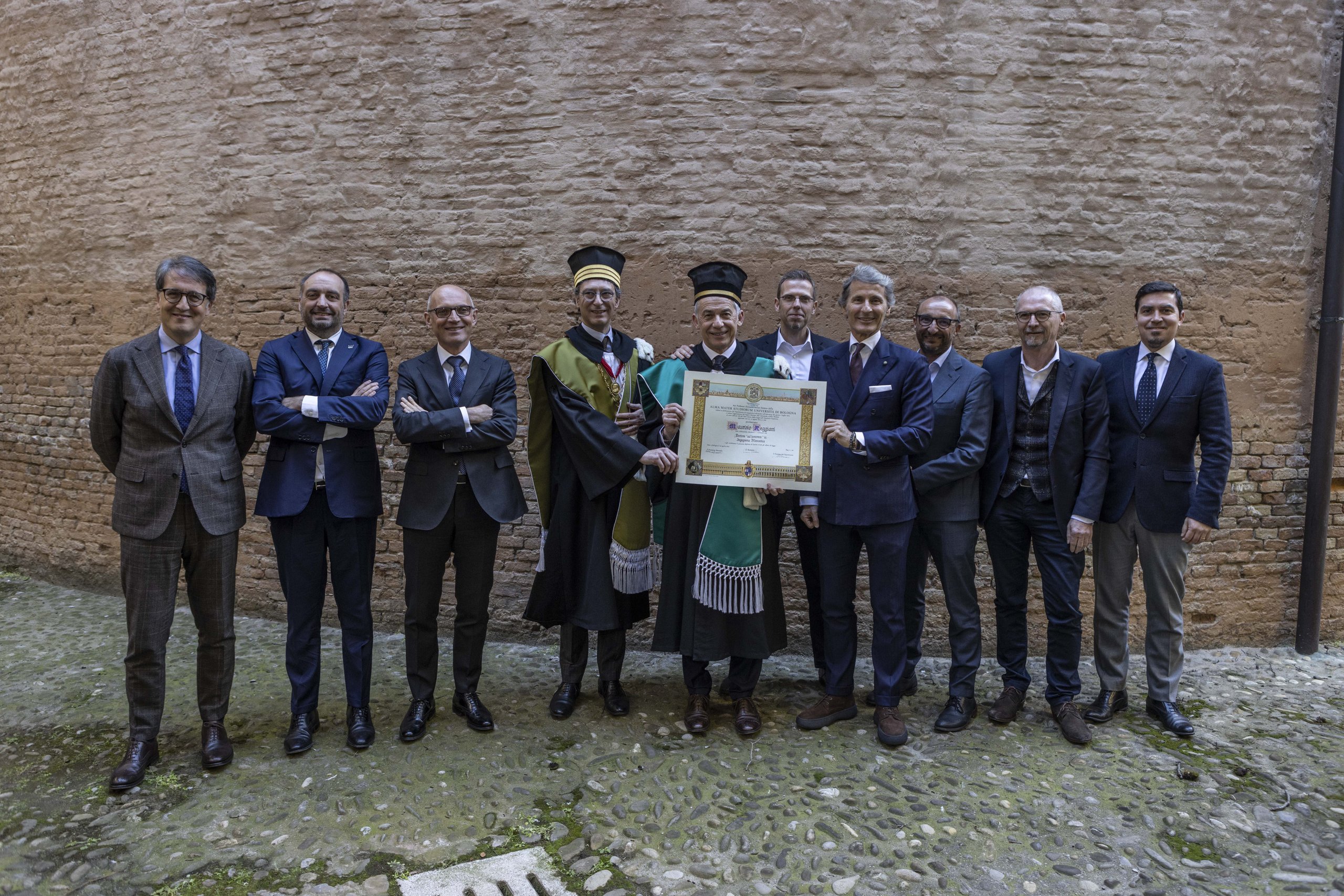
Maurizio Reggiani proudly displays his honorary degree certificate with two colleagues.
The Composite Revolution: Forged Carbon and 160 Patents
All those researchers, all those university labs, converged on a single technical frontier: composite materials. During his time as CTO, Reggiani’s work in this field contributed to more than 160 patent filings, a number that puts Lamborghini in rare company among low-volume manufacturers. But the real story is what those patents enabled.
One report describes a key development under Reggiani’s leadership: Forged Composite technology, an advanced compression molding technique using carbon fiber sheet molding compounds. The Sesto Elemento used it for its monocoque and suspension arms. The goal was to make complex composite parts faster and cheaper to produce than traditional carbon fiber layup, which matters enormously for a company building hundreds rather than tens of thousands of units per year. That same research pushed into even more exotic territory, with Lamborghini developing carbon fiber connecting rods lighter than conventional steel units to improve engine response.
For buyers, this work shows up in ways that are easy to take for granted. The Aventador’s carbon fiber monocoque, the Huracán Performante’s active aerodynamic system (which earned an Innovation Award), and the structural efficiency of the Urus all trace back to an R&D culture Reggiani built. When enthusiasts debate whether Lamborghini competes on engineering substance or just visual drama, the patent portfolio is a concrete rebuttal.
The Cars He Shaped: Reggiani’s Fingerprints Across the Lineup
Reggiani’s influence spans the Murciélago, Gallardo, Aventador, Huracán, and Urus, covering essentially every production Lamborghini from the early 2000s through the end of the naturally aspirated era. His accolades reflect that breadth: the Five Diamond Engineering Award for the Aventador, the Innovation Award for the Huracán Performante, plus two Caschi d’Oro (Golden Helmet) awards for motorsport work. Motor Trend recognized him for two consecutive years as one of the fifty most influential people in the global automotive industry.
One report suggests the Huracán became the best-selling Lamborghini of all time during its production run. If accurate, that distinction belongs to a car developed entirely under Reggiani’s technical leadership. The Urus, another product of his CTO years, may eventually surpass it. Either way, the commercial success of these models funded Lamborghini’s ability to invest in the hybrid technology now powering the Revuelto and Temerario. Engineering credibility and sales volume reinforced each other, and Reggiani sat at the center of that loop.
His career before Sant’Agata Bolognese also shaped the engineer Bologna chose to honor. He began at Maserati in 1982, contributing to the Biturbo engine program, then moved to Bugatti in 1987 where he oversaw the powertrain and transmission development of the EB110. Working on that quad-turbo V12 gave Reggiani direct experience with forced induction and advanced drivetrain packaging decades before the rest of the supercar world caught up.

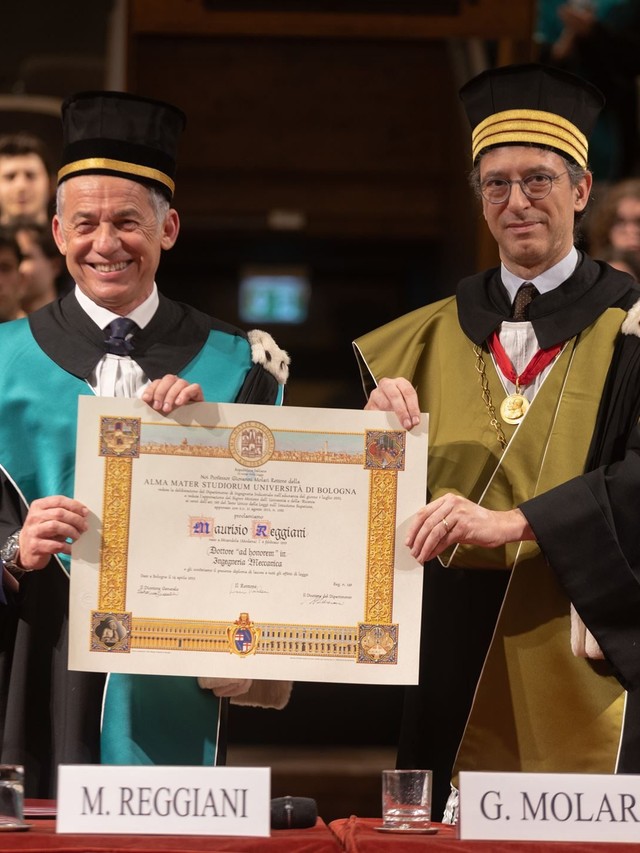
Maurizio Reggiani shakes hands with G.
Motorsport, Eccentrica, and What Comes Next
Reggiani’s 2022 appointment as Vice-President of Motorsport signals where Lamborghini sees his value now. The company’s racing ambitions are expanding, and the transition from the Huracán-based GT3 platform to the Temerario-based successor requires exactly the kind of structural and materials expertise Reggiani spent decades accumulating. How hybrid regulations reshape customer racing programs remains an open question across the industry, but Lamborghini positioned someone with deep powertrain development experience to lead that transition.
Outside Lamborghini, Reggiani serves as an advisor at Eccentrica, a company developing a restomod version of the Lamborghini Diablo. That project connects his engineering philosophy to the brand’s heritage in a different way, applying modern materials knowledge and production techniques to a car that defined Lamborghini’s visual identity in the 1990s. Specific production details and pricing for the Eccentrica Diablo remain unconfirmed.
The University of Bologna’s recognition places Reggiani in a lineage that includes Enzo Ferrari. For Lamborghini enthusiasts, the practical takeaway is simpler: the engineering infrastructure, patent portfolio, and academic partnerships that underpin every current Lamborghini model trace back to decisions one person made over fifteen years as CTO. That foundation does not disappear when the title changes. It compounds.

Maurizio Reggiani holds his honorary degree as two academics applaud during the ceremony.
Gallery