A Double Weekend for Lamborghini on Two Continents
Forte Racing Powered by USRT pulled off one of the more improbable GTD victories of the 2023 IMSA season at Petit Le Mans, and the result tells a larger story than a single trophy. On the same weekend, Imperiale Racing secured the Italian GT Endurance Cup finale at Vallelunga. Two customer teams, two different continents, two wins for the Huracán GT3 EVO2, and in both cases the victories were earned through adversity rather than dominance.
At Road Atlanta, drivers Loris Spinelli, Misha Goikhberg, and Patrick Liddy started 11th on the GTD grid and absorbed three separate drivethrough penalties over the course of the 10-hour race before crossing the line first. In Italy, Stuart Middleton, Raúl Guzman, and Kevin Gilardoni were promoted to victory after a 10-second post-race penalty dropped the leading Ferrari behind their Imperiale Racing entry. Neither result came easy, and neither was handed to Lamborghini.
The Petit Le Mans result carries particular weight. Lamborghini says this was the brand’s first IMSA WeatherTech Sports Car Championship victory since Long Beach in 2021, and the first ever for Forte Racing in the series. For a team that graduated from Lamborghini Super Trofeo North America to GT3 competition only at the start of 2023, winning one of American endurance racing’s marquee events in their debut season validates the entire customer racing pipeline that Squadra Corse has spent years building.
How Forte Racing Won a Race It Kept Losing
The raw sequence of events at Road Atlanta reads like a stress test designed to break a team’s composure. After climbing from 11th to fourth within the opening hour, the #78 Huracán GT3 EVO2 looked like a legitimate contender. Then the penalties started.
Lamborghini’s account describes Spinelli receiving a drivethrough for changing lanes during a restart procedure. A second drivethrough followed contact with an Aston Martin. A pit-stop infringement triggered the third. Two of these penalties arrived inside the final two hours, the portion of an endurance race where clean execution matters most.
What saved Forte Racing was the stop-start character of the race itself. Multiple full-course yellow periods compressed the field repeatedly, allowing the #78 crew to claw back positions and, critically, save enough fuel to assume the lead inside the final hour. Spinelli then held off a charging Porsche driven by Jan Heylen, which subsequently retired in the closing stages. The combination of relentless pace, smart fuel management under caution, and a car that stayed competitive despite repeated trips through pit lane tells you something about both the team’s composure and the Huracán GT3 EVO2’s mechanical durability over a 10-hour distance.
One detail worth noting: web research suggests the Lamborghini appeared to gain a performance advantage as night fell and track temperatures dropped, with the car reportedly coming into its own in cooler conditions. Whether that reflects a deliberate setup choice or inherent tire behavior, it points to the kind of strategic depth that separates a lucky result from a deserved one.

The Lamborghini Huracán GT3 Evo navigates a challenging turn on the racetrack during the race.
From Super Trofeo to IMSA: The Ladder That Actually Works
Forte Racing’s trajectory illustrates something Lamborghini rarely gets enough credit for: a customer racing ladder that produces real results at the top level. The team, founded as US RaceTronics by Shane Seneviratne, transitioned to Lamborghini Super Trofeo in 2015 and won multiple North American and World Championships before stepping up to GT3 competition for 2023.
That progression matters because GT3 racing is brutally competitive. The GTD grid at any IMSA round features factory-supported Porsche, Mercedes-AMG, BMW, Aston Martin, and Ferrari entries alongside customer programs. A team arriving from a one-make series and winning a flagship endurance race in its first full season is the strongest possible endorsement of the ecosystem Squadra Corse built around the Super Trofeo platform. The one-make series teaches teams how to operate Lamborghini hardware under race conditions, build relationships with the factory, and develop driver talent. Forte Racing proved the pathway leads somewhere concrete.
The 2023 season as a whole reflected steady improvement. Spinelli took an outright pole position, beating both GTD and GTD Pro cars, at the 6 Hours of Watkins Glen in June. He and Goikhberg finished second at the Indianapolis sprint race in September. Forte Racing concluded the GTD championship in fifth place, a credible result for a first-year program. Multiple enthusiast communities followed the team closely during the season, with forum and social media discussion highlighting the distinctive livery and the car’s dramatic exhaust flames as fan favorites on the IMSA grid. That kind of grassroots enthusiasm is something money alone cannot buy.

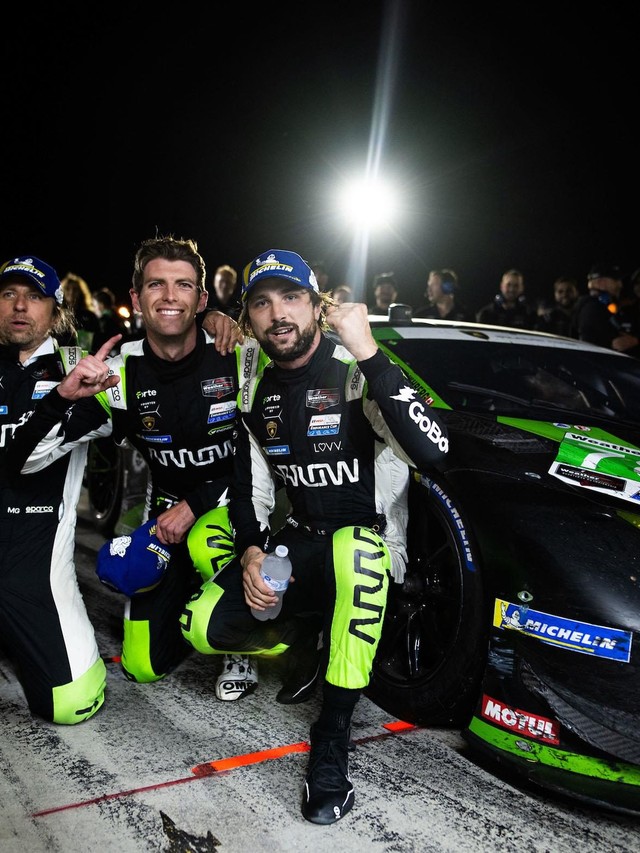
The victorious team celebrates their win alongside their Lamborghini Huracán GT3 Evo in the pit lane.
The Huracán GT3 EVO2 Against the Field
GT3 class racing operates under Balance of Performance regulations designed to equalize the field, so no single manufacturer should hold a persistent engineering advantage. What separates winners from the rest is reliability over distance, team execution, and the ability to extract performance from the allowed window.
The Huracán GT3 EVO2’s naturally aspirated V10 architecture gives it a character distinct from the turbocharged competition. Porsche’s 911 GT3 R, Mercedes-AMG’s GT3, and Ferrari’s 296 GT3 all rely on forced induction, which can complicate fuel strategy and heat management over long stints. A naturally aspirated engine delivers more predictable power delivery and, in theory, fewer thermal management headaches during a 10-hour race. Whether that contributed directly to Forte Racing’s ability to stay competitive despite three penalty-induced pit lane detours is impossible to isolate, but the car’s consistency across the full distance speaks for itself.
Petit Le Mans also represents Lamborghini’s sixth major American endurance victory, following three Daytona 24 Hours wins (2018, 2019, 2020) and two Sebring 12 Hours victories (2018, 2019). That record in the United States, the world’s largest supercar market, carries commercial weight well beyond the trophy cabinet. Every GT3 win on American soil reinforces the brand’s credibility with the exact audience most likely to buy a Huracán or Revuelto.
Imperiale Racing’s Vallelunga Victory and the Bigger Picture
The Italian GT Endurance Cup result at Vallelunga deserves more than a footnote, because it reinforces the same thesis from a different angle. Imperiale Racing’s trio of Middleton, Guzman, and Gilardoni started second, with Gilardoni working into the lead before a collision with Tommaso Mosca’s Ferrari dropped them back to second on the road. A post-race 10-second penalty applied to the Ferrari promoted Imperiale to the top step.
Winning on a technicality is never as satisfying as crossing the line first, but the result still counts in championship standings and confirms the Huracán GT3 EVO2‘s competitiveness across different racing environments, from the high-speed sweeps of Road Atlanta to the tighter confines of Vallelunga. Two customer teams, operating independently on opposite sides of the Atlantic, both found ways to win on the same weekend. That is not coincidence; it is infrastructure.

Three drivers celebrate their triumph on the Vallelunga podium with their hard-earned trophies.
What Comes Next for Forte Racing and Lamborghini’s GT3 Future
Reports indicate Forte Racing will not return to the IMSA WeatherTech SportsCar Championship in 2026, with the team reportedly considering a move to GT World Challenge America or the VP Racing SportsCar Challenge. Misha Goikhberg is also reportedly exploring a shift to LMP2 following a new Bronze grading from the FIA. For fans who followed the team’s breakout 2023 campaign, that trajectory is bittersweet.
The practical takeaway for Lamborghini enthusiasts watching the GT3 landscape: the Huracán GT3 EVO2 proved it can win at the highest level of American endurance racing, even in the hands of a customer team running its first full season. As Lamborghini prepares the Temerario GT3 to eventually succeed the Huracán platform in competition, the engineering lessons and operational knowledge built through campaigns like Forte Racing’s will shape how that next-generation car enters the grid. Squadra Corse now knows exactly what its customer teams need to compete at this level, and the Petit Le Mans result is the strongest possible proof that the current system delivers.
Gallery


