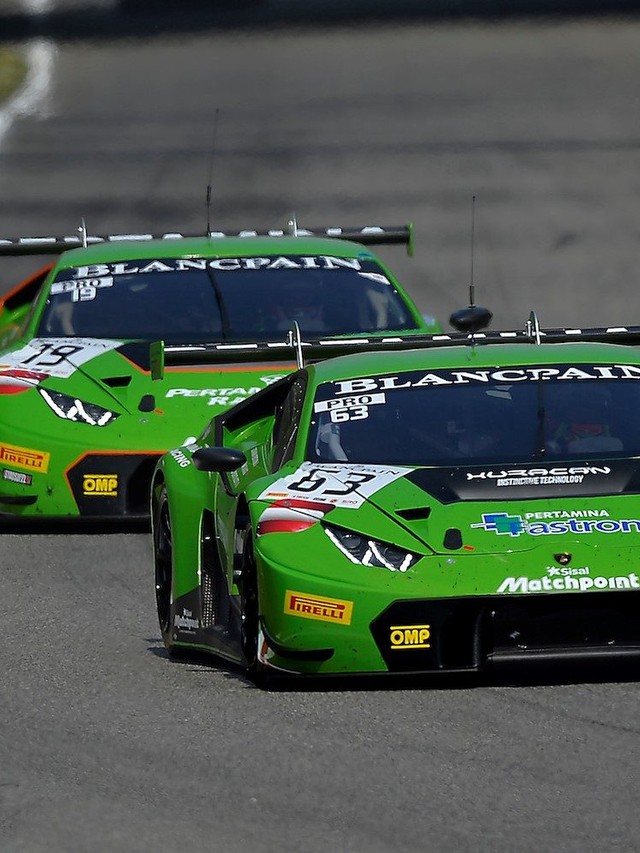
A Victory at Paul Ricard and Podiums From Lausitzring to Detroit
A single weekend in early June 2016 offered the clearest possible proof that the Lamborghini Huracán GT3 was not merely competitive but genuinely dangerous across every major GT series it entered. Orange 1 Team Lazarus delivered the car’s first International GT Open victory of the season at Paul Ricard, and they did it the hard way. Thomas Biagi and Fabrizio Crestani started eighth, clawed through the field on strategy, and inherited the lead when two cars battling for first made contact. The result: top step of the podium for a car that began the afternoon near the back of the pack.
That win was the headline, but it was only one chapter. At the Lausitzring, Grasser Racing Team’s Rolf Ineichen and Christian Engelhart brought their car home second in ADAC GT Masters Race 1 against a 33-car grid. In Detroit, Paul Miller Racing’s Bryan Sellers and Lamborghini GT3 Junior Driver Madison Snow earned the team’s first IMSA WeatherTech SportsCar Championship pole position of the season in the GTD class. Three circuits, two continents, one platform delivering results everywhere it appeared. What made the weekend remarkable was not any single trophy but the sheer breadth of the Huracán GT3’s competitiveness, a quality that only a car with deep engineering reserves can sustain across such different environments.
Recovery Drives and the Pace the Results Don’t Show
Raw classifications only tell part of the story. Several Lamborghini entries demonstrated front-running pace that penalties and misfortune obscured.
FFF Racing made its GT Open debut with ex-Formula 1 driver Vitantonio Liuzzi and Andrea Caldarelli aboard a Huracán GT3. The pair recovered to finish third overall in Race 1, a strong opening statement for a brand-new team entry. Ebimotors, with Fabio Babini and Emanuele Busnelli, added a sixth-place finish in the same race.
At the Lausitzring, Grasser Racing Team‘s weekend turned messier in Race 2. Car number 63 was excluded after a multi-car incident at the start, while the team’s second entry, car 16 with Mirko Bortolotti and Luca Stolz, ran second for most of the race before a drive-through penalty during the pit stop window dropped them to seventh. Bonaldi Motorsport’s Patrick Kujala and Milos Pavlovic quietly produced one of the weekend’s most impressive drives, climbing from nineteenth on the grid to eighth.
In Detroit, Paul Miller Racing dominated the GTD class for most of the race after qualifying on pole, only to lose five positions on a restart following a neutralization and finish eighth. Change Racing’s Corey Lewis and Spencer Pumpelly fared better in the final classification, crossing the line sixth. The pattern across all three series was consistent: the Huracán GT3 showed the pace to lead, even when circumstances conspired against the final result. That consistency across wildly different circuits and rulesets pointed to something deeper than good fortune or a single-track setup advantage.
Why Customer Racing Wins Matter More Than Factory Trophies
Lamborghini does not field a full factory GT3 effort in the way some rivals do. Its motorsport model depends on customer teams buying cars from Squadra Corse and running them independently, with factory support but privateer budgets and logistics. When Orange 1 Team Lazarus wins at Paul Ricard, or Grasser Racing Team takes a podium at the Lausitzring, those results validate the car in conditions Lamborghini cannot fully control. The teams choose their own engineers, set their own strategies, and manage their own pit stops.
For prospective buyers evaluating a Huracán GT3 against rival GT3 machinery from Porsche, Ferrari, or Mercedes-AMG, that independence is the point. A customer car that can win from eighth on the grid, or qualify on pole in IMSA’s GTD class, signals a platform that works without a factory hand on every wrench. The weekend’s geographic spread reinforced the message: from the long sweepers of Paul Ricard to the tight street-adjacent layout of Belle Isle, the Huracán GT3 produced results that spoke to fundamental balance in the car’s engineering rather than optimization for a single venue. It is precisely this kind of broad-spectrum competitiveness that turns a race car into a commercially viable customer platform, and that turns a weekend of scattered results into a coherent argument for the car’s quality.
A Decade-Long Platform and Its Incoming Successor
The Huracán GT3’s competitive longevity in a class where rivals regularly introduce entirely new platforms is itself a statement about the car’s underlying architecture. According to Road & Track, eleven brands released an entirely new GT3 car during the Huracán GT3’s lifespan, and Porsche alone produced three different platforms in that same window. Lamborghini updated its car through successive Evo specifications while keeping the naturally aspirated V10 at the core.
The upcoming Temerario GT3 will replace the Huracán GT3 Evo 2 as Lamborghini’s factory-backed GT3 contender, representing a meaningful philosophical shift: the first race car fully designed and developed in-house at Sant’Agata Bolognese, powered by a modified version of the road car’s twin-turbocharged V8 with the hybrid system stripped to comply with GT3 regulations. For teams currently running Huracán GT3s, the transition means adapting to an entirely new powerband, different weight distribution, and the complexities of turbo management in wheel-to-wheel racing.
Weekends like this one at Paul Ricard, Lausitzring, and Detroit set the competitive benchmark the Temerario GT3 will be measured against from its first race. Customer teams will expect the same kind of broad-spectrum competitiveness: the ability to fight for podiums across sprint races and endurance formats, on fast circuits and slow ones, in the hands of gentleman drivers and professionals alike. The Huracán GT3 earned that reputation over a full decade of global competition. Its successor will need to prove the same versatility, and quickly.
Gallery


