A Three-Hour Fight Decided by a Blink
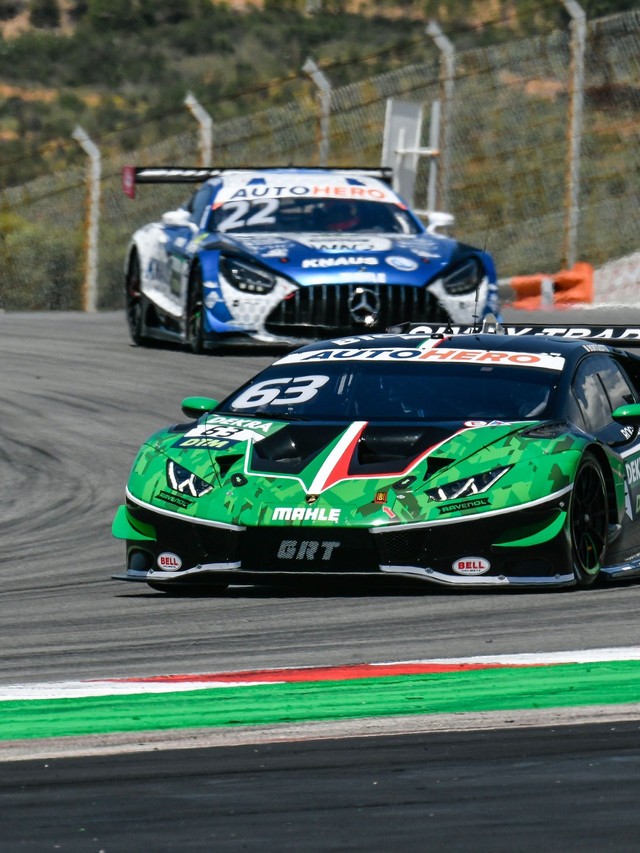
Grasser Racing Team’s #63 Lamborghini Huracán GT3 crossed the finish line at Silverstone’s 3H Endurance Cup just three tenths of a second ahead of the HTP Motorsport Mercedes-AMG GT. That margin, roughly the time it takes to snap your fingers, came after 180 minutes of unbroken, nose-to-tail combat. It was the Huracán GT3’s third consecutive victory in the Blancpain GT Series, following wins at Monza and Brands Hatch, and it placed Lamborghini Factory Drivers Mirko Bortolotti, Andrea Caldarelli, and Christian Engelhart at the top of the championship standings. More than a streak, it was the moment Lamborghini’s still-young motorsport division proved it could sustain front-running pace against the best GT3 machinery in the world.
Qualifying second out of 55 entries, Bortolotti wasted no time at the start, diving past the AKKA ASP Mercedes-AMG GT at Copse to seize the lead. He stretched the gap to five seconds before a safety car compressed the field and erased his advantage entirely. From that point forward, every meter of track was contested.
Caldarelli took over in the second stint and held the lead through heavy lapped traffic, a task that in endurance racing amounts to threading a needle at 150 mph while rivals with fresh tires probe for any hesitation. Engelhart inherited the lead for the final stint and spent it under relentless pressure from two Mercedes-AMG GTs, the HTP and AKKA ASP entries shadowing his every braking point. His defensive drive over those closing laps, protecting three tenths at a circuit as fast and flowing as Silverstone, was the kind of performance that separates factory-caliber drivers from the rest of the field and, critically, the kind that transforms a promising racing program into a feared one.
Three Circuits, Three Wins, One Unmistakable Message
A single Blancpain GT Series victory proves a car and team can peak on a given weekend. Three in a row, across circuits with fundamentally different aerodynamic demands, proves the entire program is operating at a consistently higher level than the competition.
Monza rewards top speed and low drag. Brands Hatch punishes chassis stiffness and rewards agility in tight, undulating corners. Silverstone asks for high-speed aerodynamic confidence and precise braking into fast entries like Copse and Maggotts. For the same car and driver lineup to dominate all three suggests the Huracán GT3‘s underlying platform possesses a rare breadth of capability. Lamborghini credited the winning formula to race strategy, teamwork, and car balance, which is predictable corporate language, but the results across three very different tracks support the claim.
The Blancpain GT Series (now the GT World Challenge Europe) remains one of the most competitive customer racing championships in the world. Fields of 50-plus GT3 cars from Mercedes-AMG, Ferrari, Porsche, Audi, Bentley, and others make every race a knife fight. A single manufacturer stringing together three consecutive overall victories in that environment is unusual. For Lamborghini’s relatively young motorsport division, it was genuinely significant, the clearest evidence yet that Squadra Corse had built not just a fast car but a program capable of sustained dominance.
Squadra Corse’s Quiet Engineering Advantage
The Huracán GT3 and the Mercedes-AMG GT3 that chased it home at Silverstone represent fundamentally different engineering philosophies. Lamborghini’s car places its naturally aspirated 5.2-liter V10 behind the driver in a mid-engine layout, built around an aluminum and carbon fiber hybrid chassis co-developed with Dallara. The Mercedes-AMG GT3 uses a front-mid-mounted, naturally aspirated 6.3-liter V8 connected to a rear transaxle via a carbon torque tube. Both approaches aim for balanced weight distribution, but they arrive there by very different paths, producing distinct handling characteristics that teams must exploit or manage depending on the circuit.
GT3 regulations use Balance of Performance to equalize power output across manufacturers, which means the real differentiators are chassis behavior, tire management, pit strategy, and driver execution. Holding off two Mercedes entries for an entire final stint at a high-speed circuit is a statement about aerodynamic stability and mechanical grip under sustained load, not just raw power. At Silverstone, Lamborghini and Grasser Racing Team clearly held an edge in all four categories.
The broader trajectory reinforces the point. Lamborghini’s Squadra Corse campaigns the Huracán GT3 globally through customer teams, and the program’s arc since the car’s 2015 debut has been a steady climb. The original Huracán GT3 gave way to the EVO and then the EVO2, each iteration refining aerodynamics, suspension geometry, and engine efficiency. That development arc eventually culminated in something once considered almost unthinkable for Sant’Agata: Lamborghini achieved its first overall victory at the 24 Hours of Spa with the Huracán GT3 EVO2, widely reported as the brand’s 191st win in the GT3 era. The seeds of that later triumph were planted in seasons exactly like this one, when Squadra Corse learned how to win under pressure and then kept winning.
From Pit Lane to the Showroom: Why GT3 Wins Sell Road Cars
For a brand that spent decades defined primarily by road-car theatrics, a credible and successful racing program changes the conversation. Every victory at a major circuit reinforces the idea that the engineering beneath the Huracán‘s dramatic bodywork is genuinely competitive, not merely styled to look fast.
This matters commercially. Buyers in the supercar segment are increasingly sophisticated, and many cross-shop the Huracán against the Porsche 911 GT3, the Ferrari 488, and the Mercedes-AMG GT. When Lamborghini can point to a car derived from the same platform winning endurance races against those exact rivals, the showroom pitch becomes considerably easier. The road-going Huracán shares its V10 architecture, its aluminum-carbon construction philosophy, and its fundamental layout with the GT3 car. That connection is not marketing fiction; it is structural.
The practical takeaway for prospective buyers is straightforward: the car you can order from a dealer shares meaningful DNA with a machine that won three consecutive races in one of the world’s toughest GT championships. Ferrari and Porsche certainly run successful GT3 programs, but Lamborghini’s ability to match them, and in this stretch outpace them, with a relatively newer motorsport operation speaks to how seriously Sant’Agata treats the engineering transfer between track and road. The Silverstone hat trick was not just a racing result. It was proof of concept for the entire Squadra Corse philosophy: build a race car that validates the road car, and let the results do the talking.
The Supporting Cast: Customer Teams and the Pro-Am Victory
Beyond the headline result, the Silverstone race offered a broader snapshot of Lamborghini’s customer racing ecosystem. Orange 1 Team Lazarus finished 14th with the crew of Crestani, Yacaman, and Pohler, while Ombra Racing placed 15th with Beretta, Gattuso, and Piccini. The second Grasser Racing Team entry finished 17th, and Attempto Racing’s Lamborghini came home 19th. None of those are podium results, but in a 55-car field packed with factory-backed machinery, consistent top-20 finishes from multiple customer entries indicate a healthy and competitive privateer base, exactly the foundation a sustained GT3 program requires.
The standout among the supporting entries was Barwell Motorsport’s Huracán GT3, which won the Pro-Am class and finished 20th overall with Adrian Amstutz joined by Lamborghini GT3 Junior Drivers Patrik Kujala and Martin Kodric. Pro-Am class victories matter more than casual observers might assume. They demonstrate that the car is accessible and competitive for gentleman drivers paired with young professionals, which is exactly the audience that sustains a customer racing program financially. A GT3 car that only works in the hands of elite factory drivers is a poor business proposition. One that lets a paying amateur compete for class honors while developing the next generation of factory talent is a program with longevity built in.
Kujala and Kodric were exactly the kind of rising talent Squadra Corse cultivated through these customer programs, giving them seat time in competitive environments alongside experienced amateurs. Ferrari and Porsche use similar models, but Lamborghini’s version, run through a smaller and more focused operation, tends to produce tighter relationships between factory and customer teams. That closeness showed at Silverstone, where the overall victory and the Pro-Am win together painted a picture of a program firing on every level.
What This Streak Signals for Lamborghini’s Motorsport Future
The 2017 Blancpain hat trick marked a turning point in how the wider motorsport community perceived Lamborghini’s GT3 ambitions. Before this run, the Huracán GT3 was respected but not feared. Afterward, it became a car that rival teams had to plan around, a status the platform maintained through successive EVO and EVO2 evolutions.
The Huracán GT3 program became one of the most successful customer racing platforms of its generation. One report indicates the Huracán’s successor, the Temerario GT3, is set to debut at the Goodwood Festival of Speed on July 11, which would mark the beginning of a new chapter for Squadra Corse. The transition from a naturally aspirated V10 to the Temerario’s twin-turbocharged V8 hybrid architecture will fundamentally change how customer teams approach setup, tire strategy, and power delivery. For teams and drivers who built their programs around the Huracán’s linear throttle response and high-revving character, adapting to an entirely new powerband and the added complexity of hybrid energy management will be a significant adjustment.
Lamborghini has not detailed how the Temerario GT3 will be positioned relative to the Huracán EVO2 in terms of customer pricing or upgrade paths. One source indicates the Huracán GT3 EVO was available both as a standalone purchase and as an upgrade kit for existing cars, a model that gave teams flexibility and protected their initial investment. Whether Squadra Corse follows the same approach with the Temerario remains to be seen.
What the Silverstone result and the broader 2017 streak established is something more durable than any single season’s points tally: proof that Lamborghini’s motorsport division could build, develop, and campaign a GT3 car at the absolute highest level. Every win the Huracán GT3 collected afterward, including that landmark Spa triumph, traced its lineage back to the moment a green number 63 car crossed the line at Silverstone with three tenths in hand and the championship lead secured.
Gallery


