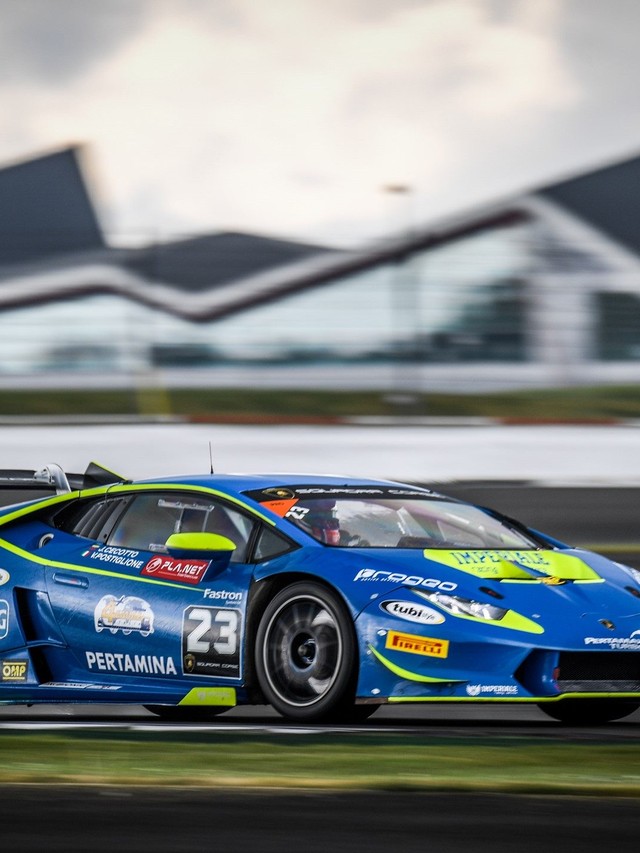
Pole to Flag at Silverstone: Postiglione and Cecotto Take Race 1
Vito Postiglione and seventeen-year-old Jonathan Cecotto, racing for Imperiale Racing, converted pole position into a commanding victory in Race 1 of the Lamborghini Super Trofeo Europe at Silverstone, the second round of the 2017 season. Postiglione controlled the field from lights out and held the lead through the mandatory pit window before handing the Huracán LP 620-2 Super Trofeo to Cecotto, who brought the car home without surrendering the position.
The result carried a personal milestone for Postiglione, who took his first Super Trofeo Europe victory at this same circuit a year earlier. For Cecotto, the son of former Formula 1 driver Johnny Alberto Cecotto, the win confirmed a trajectory that had been building since a near-miss at Monza in the opening round. As Cecotto put it after the race:
“At Monza we got very close to success. Today, we scored this first victory. I’m very happy, also because I am going to start from the first row in Race 2.”
The result behind them required stewards to sort out a messy sequence of penalties and exclusions, a reminder that even in a one-make series, the midfield battle runs hot enough to generate controversy.
Penalties Reshuffle the Podium
What looked like a straightforward finishing order turned complicated once the stewards got involved. Raphael Abbate and Yuki Nemoto of VS Racing crossed the line in second, but Lamborghini says the pair were penalized for failing to respect the minimum pit-stop time during their driver change. That dropped them to third initially, elevating Loris Spinelli and Mikaël Grenier of Antonelli Motorsport into second.
Then Spinelli and Grenier were excluded entirely for a technical irregularity, pushing Abbate and Nemoto back up to second and promoting Rik Breukers and Axcil Jefferies of GDL Racing onto the podium in third. Gerhard Tweraser and Sergey Afanasiev of ArtLine Team Georgia finished fourth, while Leipert Motorsport’s Jan Kisiel and Seb Morris rounded out the top five. Morris, racing on home soil at Silverstone for the first time in Super Trofeo, posted the second-fastest time in qualifying before a sluggish start cost him positions.
In the PRO-AM class, Leipert Motorsport’s Niels Lagrange and Pieter Vanneste took the win in only their third Super Trofeo Europe outing. Raffaele Giannoni of Automobile Tricolore claimed his first AM class victory of the season, while Gerard Van der Horst of Van der Horst Motorsport won the Lamborghini Cup and moved to the top of its standings. Andrej Lewandowski and Teodor Myszkowski of VS Racing maintained their AM championship lead thanks to a second-place class finish.
A Seventeen-Year-Old With a Famous Name and Genuine Speed
Jonathan Cecotto’s age alone makes him notable, but the context makes him interesting. At seventeen, he was already sharing a car with a seasoned professional in Postiglione, a driver with a World Final victory at Valencia in December 2016 on his résumé. The Super Trofeo format, pairing experienced drivers with younger or amateur teammates, creates exactly this kind of accelerated development environment.
The series structure splits competitors across PRO, PRO-AM, AM, and Lamborghini Cup classes, each designed to match different experience levels. For a young driver like Cecotto, the PRO class offers direct competition against established racers while the mandatory driver-change format guarantees seat time under genuine pressure. Because everyone races the same Huracán LP 620-2 Super Trofeo, the equipment variable disappears and the emphasis falls squarely on racecraft and car management. That kind of parity separates promising names from genuine talent more efficiently than a mixed-class grid ever could.
The Huracán Super Trofeo: A Purpose-Built Racing Platform
The car at the center of this series deserves more attention than a simple spec mention. The Lamborghini Huracán Super Trofeo is purpose-built for one-make racing. It shares its DNA with the road-going Huracán but strips away the street-legal compromises: full roll cage, race-specification damping, aggressive aerodynamics including that prominent rear wing visible in every trackside photo, competition slicks, and an E-gear system locked into its most aggressive mapping.
What makes the platform effective for a customer series is durability paired with accessibility. Teams ranging from well-funded professional outfits like Imperiale Racing to smaller privateer operations can campaign these cars across a full European calendar (Monza, Silverstone, Paul Ricard, Spa, Nürburgring, and the World Final at Imola in 2017) without the engineering overhead of a prototype program. The car rewards clean driving and smart setup choices rather than unlimited development budgets. Lamborghini does not publish official entry costs, and reliable figures remain scarce, though the practical reality is that customer one-make racing at this level requires a substantial commitment that varies significantly by team structure and sponsorship arrangements.
From Customer Racing to the GT3 Stage: The Bigger Lamborghini Motorsport Picture
The Super Trofeo series occupies a specific rung on Lamborghini’s motorsport ladder, and understanding that rung explains why results like Silverstone matter beyond the trophy. Squadra Corse, Lamborghini’s motorsport division, uses the one-make series as a proving ground for drivers, teams, and operational processes. The skills and relationships built in Super Trofeo feed directly into Lamborghini’s GT3 customer racing efforts, where teams compete against Ferrari, Porsche, and Mercedes-AMG machinery in international endurance and sprint championships.
Lamborghini’s Temerario GT3, the brand’s first competition car fully designed, developed, and built in-house, represents the next chapter in that progression. According to Autoblog, the Temerario GT3 was conceived with motorsport engineering integrated from the earliest design stages, with the same engineers working on both road and race versions of the engine. That kind of vertical integration only works when you already have a functioning ecosystem of teams, drivers, and operational knowledge, and the Super Trofeo provides exactly that ecosystem.
For the drivers who cut their teeth in the one-make series, the pathway upward is tangible. A strong Super Trofeo record can lead to factory driver consideration and GT3 seats, which in turn opens doors to major international endurance events. Whether Cecotto or any other young driver from the 2017 grid ultimately made that jump is a separate question, but the infrastructure exists specifically to make it possible.
The practical takeaway for anyone following Lamborghini’s racing ambitions: the Super Trofeo is not a sideshow. It functions as the foundation layer for everything Squadra Corse builds above it, from GT3 customer programs to the brand’s presence at events like the 12 Hours of Sebring. Silverstone’s Race 1 in 2017 was one data point in that larger project, but the pattern of pairing veterans with emerging talent, enforcing strict technical parity, and running a demanding multi-circuit calendar reveals a manufacturer thinking in terms of long-term competitive infrastructure rather than individual weekend results.
Gallery


