A Naturally Aspirated V10 That Embarrassed Hybrids
When Lamborghini pulled the covers off the Huracán Performante at the Geneva Motor Show on March 6, 2017, the car arrived with a credential no amount of marketing could fabricate: a Nürburgring Nordschleife production car lap record of 6:52.01 minutes, set on October 5, 2016. The previous record holder was the Porsche 918 Spyder, a plug-in hybrid producing, according to one report, 887 horsepower. The Performante beat it by nearly five seconds.
The 918 Spyder threw a twin-turbo V8 and two electric motors at the problem. The Performante countered with a naturally aspirated 5.2-liter V10 producing 640 horsepower at 8,000 rpm and zero electrical assistance. Lamborghini’s argument was that smarter aerodynamics and obsessive weight reduction could outperform brute hybrid force around the most demanding circuit on earth.
Three technologies made it possible: Aerodinamica Lamborghini Attiva (ALA), Forged Composite construction, and a motorsport-derived V10 powertrain. Together they form a single engineering thesis: aerodynamic intelligence and material science can substitute for raw electrical horsepower.
ALA: The Aerodynamic System That Thinks Mid-Corner
Active aerodynamics existed before the Performante. What made Lamborghini’s ALA system different was its ability to manage airflow independently on each side of the car, a capability Lamborghini calls aero vectoring.
Up front, an electric motor controls active flaps inside the Forged Composite spoiler. When ALA switches off, the default state for high-speed cornering and braking, those flaps stay closed, generating maximum downforce. When the system activates under heavy throttle, the flaps open, routing air through a channel along the car’s underside to slash drag and allow a top speed of more than 325 km/h.
The rear is where things get genuinely clever. Four ducts sit beneath the engine cover. Two central ones handle ventilation and exhaust cooling permanently; two outer ducts connect to internal channels running through the rear wing. Electro-actuated flaps control airflow through those channels. Close the flaps and the wing produces what Lamborghini says is 750% more vertical downforce than a standard Huracán coupe. Open them and air bleeds through ridges underneath the wing surface, reducing drag dramatically.
The rear wing’s internal channel splits into independent left and right paths. During a right-hand turn, Lamborghini’s proprietary Piattaforma Inerziale (LPI) can instruct ALA to open only the left-side flap, reducing downforce on the outside of the turn while maintaining full downforce on the inside wheel. The car effectively uses aerodynamics to do what a mechanical limited-slip differential does with friction.
Lamborghini states the entire ALA system activates its flaps in under 500 milliseconds and weighs 80% less than a traditional hydraulic active aero setup, critical when the Performante’s dry weight sits at just 1,382 kg.

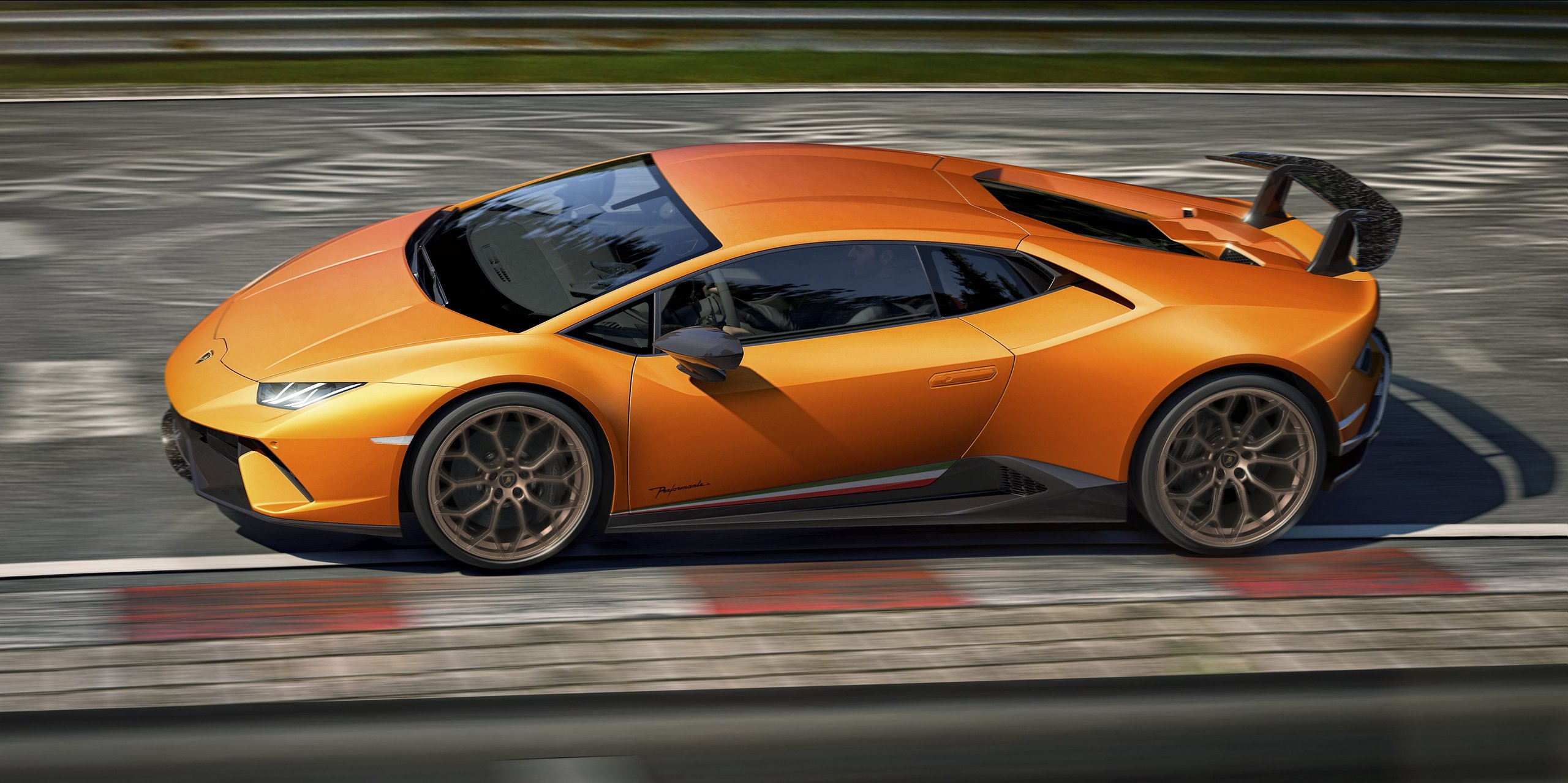
The orange Lamborghini Huracán Performante showcases its dynamic performance on the track with impressive speed and agility.
Forged Composite: The Material That Made ALA Possible
Forged Composite, Lamborghini’s patented material, solves a specific manufacturing problem that traditional carbon fiber cannot, and without it the ALA wing could not exist as a single component.
Conventional carbon fiber layup uses woven sheets of continuous fibers cured under heat and pressure. The process produces strong, lightweight panels but struggles with complex three-dimensional shapes. Forged Composite takes a different approach: chopped carbon fibers suspended in a resin matrix are compression-molded into shape, filling intricate geometries in a single piece while maintaining optimum stiffness. The Performante’s rear wing, with its internal air ducts for the ALA system, could only exist as one component because of this process. Traditional layup would require multiple bonded pieces, adding weight and potential failure points.
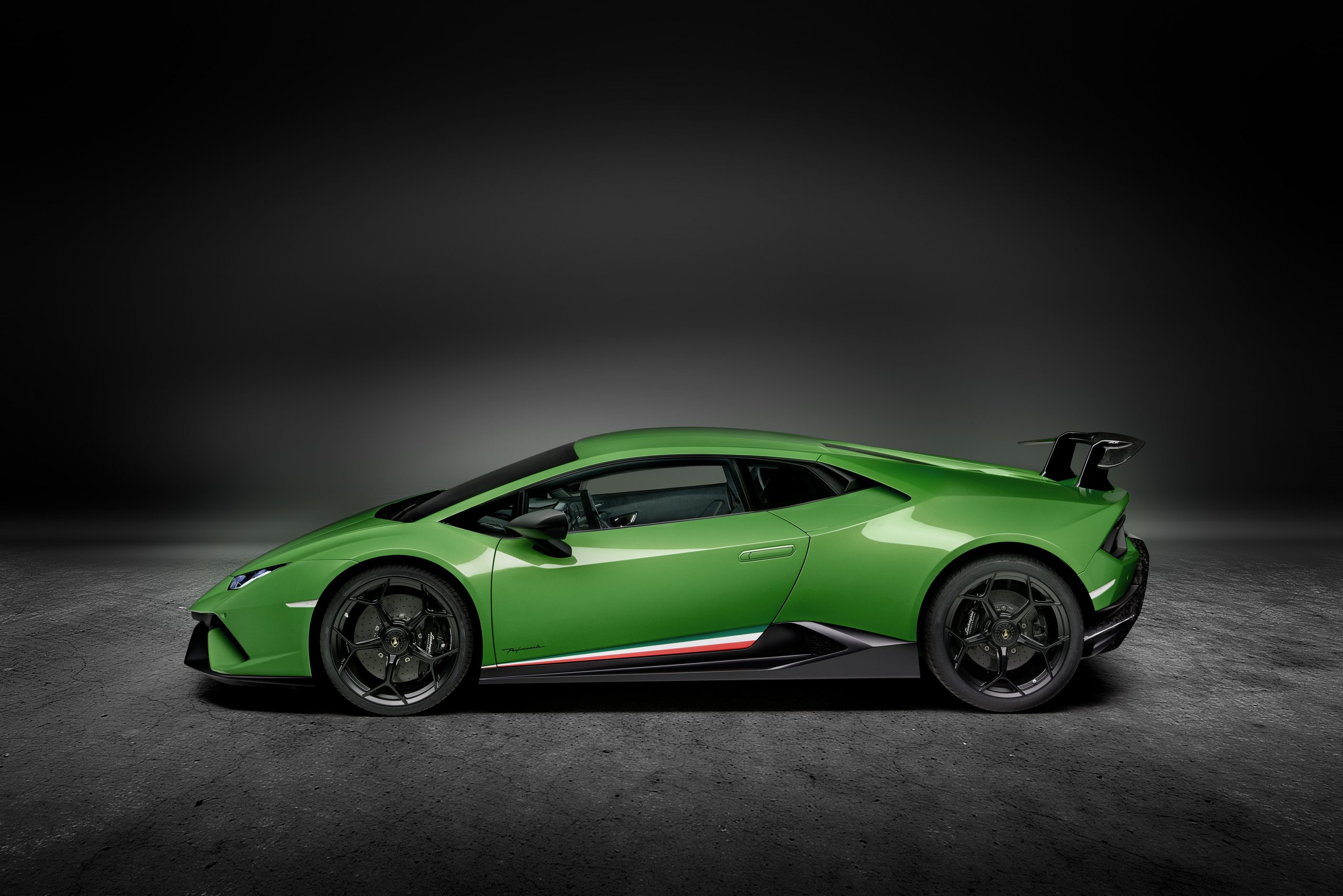
Lamborghini says Forged Composite contributes to the Performante’s 40 kg weight reduction over the standard Huracán. The material appears in the front and rear spoilers, engine cover, rear bumper, and aerodynamic diffuser. Visually, it carries a distinctive marbled appearance quite different from woven carbon fiber, and Lamborghini leaves it in a gloss, naked finish on ALA components to make the technology visible rather than hiding it under paint.

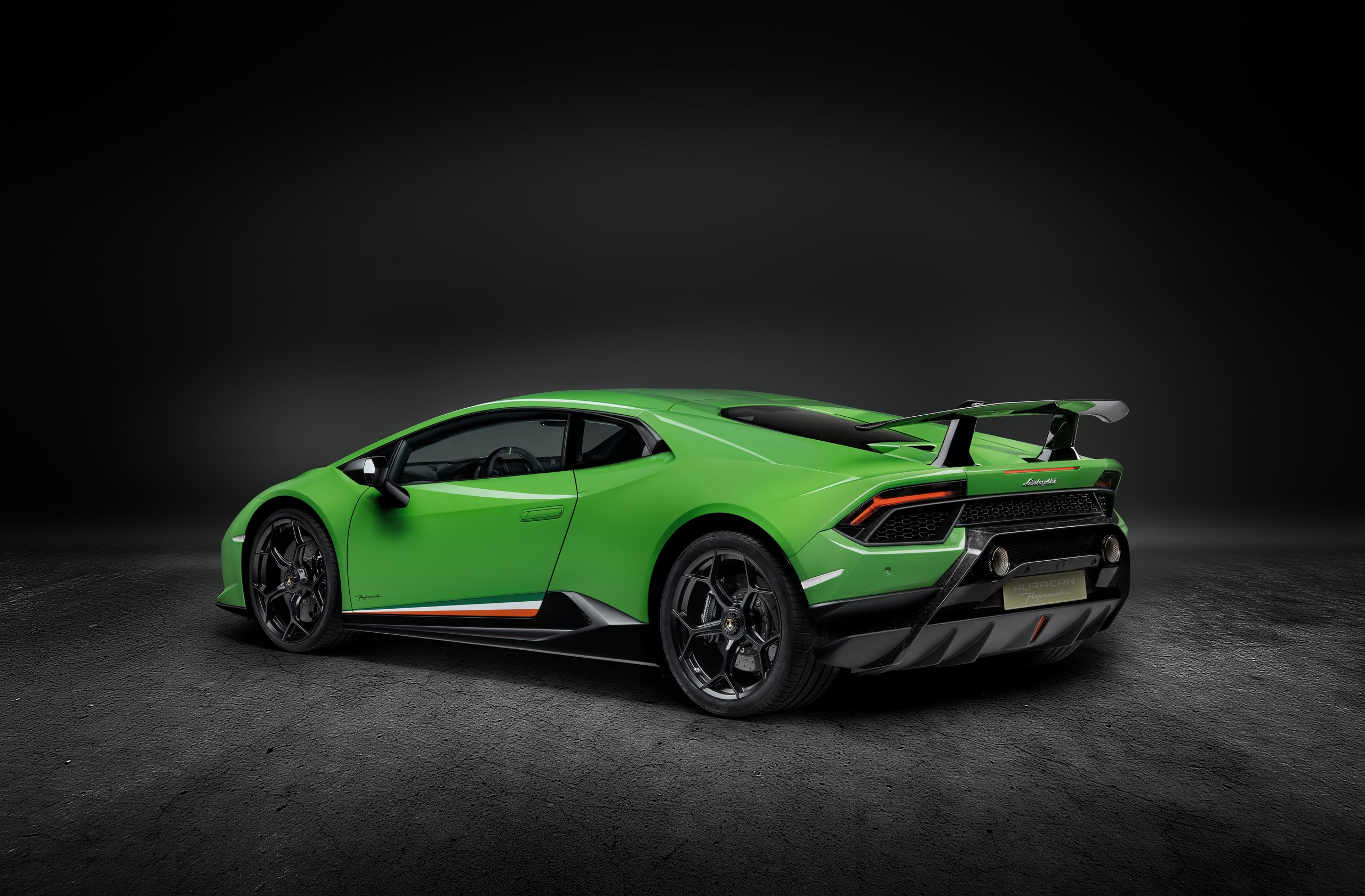
The green Lamborghini Huracán Performante's rear view emphasizes its powerful exhaust system and aerodynamic diffuser.
The V10 at 8,000 RPM: Motorsport Breathing in a Road Car
The Performante’s 5.2-liter V10 received meaningful internal changes drawn from Lamborghini’s Squadra Corse motorsport program. New titanium intake valves allow higher valve lifts, increasing the engine’s ability to breathe at high rpm. Intake and exhaust fluid dynamics were optimized, with redesigned intake ducts reducing pressure losses and improving throttle response. The exhaust system was lightened and repositioned higher and more centrally, reducing back pressure.
Output: 640 hp at 8,000 rpm and 600 Nm of torque at 6,500 rpm, with more than 70% of that torque available from just 1,000 rpm. Road & Track notes the Performante carries 30 more horsepower than the Huracán LP610-4. Combined with the 40 kg diet, the Performante achieves a weight-to-power ratio of 2.16 kg per horsepower. A bronze manifold cover distinguishes this engine visually, a heritage nod to previous special edition powerplants like the Diablo 30th Anniversary engine.
The seven-speed dual-clutch transmission was recalibrated to match the increased output, yielding 0 to 100 km/h in 2.9 seconds, 200 km/h in 8.9 seconds, and a braking distance from 100 km/h of 31 meters.

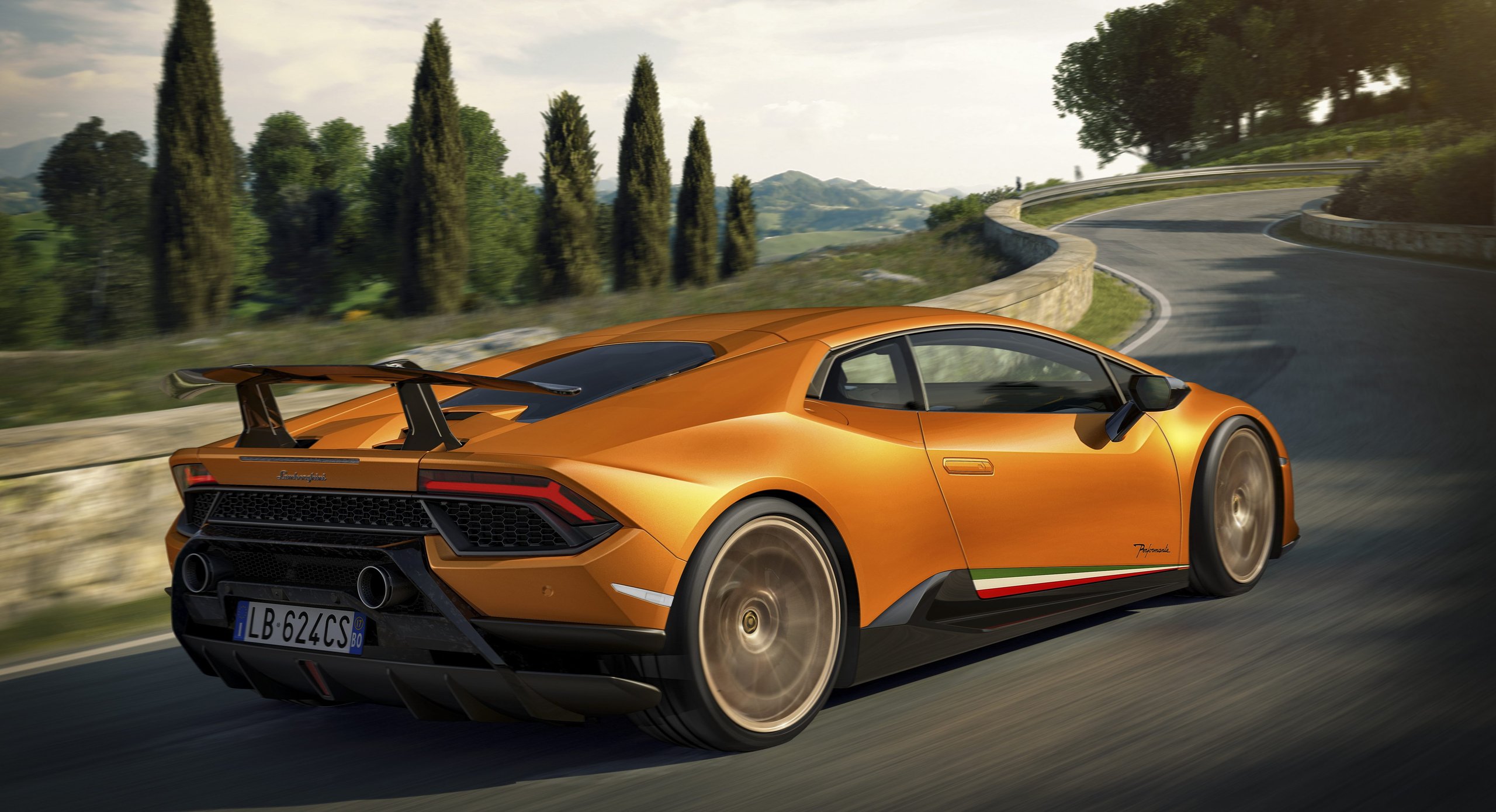
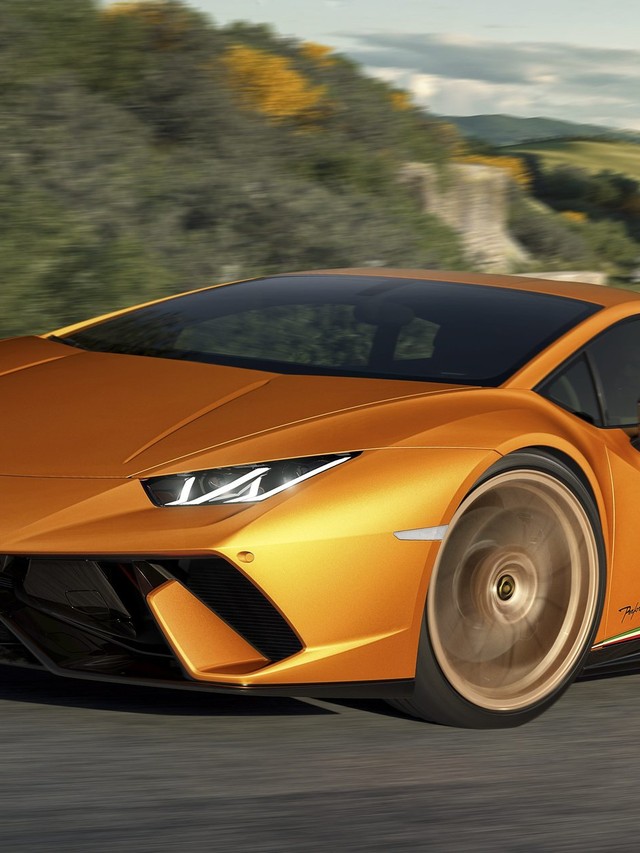
The orange Huracán Performante glides along a winding road, its vibrant color contrasting with the blurred natural backdrop.
Chassis, Tires, and the Details That Complete the Package
Lamborghini stiffened the suspension 10% vertically and 15% in roll compared to the Huracán coupe, while radial and axial arm bushing stiffness jumped 50%. The double-wishbone layout front and rear carries passive dampers as standard, with optional magnetorheological MagneRide units available. The permanent all-wheel-drive system uses a Haldex fifth-generation electronically controlled coupling with a rear mechanical self-locking differential, tuned to work in concert with ALA and Pirelli P Zero Corsa tires developed specifically for this car. A Pirelli Trofeo R track tire with street homologation is also available. Carbon ceramic brake discs with six-piston front and four-piston rear calipers handle stopping duties.
Lamborghini’s ANIMA drive mode system was recalibrated across all three settings. Strada prioritizes stability. Sport shifts toward rear-biased behavior with easier oversteer. Corsa focuses entirely on lap time extraction, with a significantly reduced steering ratio variation and ESC tuned for minimal intrusion. Buyers who plan to use Corsa mode regularly should consider the optional Lamborghini Dynamic Steering (LDS), which adds variable-ratio capability to the electromechanical power steering.
Inside the Cockpit: Lightweight Purpose, Not Luxury Theater
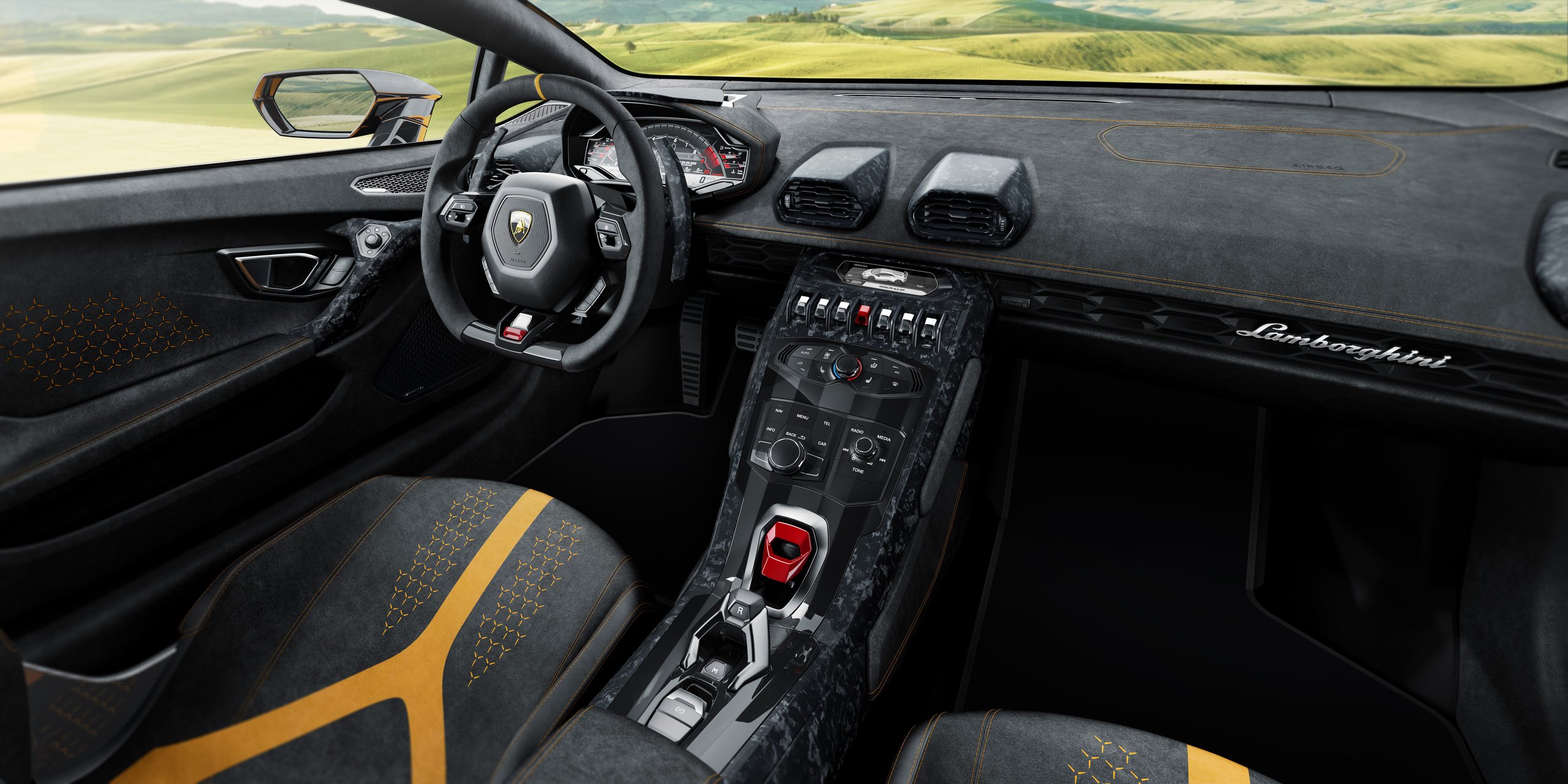
Dark Alcantara covers the sports seats, dashboard, and door panels, with Forged Composite appearing on the air vents, paddle shifters, door handles, and center console. A configurable digital instrument cluster changes its display based on the selected ANIMA mode, and a dedicated ALA graphic shows the driver exactly when and how the active aerodynamics are working, including aero vectoring activity. Apple CarPlay integration and Lamborghini’s proprietary telemetry system, which allows drivers to record and analyze performance data through an iPhone app, round out the technology package. Official imagery shows vibrant accent stitching, green in one configuration, orange in another, against the dark Alcantara, with a fighter jet-style engine start button adding a small theatrical touch to an otherwise purpose-driven cabin.

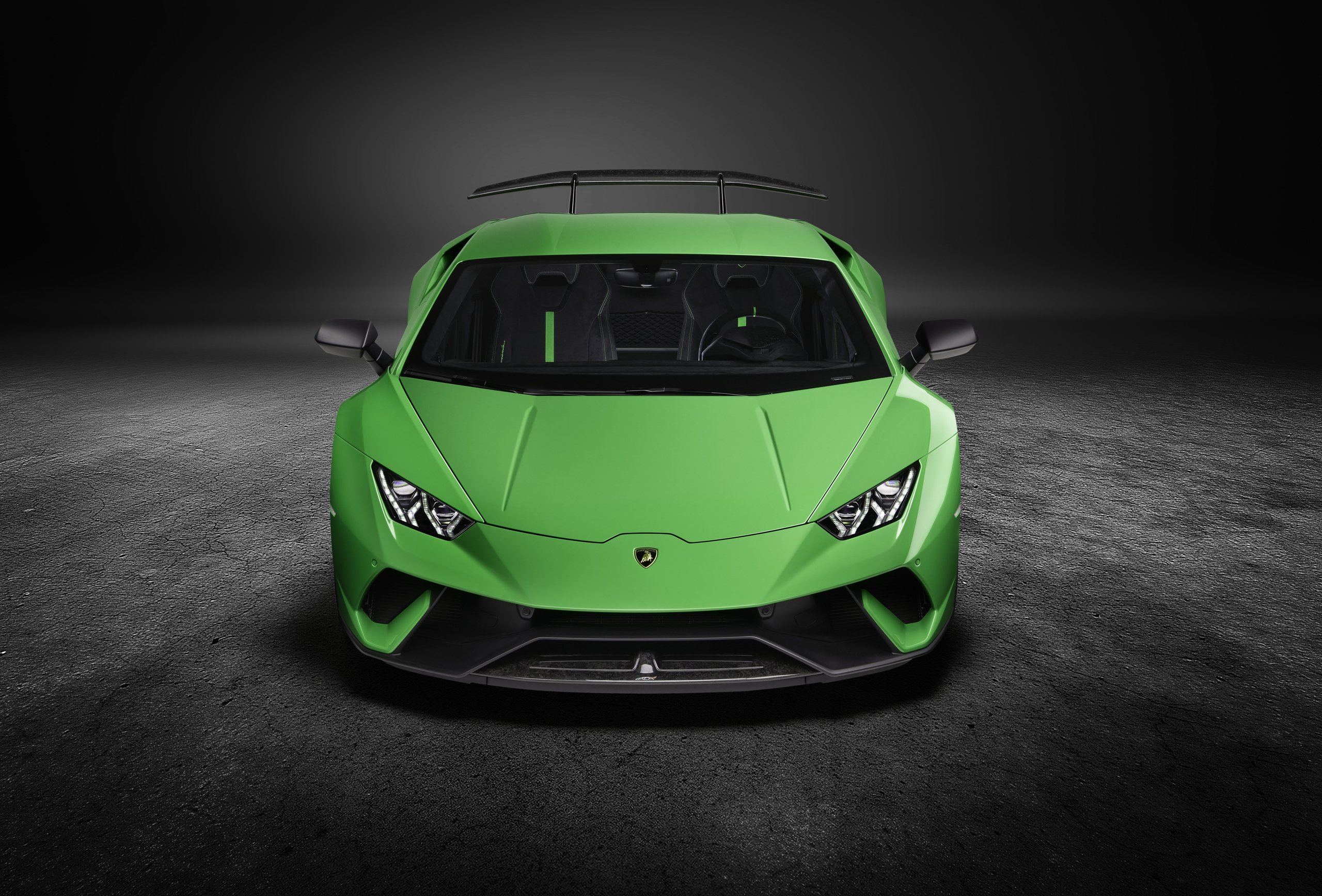
The Huracán Performante interior showcases a blend of black Alcantara and carbon fiber with striking green accents.
Beating the 918 Spyder Without Electrification
The Porsche 918 Spyder represented the state of the art in hybrid supercar engineering: a twin-turbo V8 augmented by two electric motors and a combined 887 horsepower, according to one report. Beating that car by nearly five seconds with 247 fewer horsepower and no electrical assistance was a statement about engineering philosophy as much as outright speed.
Lamborghini’s position was clear: intelligent aerodynamics and disciplined weight management could compensate for a raw power deficit. The Performante weighed significantly less than the 918 and could dynamically adjust its aerodynamic profile corner by corner, something the Porsche’s fixed aero could not match.
For buyers considering a Performante today, this context shapes the car’s collectibility. It was the first Lamborghini to carry ALA technology, which later evolved into ALA 2.0 on the Aventador SVJ, and it sits at the head of a lineage that includes the later STO and Tecnica variants. Lamborghini set suggested retail prices at launch of EUR 195,040 in Europe, GBP 173,271 in the UK, USD 274,390 in the United States, RMB 3,850,000 in China, and YEN 31,638,800 in Japan, all excluding applicable taxes except China. Summer 2017 deliveries followed the Geneva debut.

Two Huracán Performante models, in vibrant orange and classic white, stand ready against a stunning landscape.
The Performante’s Place in Lamborghini’s V10 Story
The technology the Performante debuted, particularly ALA and Forged Composite structural components, migrated upward to the Aventador SVJ and informed the engineering culture that produced the Huracán STO. Lamborghini’s entire approach to active aerodynamics in road cars traces back to this car.
In an era when every competitor was adding turbochargers, electric motors, or both, the Performante demonstrated that a naturally aspirated engine paired with aerodynamic intelligence could set absolute performance benchmarks. That philosophy explains why Performante values on the secondary market remain strong among collectors who recognize it as the car that proved the point before the industry moved on.
Lamborghini confirmed nothing about long-term maintenance costs or repairability of Forged Composite components in its official material, and those remain open questions for prospective buyers. The exotic variables worth investigating before purchase include ALA actuators, Forged Composite body panels, and the bespoke Pirelli tire fitment. What the car delivers in return is a driving experience built on engineering conviction rather than electrified compromise, and a Nürburgring lap time that stands as one of the most remarkable achievements in naturally aspirated supercar history.

The orange Huracán Performante navigates a scenic road, blending performance with the beauty of the Italian countryside.
Gallery