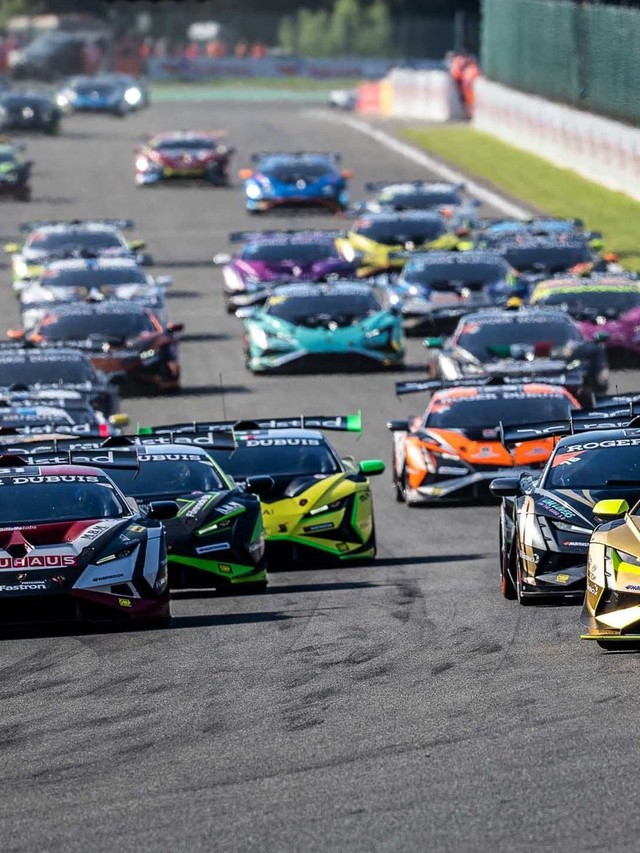
The Huracán’s Baptism by Fire: Monza Kicks Off 2015 Super Trofeo Europe
More than thirty Lamborghini Huracán race cars on the Monza grid, every one of them untested in competition. That is the scenario greeting the seventh season of the Lamborghini Blancpain Super Trofeo Europe this weekend (April 10 to 12), and it makes the opening round something closer to a controlled experiment than a routine curtain-raiser. The new Lamborghini Huracán LP 620-2 Super Trofeo replaces the Gallardo that served the series since its 2009 launch, and every team will be learning the car’s limits in real time, under race conditions, at one of the fastest circuits in Europe.
Lamborghini says the Monza grid represents a 50 percent increase in new drivers and teams compared to the previous year. That figure alone signals genuine commercial momentum for a one-make series now in its seventh year, a point at which customer interest often plateaus. The introduction of a fundamentally different race car appears to have done the opposite, pulling in fresh entries from across the GT and single-seater worlds. The reason is straightforward: this Huracán is rear-wheel drive, and that single engineering decision redefines what the Super Trofeo is for.
LP 620-2 Super Trofeo: A New Breed of Lamborghini Racer and Its RWD Philosophy
The naming convention tells the story before you read a single spec sheet. Where the road-going Huracán carries the LP 610-4 designation (610 horsepower, four-wheel drive), the Super Trofeo race car is badged LP 620-2: 620 horsepower, two driven wheels. That “2” is the most consequential digit in the entire model name.
Power comes from a naturally aspirated 5.2-liter V10 producing 620 horsepower at 8,250 rpm and 570 Nm of torque at 6,500 rpm. The engine uses direct injection and breathes through a BMC air intake, managed by a MOTEC M182 system that also governs a 9-position traction control. A 6-speed sequential gearbox, electrically actuated by Marelli and mated to a 3-disc racing clutch with a lightweight flywheel, replaces the road car’s dual-clutch unit. The result is a powertrain that feels nothing like its street sibling.
Underneath, a hybrid carbon and aluminum chassis features modified geometries to accommodate the dedicated racing gearbox and improved radiator packaging. Double-wishbone suspension runs on rigid bushings rather than the compliant rubber items found in the road car, while Brembo/PFC brakes use 380x35mm front and 355x32mm rear steel discs with 6-pot and 4-pot monoblock calipers respectively. Dry weight sits at 1,270 kg (2,800 lbs), which Lamborghini says represents a 335-pound reduction from the street Huracán. Weight distribution lands at 42 percent front, 58 percent rear, a balance that rewards smooth throttle application and punishes ham-fisted exits.
The practical takeaway for anyone considering a Super Trofeo campaign is that this car demands a different skill set from its Gallardo predecessor. The old car sent power to all four wheels, forgiving sloppy corner exits with front-axle traction. The Huracán race car offers no such safety net. Drivers who master it will emerge with reflexes directly transferable to rear-drive GT3 machinery, and that is precisely the point.
Strategic Play: How the Super Trofeo Feeds Lamborghini’s GT3 Ambitions
Stripping out the front driveshafts was not primarily about saving weight, though the savings are welcome. It was about building a talent pipeline. GT3 cars, the backbone of global customer racing, run rear-wheel drive. A driver stepping from an all-wheel-drive one-make series into a GT3 cockpit faces a steep learning curve in traction management, car rotation, and throttle modulation. By making the Super Trofeo rear-drive, Lamborghini Squadra Corse effectively compressed that transition.
Consider the career path the series now offers. A young driver enters the AM class, learns to manage 620 horsepower through the rear axle alone, graduates through PRO-AM into PRO, and arrives at GT3 competition already fluent in the language of rear-drive racing. Alberto Di Folco illustrates the model: the 19-year-old won the 2014 PRO-AM championship and now steps up to the PRO class with debuting team Raton Racing. His progression mirrors what Lamborghini wants the series to produce at scale.
This approach stands in contrast to some rival one-make programs that prioritize accessibility over developmental rigor. Lamborghini’s bet is that a harder, more demanding car attracts more serious talent and, ultimately, more GT3 customers. Whether that theory proves correct will play out over several seasons, but the early evidence is encouraging: the Monza entry list reads like a scouting report for GT racing’s next generation.
A Transformed Grid: Record Entries and Emerging Talent Ignite the Championship
The quality of the new arrivals matters as much as the quantity. Matteo Bobbi, the 2013 FIA GT winner, joins Bonaldi Motorsport in a PRO-AM entry alongside Britain’s Jay Palmer. Patrick Kujala brings GP3 single-seater experience to the same Bonaldi stable. Current International GT Open champions Daniel Zampieri and Roman Mavlanov anchor one of two cars fielded by the debuting Antonelli Motorsport squad. Edoardo Liberati and Patric Niederhauser, both under 23 and both carrying GT and GP3 credentials respectively, share Raton Racing’s second entry.
The returning roster carries its own weight. Two-time champion Cédric Leimer (2011 and 2012) races again under the Autovitesse Garage R. Affolter banner. GRT Grasser Racing Team, a squad that would go on to become one of Lamborghini’s most prominent GT3 partners, returns alongside Kinetic Racing Team and Leiper Motorsport. Newcomer Vincenzo Sospiri Racing fields the Italian-Japanese crew of Shinya Michimi and Kei Francesco Cozzolino, adding international flavor to a grid already spanning Georgia (Artline Team Georgia), Germany (Konrad Motorsport), and Switzerland (Sportec Motorsport).
What the entry list reveals, beyond individual names, is that the Super Trofeo now attracts the kind of multi-car professional outfits that treat one-make racing as a business rather than a hobby. That shift in team profile, drawn by a car that genuinely prepares drivers for the next rung of the GT ladder, tends to raise the competitive standard across every class.
Competitive Landscape: Lamborghini’s One-Make Series Against Its Rivals
Every major supercar manufacturer runs some version of a customer racing ladder. Ferrari operates its Challenge series, Porsche fields the Carrera Cup, and McLaren offers its Trophy program. Each takes a different philosophical approach to the question of what a one-make race car should teach its driver.
Lamborghini’s answer, as of 2015, is the most aggressive in one specific dimension: the deliberate mismatch between road car and race car drivetrain. Selling a rear-wheel-drive race car derived from an all-wheel-drive road car is an unusual move. It signals that Squadra Corse views the Super Trofeo not as a marketing exercise for the showroom Huracán but as a genuine motorsport development tool. The car’s 2.05 kg/CV weight-to-power ratio, its racing ABS with 12 adjustable positions, and its adjustable brake bias all reinforce that message. This is a car built to teach, not to flatter.
The broader strategic context connects to Lamborghini’s GT3 program. According to Autoblog, the Temerario GT3 represents Lamborghini’s first competition car fully designed, developed, and built in-house. Viewed through that lens, the Super Trofeo series is the proving ground where Squadra Corse refined the organizational and engineering processes that would eventually produce a factory GT3 car. Every season of the one-make series generates data, driver feedback, and operational experience that feeds directly into the higher-tier program.
New Race Format and How to Watch
The 2015 season introduces a revised qualifying structure. Two 15-minute sessions, separated by a five-minute pause, set the grids for Race One and Race Two independently. The format gives every driver two clean shots at a fast lap rather than one session determining both race grids, a change that should reduce the penalty for a single qualifying mistake and produce more varied starting orders across the weekend.
Both races run to the established 50-minute distance with a mandatory pit stop, a format that rewards consistency and pit-crew efficiency alongside raw pace. The Monza weekend schedule places free practice on Friday, qualifying on Saturday morning at 11:15 CET, Race One on Saturday afternoon at 3:05 PM CET, and Race Two on Sunday at 11:30 AM CET.
Lamborghini says coverage will air on Nuvolari TV in Italy and Motors TV across Europe. Both races will also be streamed live on the Lamborghini Squadra Corse website. The five remaining European rounds visit circuits that run alongside the Blancpain Endurance Series, and the season concludes at Sebring in November with the third edition of the World Final, where European, Asian, and North American champions converge. The pairing with the Blancpain Endurance Series also means Super Trofeo fans get exposed to GT3 racing on the same weekend, neatly reinforcing the developmental narrative Lamborghini is building around this entire program.


