Lamborghini’s Hybrid Design Statement Rolls onto the Villa d’Este Lawn
Lamborghini chose one of the most rarefied stages in the automotive world to make a quiet but deliberate point about its electrified future. The company entered its Asterion LPI 910-4 plug-in hybrid concept into the Concorso d’Eleganza Villa d’Este Design Award, the prize established in 2002 specifically for conceptual cars and prototypes. Filippo Perini, then Head of Centro Stile Lamborghini and the designer who shaped the Asterion with his team, accompanied the car on the lakeside concourse.
Villa d’Este is not a motor show floor where concepts compete for attention against dozens of other unveilings. It is an invitation-only gathering on the shores of Lake Como where a car’s design is judged as art, weighed against decades of automotive history. By placing the Asterion in that context, Lamborghini was asking the design establishment to evaluate whether a hybrid powertrain and a Lamborghini badge could coexist on aesthetic terms, not just engineering ones.
The Asterion LPI 910-4 had debuted at the Paris Auto Salon in 2014 as Lamborghini’s first plug-in hybrid technology demonstrator. It was never intended as a production announcement. Instead, it functioned as a public argument: that Sant’Agata could embrace electrification without surrendering the visual and visceral identity that separates a Lamborghini from everything else on the road. The Villa d’Este entry extended that argument from a crowded Paris hall to one of the most discerning audiences in the collector world, and in doing so revealed the deeper thesis the car embodied. The Asterion proposed that hybrid technology could serve a Lamborghini’s character rather than dilute it, a proposition that would echo through every electrified model the company has built since.
The Asterion’s Aesthetic: A GT Detour in a Wedge-Shaped World
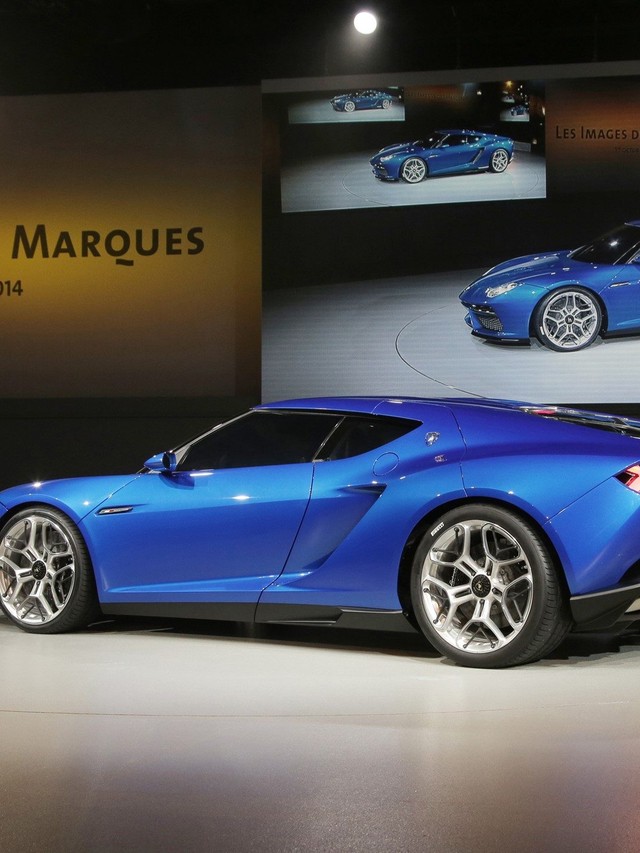
What made the Asterion genuinely surprising to Lamborghini followers was not the hybrid system. It was the shape. At a time when the Aventador and Veneno defined the brand’s visual language through extreme angles and fighter-jet aggression, the Asterion arrived with curves, softer surfacing, and a roofline that suggested grand touring rather than Nürburgring lap times.
One source at the time described the design as reminiscent of the earlier Estoque concept, and the comparison holds. Both cars explored what a Lamborghini might look like if the brief expanded beyond pure lateral-g performance and into the realm of long-distance, continent-crossing luxury. The Asterion’s proportions drew from heritage models like the Miura, the 350GT, and the Espada, all cars that prioritized beauty alongside speed. Perini and his Centro Stile team described the result as “new, unexpected, and sensual,” a phrase that would sound absurd applied to an Aventador SV but made perfect sense when you studied the Asterion’s flowing fender lines and restrained rear haunches.
This is where the design story becomes genuinely interesting for anyone following Lamborghini’s current lineup. The Asterion proposed a softer, GT-oriented aesthetic for a hybrid Lamborghini. The company ultimately rejected that direction. When the Revuelto arrived as the brand’s first production V12 hybrid, it doubled down on sharp surfaces, aerospace-inspired sculpting, and the iconic center line that traces back to the Countach. Available evidence does not indicate a direct design lineage between the Asterion and the Revuelto. They represent two fundamentally different answers to the same question: what should a hybrid Lamborghini look like?
That Lamborghini chose the aggressive path for production tells you something about how the brand reads its customer base. Collectors and enthusiasts who buy these cars overwhelmingly want visual drama. The Asterion tested whether the market would accept a gentler Lamborghini, and the answer, delivered through the Urus SUV receiving the green light instead, was a polite but firm no. Yet the underlying hybrid philosophy the Asterion carried beneath those gentle curves survived the aesthetic rejection entirely intact.

The blue Lamborghini Asterion LPI 910-4 concept car stands out with its elegant and futuristic design in a studio environment.
910 Horsepower and a V10: The Powertrain That Proved a Point
The Asterion’s nomenclature decoded in typical Lamborghini fashion. According to widely available reporting, “LPI” stood for Longitudinale Posteriore Ibrido, confirming the longitudinal rear engine placement and hybrid architecture. The “910” referred to the combined metric horsepower output, and “4” indicated all-wheel drive.
At the core sat a 5.2-liter naturally aspirated V10, mounted longitudinally in the mid-rear position. Three electric motors supplemented that engine, and the combined system delivered 910 horsepower (669 kW). Lamborghini claimed a 0-100 km/h sprint of 3.0 seconds and a top speed of 320 km/h. Those figures placed the Asterion in the same performance conversation as the Ferrari LaFerrari and Porsche 918 Spyder, both of which were production vehicles rather than demonstrators.
The more revealing number, and the one that best illustrated the Asterion’s core thesis, was the 50-kilometer pure electric range. In 2014, the idea that a 910 hp Lamborghini could creep through Milan or Monaco on battery power alone felt borderline radical. Lamborghini stated the concept achieved CO2 emissions of just 98 g/km, a figure that would have been remarkable for a family hatchback at the time, let alone a mid-engine supercar. The electric range signaled that Lamborghini understood something about its buyer demographic: these cars spend a disproportionate amount of their lives in city traffic, on short errands, and being parked at restaurants. A silent electric mode for those moments, with the V10 waiting in reserve for the open road, represented a genuinely practical vision of how electrification could serve the ownership experience rather than simply inflate a spec sheet.
Lamborghini emphasized that the entire concept was developed in-house, using existing technologies and the company’s own engineering resources. The subtext was clear: this was not a fantasy sketch or a partnership project. It was something Sant’Agata could, in theory, build.
From Concept to Cancellation to Vindication
The Asterion never reached production, and the reasons remain a source of mild frustration among enthusiasts. Forum discussion at the time coalesced around a widely held belief: Lamborghini chose the Urus SUV over the Asterion because the business case for a luxury SUV was simply stronger. The company’s stated rationale focused on the Asterion not delivering “ultimate track performance,” a justification that struck many observers as unconvincing given that the concept was explicitly positioned as a grand tourer, not a lap-time weapon.
Bloomberg reported at the time that even Lamborghini’s head designer required persuasion regarding the electric direction. That detail is worth pausing on. If the person responsible for shaping the car’s visual identity needed convincing, it suggests the internal debate at Sant’Agata was more contentious than the polished Paris reveal let on.
What the Asterion did accomplish, even without a production run, was organizational. It forced Lamborghini’s engineering team to solve the packaging challenges of integrating electric motors and batteries into a mid-engine supercar platform. It demonstrated that a naturally aspirated engine and electric assistance could coexist without one diminishing the other. And it gave Lamborghini a public proof of concept that made the Revuelto‘s eventual hybrid architecture feel less like a shock and more like a logical next step.
The Revuelto went in a different direction technically, pairing a V12 with three electric motors rather than a V10, and its design language stayed firmly in the angular Lamborghini tradition. But the fundamental proposition, a naturally aspirated engine augmented by electric power for both performance and efficiency, originated with the Asterion. The Urus SE, Lamborghini’s plug-in hybrid SUV, carries the same philosophical DNA: use electrification to enhance the driving experience rather than replace it. In both cases, the Asterion’s central argument survived the car itself.
Competitive Context: Where the Asterion Stood Against Its Hybrid Peers
When the Asterion appeared in 2014, the hybrid hypercar conversation was dominated by two production machines. The Ferrari LaFerrari paired a 6.3-liter V12 with a single electric motor for 950 horsepower. The Porsche 918 Spyder combined a 4.6-liter V8 with two electric motors for 887 horsepower and an electric-only range that exceeded the Asterion’s. Both were production cars with price tags north of a million dollars.
The Asterion occupied a different space entirely. It was a concept, not a commitment, and its GT-oriented character set it apart from the track-focused LaFerrari and the technology-obsessed 918. Where Ferrari and Porsche used hybridization to chase lap records, Lamborghini proposed using it to make a supercar more livable. The 50-km electric range and sub-100 g/km emissions were the headline figures, not Nürburgring times.
This philosophical difference matters because it predicted exactly how Lamborghini would eventually approach production hybrids. The Revuelto and Urus SE both prioritize the ownership experience alongside outright performance. Ferrari’s SF90 Stradale and Porsche’s upcoming electric 718 successor take different approaches, but Lamborghini’s emphasis on making electrification serve the owner’s lifestyle rather than purely the spec sheet traces directly to the argument the Asterion made on the Villa d’Este lawn.
For prospective Lamborghini buyers watching the brand’s hybrid evolution, the Asterion’s legacy offers a practical takeaway. Lamborghini’s electrification strategy is not about chasing the highest combined horsepower number or the longest electric range. It is about preserving the character of the driving experience while using electric power to smooth out the compromises that come with owning a mid-engine supercar in a world of congestion charges and emissions zones.
Filippo Perini’s Vision and What Villa d’Este Validated
Perini’s presence alongside the Asterion at Villa d’Este was not ceremonial. As Head of Centro Stile, he was the person best positioned to articulate why the car looked the way it did, and why that appearance mattered as much as the powertrain underneath. The Asterion represented a deliberate departure from the design language Perini himself had helped establish with cars like the Aventador. It was an exercise in restraint from a company not known for the quality.
The Villa d’Este Design Award judging panel evaluates concepts against the full sweep of automotive design history. Entering the Asterion in that competition was Lamborghini’s way of asking whether a hybrid supercar could stand as a design object, not merely a technology showcase. The distinction matters. Motor shows reward spectacle. Concours d’eleganza reward proportion, surface quality, and the coherence of a design vision. By choosing Villa d’Este, Lamborghini subjected the Asterion to a far more demanding aesthetic standard than it would have faced at Geneva or Frankfurt.
Whether the Asterion won the award is almost beside the point. The entry itself communicated that Lamborghini considered its hybrid concept worthy of being judged alongside the most beautiful cars ever built. For a brand whose identity is built on provocation and visual excess, that quiet confidence said more about its belief in the car than any horsepower figure could.
Looking back, the Asterion reads as a turning point that Lamborghini acknowledged but did not fully follow. The softer GT aesthetic was shelved. The hybrid engineering philosophy survived. Every electrified Lamborghini on sale today carries some version of the argument the Asterion first made in Paris and then defended, with Perini standing beside it, on the shores of Lake Como. The car that never reached production may have done more to shape Lamborghini’s present than any concept that did.


