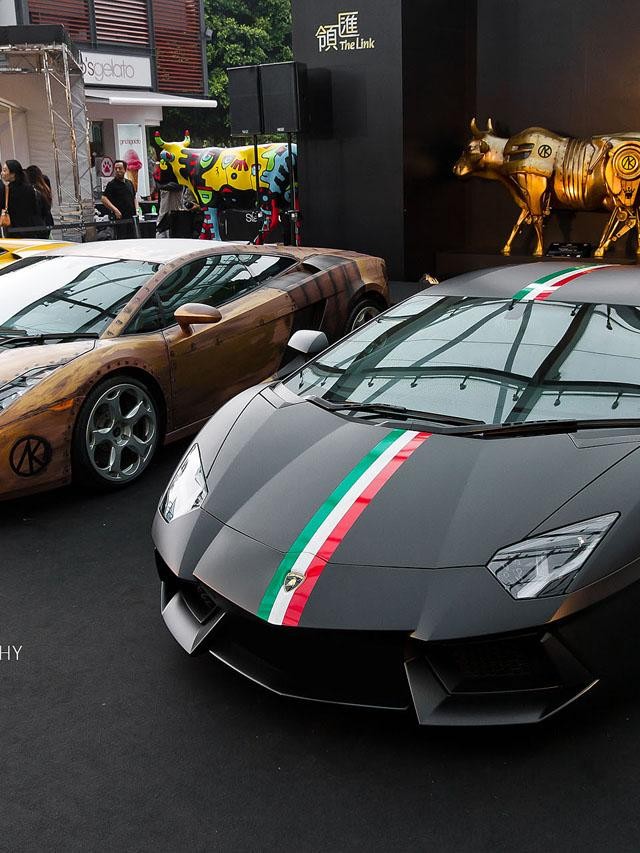
Introducing the Aventador S: Lamborghini’s 2016 V12 Flagship Evolution
When Lamborghini revealed the Aventador S on December 19, 2016, Sant’Agata Bolognese chose not to simply bolt on more power and call it a day. Five years into the Aventador’s production life, the company reworked the car’s aerodynamics, suspension geometry, and electronic architecture, then added a rear-wheel steering system no series-production Lamborghini had carried before. Taken together, these changes answered a question the original LP 700-4 had left open: could a car this large, this dramatic, and this committed to a naturally aspirated V12 also feel genuinely agile?
Lamborghini says the 6.5-liter V12 now produced 740 hp, with a claimed 0-100 km/h sprint of 2.9 seconds and a 350 km/h top speed. Those numbers mattered, but they were almost beside the point. The Aventador S marked the moment Lamborghini stopped treating its V12 flagship as a straight-line spectacle and started engineering it as a precision instrument, one whose chassis could finally keep pace with its engine.
The ‘S’ Designation: A Legacy of Enhancement in Lamborghini’s V12 Lineage
Lamborghini’s use of the S suffix predates most of its current audience. The 1971 Miura S refined Marcello Gandini‘s original masterpiece with additional power and improved oiling, but also with subtle suspension changes that made the car more predictable at speed. The Countach S, arriving in 1978, widened the body, added those iconic flared arches, and recalibrated the chassis. In both cases, the letter signaled not just more power but a fundamental rethinking of how the car behaved.
The Aventador S followed exactly this pattern. Lamborghini acknowledged that the LP 700-4, for all its visual drama and V12 theater, could feel unwieldy in tight corners. Its 2,700 mm wheelbase and considerable mass made it a weapon on long straights but sometimes a handful on technical roads. The S designation promised to fix that, and the fix came in a form the brand had never attempted at scale: a fully integrated rear-steering and electronic dynamics platform that would reshape every Aventador variant to follow.
Engineering the Shift: How Four-Wheel Steering and Advanced Aerodynamics Redefined Aventador Dynamics
The headline technology was Lamborghini Rear-wheel Steering (LRS), working in concert with the existing Lamborghini Dynamic Steering (LDS) on the front axle. At low speeds, the rear wheels turned opposite to the fronts, effectively shortening the car’s virtual wheelbase and tightening the turning circle. At higher speeds, the rears steered in the same direction, creating a longer virtual wheelbase for greater stability. Two electromechanical actuators managed the rear axle, responding to driver inputs in as little as five milliseconds.
All of this fed through a new central control unit, the Lamborghini Dinamica Veicolo Attiva (LDVA), which Lamborghini described as the car’s electronic brain. The LDVA pulled data from every sensor on the car in real time to coordinate steering, suspension damping, all-wheel-drive torque split, and stability control as a single integrated system. Where the original Aventador relied on brute mechanical grip and electronic stability interventions that felt more like safety nets, the S turned those systems into active participants in the driving experience. Reviewers at the time noted sharper turn-in, more confidence in mid-corner adjustments, and a car that finally felt smaller than its physical dimensions suggested.
The introduction of the customizable EGO driving mode reinforced this philosophy. Where the LP 700-4 offered Strada, Sport, and Corsa as fixed presets, the Aventador S let drivers mix and match steering weight, suspension firmness, and powertrain response independently, a tacit acknowledgment that owners used these cars in wildly different ways and that a single preset could not serve all of them.
Aerodynamically, the changes ran deeper than a cosmetic refresh. The new front splitter, with its carbon fiber construction and aggressive geometry, worked with redesigned air intakes to increase front downforce. Lamborghini says overall aerodynamic efficiency improved by more than 130 percent over the outgoing LP 700-4. At the rear, a new active wing and redesigned diffuser were calibrated to complement the four-wheel steering system’s variable virtual wheelbase: at high speed, when the rear wheels steered in phase with the fronts, the aero package provided the downforce to match that stability. The integration between mechanical and aerodynamic systems was more cohesive than anything the Aventador platform had offered before.
The Enduring Roar: The Aventador S’s Naturally Aspirated V12 in a Changing Landscape
By 2016, rivals were already moving toward turbocharging and hybrid assistance. Lamborghini’s answer was not to add boost or batteries but to extract 740 hp from the existing naturally aspirated 6.5-liter V12 and make it work within a smarter, more integrated chassis. That approach represented the last moment when Lamborghini could credibly argue that a naturally aspirated V12, without electrification, could still compete at the very top of the supercar hierarchy.
The bet paid off commercially and critically, buying the V12 program enough credibility to survive until the Revuelto could arrive with its hybrid architecture fully developed. For buyers who actually tracked these cars, the aero and chassis improvements translated into measurably higher corner speeds and greater confidence under braking. The Aventador S was not a track-focused variant in the way the SV had been, but it closed a meaningful gap between the grand-touring character of the base car and the raw performance of the stripped-down special editions.
Paving the Way: The Aventador S’s Influence on Later Variants and the Revuelto
Looking back from 2025, the Aventador S reads as a turning point rather than a mid-cycle update. The four-wheel steering system introduced on the S carried forward into the SVJ, where it combined with active aerodynamics (ALA 2.0) to produce a Nurburgring lap time of 6:44.97, a production car record at the time. Without the S establishing the rear-steering architecture and the LDVA control philosophy, the SVJ’s record-setting precision would not have been possible.
The LDVA’s centralized approach to vehicle dynamics also foreshadowed the electronic integration strategy of the Revuelto, the Aventador’s hybrid V12 successor. Where the Aventador S coordinated steering, suspension, and drivetrain through a single brain, the Revuelto extends that logic to include three electric motors and a dual-clutch gearbox. The conceptual DNA is unmistakable.
For anyone shopping the used Aventador market today, the S remains a compelling sweet spot: more dynamic and technologically complete than the LP 700-4, less extreme and less expensive than the SVJ, and equipped with the engineering foundation that made every subsequent Aventador variant better. The single-clutch gearbox still divides opinion, and visibility from the cockpit remains a known compromise, but those quirks belong to the car’s character rather than its shortcomings. The Aventador S was the moment Lamborghini proved its V12 flagship could evolve without losing its soul.
Gallery


