The Super Trofeo’s Enduring Purpose: Racing as a Brand Experience
When the Lamborghini Blancpain Super Trofeo North America series arrived at Watkins Glen International for Rounds 3 and 4 in the summer of 2016, it brought a formula that had been sharpening itself since the series launched in 2009 under the Squadra Corse banner: two 50-minute sprint races, a paddock full of identical Huracán race cars, and a hospitality village engineered to make prospective buyers feel like they already belong to the club.
The event itself was routine by Super Trofeo standards. What makes it worth revisiting is how cleanly it illustrates a strategy Lamborghini continues to refine today. The series was never purely about motorsport results. It functions as a controlled environment where Lamborghini can demonstrate the Huracán’s engineering credibility on track, give wealthy amateurs a structured path into racing, and surround the entire operation with curated luxury that reinforces why someone pays supercar money in the first place. Ferrari and Porsche run their own customer racing programs, but Lamborghini’s version leans harder into integrating the lifestyle wrapper with the competition itself, making the hospitality village and dealer engagement as deliberate as the race schedule.
Watkins Glen 2016: A Snapshot of Super Trofeo’s Core Elements
The 2016 season comprised 10 rounds across five circuits, culminating in a World Final in Valencia, Spain, where the North America, Europe, and Asia series converged. Watkins Glen, with its long history in American road racing and sweeping elevation changes through the Finger Lakes landscape, offered a fitting backdrop. Race 1 was scheduled for 5:55 p.m. (ET) Friday, July 1, with Race 2 at 5:35 p.m. Saturday, July 2. Two practices would take place Thursday, June 30, with qualifying at 10:35 a.m. Friday morning.
The field split across four divisions, each with its own podium: Overall, Pro-Am, Amateur, and the then-new Lamborghini Cup class. In the Pro category, Prestige Performance driver Shinya Michimi sat tied for the points lead with Corey Lewis, the 2015 Pro-Am champion who had moved up. The Pro-Am battle was tighter still, with the top six drivers separated by just nine points. Craig Duerson and Trent Hindman led that class in the No. 10 Prestige Performance entry after collecting a win and a third overall at the season opener in Laguna Seca.
Patrick Kujala, the reigning Super Trofeo Europe Champion, was set to make his North American debut alongside Brian Thienes in the No. 17 US RaceTronics car. That kind of cross-pollination between regional championships keeps the series from becoming insular and gives North American fields a credibility boost that pure gentleman-driver grids sometimes lack.
The Huracán Super Trofeo: Lamborghini’s Dedicated Track Weapon
Every car on the 2016 grid was a Huracán LP 620-2 Super Trofeo, powered by the road car’s 5.2-liter V10 with direct injection, retuned through a MoTeC engine management system to produce 620 horsepower. The frame uses a hybrid carbon and aluminum construction, with modified geometry up front for improved cooling and a revised rear section to accommodate the racing gearbox while cleaning up aerodynamics.
The one-make format is the strategic linchpin. Equalizing the machinery strips away the budget arms race that defines open-class GT racing and puts the emphasis on driver skill, team preparation, and racecraft. It also keeps costs more predictable for the gentleman drivers who form the series’ commercial backbone. One source indicates that in 2016, the car itself cost approximately $325,000, with single-event entry fees around $10,000 or $8,500 per weekend on a full-season commitment. A full season for one car and two drivers ran roughly $45,000 in entry fees alone, before factoring in team support, tires, repairs, and logistics. For 2026, those figures appear to have climbed: a Premium Entry Package for a single event is listed at $7,150, with a full-season prepaid package at $85,000. None of these numbers include the cost of actually buying the race car or running a team, which is where the real financial commitment lives.
Cultivating Talent: The Multi-Class Racing Ladder
The division structure is where the Super Trofeo’s dual identity as both a racing series and a brand loyalty engine becomes clearest. The Pro class attracts serious competitors building careers. Pro-Am pairs a professional with a bronze-rated amateur, giving the paying driver access to coaching and competitive data that would be difficult to replicate outside a factory-backed series. The Amateur class is reserved for one or two drivers holding FIA Bronze status, while the Lamborghini Cup targets beginners aged 27 or older.
Brandon Gdovic offers a useful case study in what this ladder produces. Multiple sources confirm he competed in the Pro-Am division in 2016 and remained active in the series through at least 2026, a decade-long relationship with Squadra Corse’s ecosystem. That kind of retention is exactly what Lamborghini designs the series to achieve: drivers who enter as enthusiastic amateurs and stay as loyal customers, buying road cars, attending events, and deepening their connection to the brand year after year.
For prospective participants weighing the Super Trofeo against alternatives like the Porsche Carrera Cup or Ferrari Challenge, the practical question is less about lap times and more about the total ownership experience. Lamborghini’s program bundles factory technical support, structured competition, and social access into a single package. Whether that justifies the cost depends on what you value: pure racing pedigree or the broader brand immersion.
Beyond the Track: Exclusive Hospitality and Owner Engagement
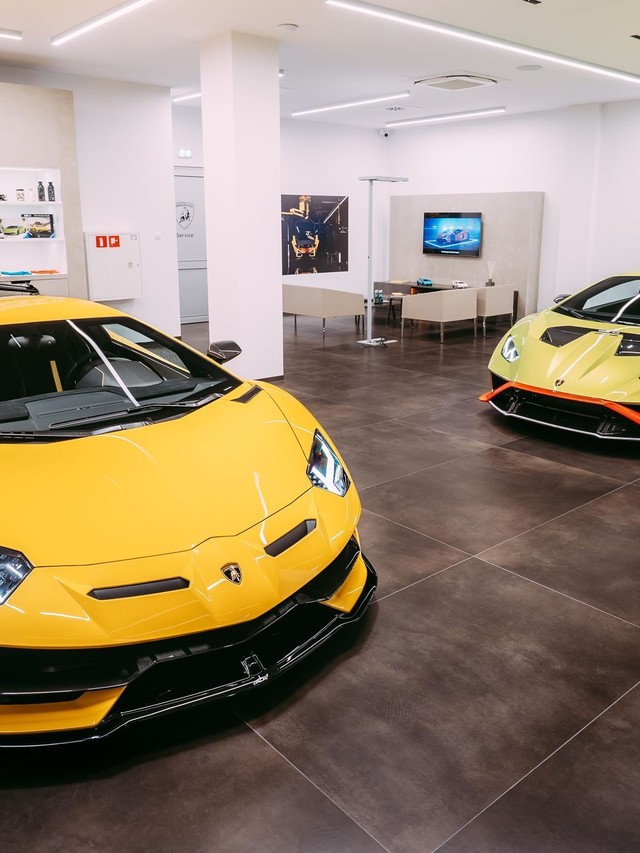
Lamborghini and its dealer network host VIP guests at every Super Trofeo event in the Lamborghini and Blancpain Village, a hospitality enclosure that goes well beyond standard paddock access. The 2016 Watkins Glen event followed this template, offering lavish amenities designed to give owners and prospective buyers a taste of the brand’s racing world without requiring them to hold a competition license.
The approach extends to the dealer level. In 2021, according to one report, Lamborghini Broward organized a dedicated “Watch Party” for clients to follow the Super Trofeo races at Watkins Glen, complete with a brunch bar, omelet station, and a Bloody Mary and Mimosa bar. It sounds like a country club event, and that is precisely the intention. The dealership becomes an extension of the race weekend, connecting customers who may never set foot in a paddock to the competitive identity Lamborghini cultivates through Squadra Corse.
This is the dimension of the Super Trofeo that competitor coverage rarely examines closely. Race results get reported. The hospitality strategy, which arguably does more to convert prospects into buyers than any podium finish, tends to be treated as background color.
Super Trofeo’s Legacy and Future: From Huracán to Temerario GT3
The Huracán Super Trofeo platform proved remarkably durable. From its introduction in 2015 through the EVO2 iteration that followed, it anchored the series for over a decade. IMSA reported 41 Huracán Super Trofeo Evo2 cars entered for the 2026 Watkins Glen rounds, demonstrating that the grid remains healthy even as the road car it derives from gives way to the hybrid Temerario.
The Temerario GT3, revealed at the 2025 Goodwood Festival of Speed, represents Lamborghini’s first competition car fully designed, developed, and built in-house. According to Autoblog, the GT3 program marks a significant shift in how Squadra Corse approaches race car development. Whether a Temerario-based Super Trofeo variant follows is a question Lamborghini has not publicly answered, but the infrastructure, the dealer engagement model, the hospitality apparatus, the multi-class format, all of it transfers regardless of what engine sits behind the driver.
For current and prospective Super Trofeo participants, the practical takeaway is straightforward: the Huracán platform still defines the series today, and anyone entering now buys into a proven, well-supported ecosystem. The transition to whatever comes next will bring new engineering questions, particularly around turbocharging and hybrid complexity in a one-make racing environment. But the strategic formula Lamborghini established back in 2009, and executed with quiet consistency at places like Watkins Glen in 2016, shows no sign of changing. The racing is the product. The experience is the sale.
Gallery


