Lamborghini’s Design Head Takes the Stage at Autostyle
On October 27, 2022, Lamborghini’s Head of Design Mitja Borkert walked onto the stage at Villa Schiarino Lena near Mantua for the 19th edition of the Autostyle Design Competition. He brought three cars: the Countach LPI 800-4, the Huracán Tecnica, and the Urus Performante. Each represented a different facet of Lamborghini’s current lineup, but the real subject of his presentation was the connective thread running through all of them: a design philosophy that begins with a single defining line and refuses to compromise on aggression.
The Autostyle event, founded in 2004 by Professor Roberto Artioli of Berman S.p.A. (an Italian OEM parts supplier for major manufacturers), occupies a specific niche in the automotive calendar. It brings together heads of design from competing brands in the intimate setting of a Mantuan villa, pairs their presentations with a student competition, and publishes the talks on Berman Autostyle’s YouTube channel for a global audience. Lamborghini says the event is a chance to illustrate brand identity while engaging with leading international designers. For enthusiasts, the real value is rarer: hearing the person who signs off on every surface, crease, and proportion explain why a Lamborghini looks the way it does.

Two men engage in a lively discussion on a sofa, set against an 'autostyle + DESIGN' branded backdrop. Image: Automobili Lamborghini.
Unpacking Lamborghini’s Design DNA: Form, Function, and Emotion
Borkert’s philosophy at Lamborghini centers on a deceptively simple idea: every car begins with a single line. That silhouette, which evolves into a riot of edges, angles, and tight windows, is what makes a Lamborghini identifiable at 200 meters in a parking garage or at 200 km/h on a highway. The goal, as Borkert frames it, is to create the “unexpected” while keeping the result pure, cutting-edge, and timeless.
Lamborghini’s method is architectural. The company treats its cars like buildings: sharp load-bearing lines, hexagonal geometries (a motif Borkert applies obsessively across the range), and a deliberate refusal to smooth away aggression for the sake of elegance. The simpler the initial line, Borkert contends, the more powerful the final result. What makes this philosophy worth watching closely is how it survives the transition to hybridization and, eventually, electrification. Lamborghini continues to incorporate classic design cues like the angular wedge shape, even as the engineering underneath changes fundamentally.
The recently revealed Manifesto concept, created to celebrate two decades of Lamborghini’s in-house Centro Stile design center, reinforced this commitment. As Car and Driver reported, the Manifesto serves as a vision for Lamborghini’s future design language rather than a preview of any specific production car, and it doubles down on the dramatic geometry that defines the brand. In that light, Borkert’s Autostyle presentation was less a showcase of three new models and more a public articulation of the principles that will govern whatever Sant’Agata builds next.
The Countach LPI 800-4: A Masterclass in Heritage Reimagined
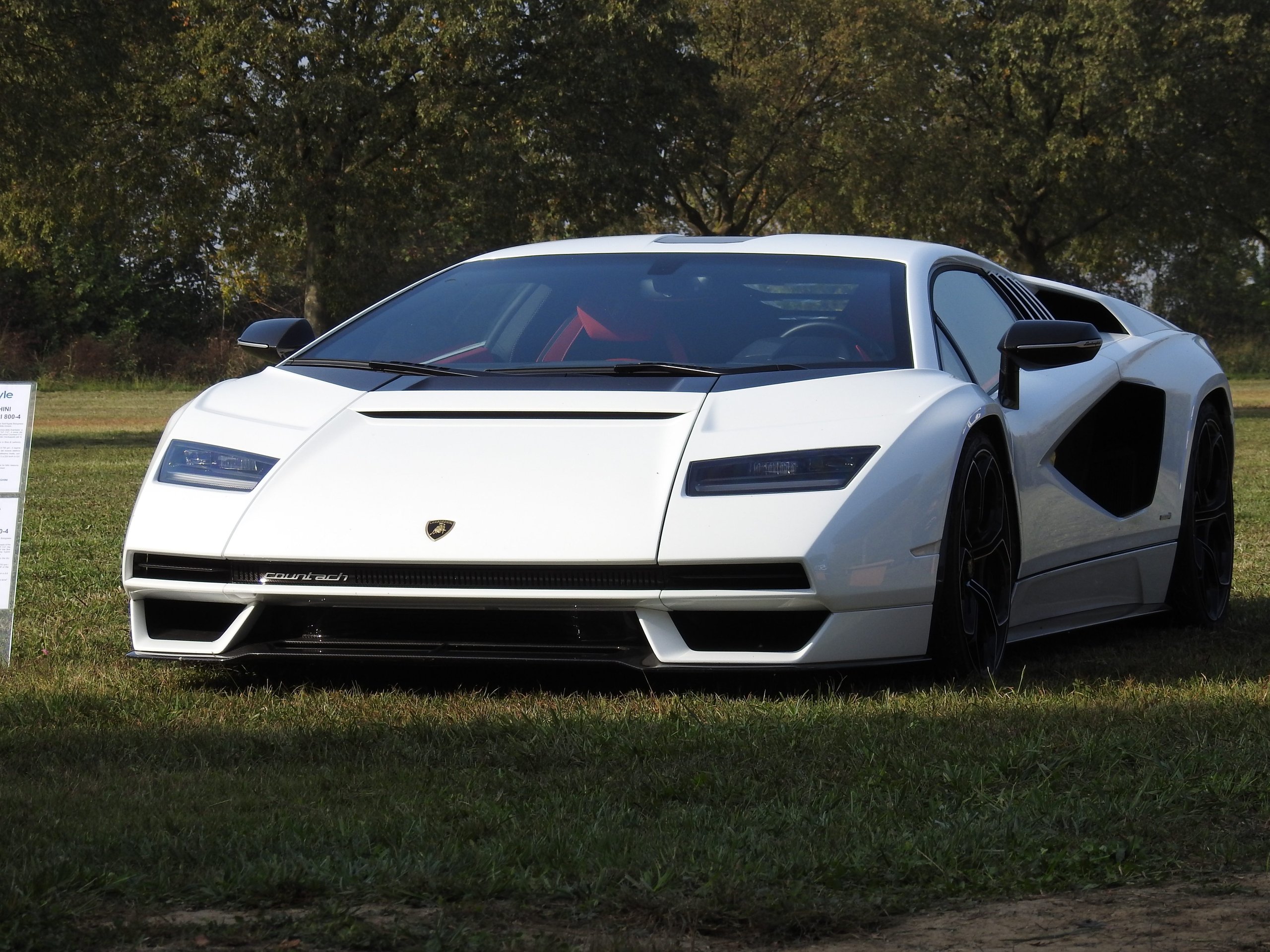
The white Countach LPI 800-4 sitting on the villa’s lawn was the most visually potent argument Borkert could make about Lamborghini’s relationship with its own history. Designed under his direction as a tribute to the original 1971 LP500 concept, the car draws from multiple Countach generations while remaining unmistakably modern. The sharp front hood lines, low rectangular grille, and that iconic wedge profile all reference the original, but the modern LED lighting, prominent front splitter, and visible carbon fiber accents belong entirely to the present.
Borkert aimed to capture what he called the “magic feeling” of the original Countach while integrating a hybrid V12 powertrain underneath. The design challenge is substantial: how do you honor a shape that defined an entire era of supercar design without producing a nostalgic pastiche? Lamborghini’s answer was to treat the original as a set of proportional rules rather than a surface to copy. The greenhouse stays impossibly tight. The wedge stays aggressive. But every panel is new.
This is Borkert’s single-line philosophy made tangible. Rather than reproducing specific details so faithfully that the result feels like a scale model, the Countach LPI 800-4 trusts the proportional DNA to carry the emotional weight, freeing the surfaces to be contemporary. Whether that gamble paid off depends on who you ask, but the car’s status as a sold-out limited edition suggests the market endorsed the approach.

The striking white Lamborghini Countach LPI 800-4 is showcased outdoors at an event. Image: Automobili Lamborghini.
Modern Manifestations: Huracán Tecnica and Urus Performante
If the Countach proved that Borkert’s design principles could bridge decades of heritage, the other two cars at Autostyle demonstrated how the same DNA adapts to very different briefs within a single model year.
Borkert considers the Huracán Tecnica “the perfect Lamborghini Huracán,” a characterization that carries weight given how many variants the V10 platform spawned over its nearly decade-long run. The Tecnica’s design incorporates significant aerodynamic improvements while emphasizing what Borkert calls a “fun to drive” concept. Design elements inspired by supersport motorcycles, including wide rear tires and a cockpit-forward stance, give the Tecnica a visual aggression distinct from the track-focused STO. The same architectural sharpness governs every surface, yet the result reads differently because the underlying brief changed.
The Urus Performante presented a different problem entirely. Borkert’s stated objective was to create “the driver’s SUV,” and his analogy is characteristically blunt: a Urus that went to the gym and came out with more muscles. The Performante uses carbon fiber extensively (more visible carbon elements than any competitor SUV, according to Lamborghini’s positioning), contributing to a 47 kg weight reduction. Wider, lower, more aggressive than the standard Urus, every aerodynamic surface serves a functional purpose rather than existing purely for visual drama.
Seeing both cars alongside the Countach LPI 800-4 in a design context, rather than a performance context, clarified how Borkert’s team applies consistent principles across wildly different vehicle architectures. The Huracán line would eventually give way to the Temerario, which Car and Driver confirmed as the successor. The Urus continues to evolve. But the single-line discipline Borkert described on stage was legible in all three shapes parked on the grass outside.

A speaker presents the Lamborghini Urus success story to an engaged audience at an indoor event. Image: Automobili Lamborghini.
Nurturing the Future: Lamborghini’s Engagement with Emerging Design Talent
The Autostyle Design Competition concludes each edition with a panel of design heads awarding twelve student participants. Lamborghini says some previous winners secured significant positions with car manufacturers, which makes the competition more than a ceremonial exercise. For a brand that relies on Centro Stile to maintain its visual identity across an expanding product range, the pipeline of design talent matters commercially.
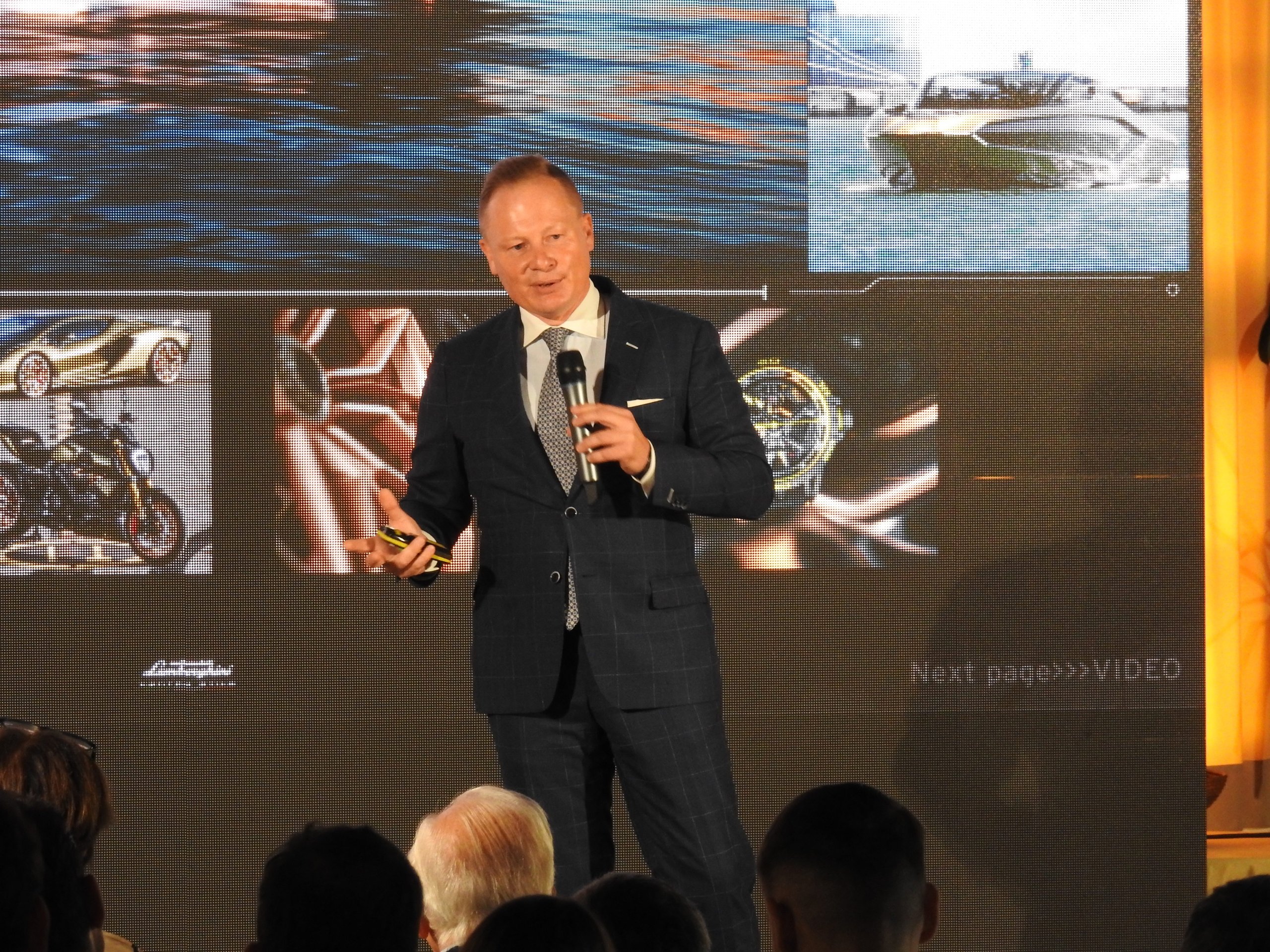
Borkert’s presentation at the event extended beyond automotive design. Event imagery shows his talk referencing boats, motorcycles, and watches, reinforcing a broader point about design language as a transferable discipline. That breadth is telling. The hexagonal geometries and single-line silhouette principle Borkert champions are not tricks confined to a particular body style; they are a grammar flexible enough to govern anything Sant’Agata puts its name on.
For LamboCars readers, the practical takeaway from Autostyle is straightforward: Lamborghini under Borkert treats design philosophy as a strategic asset, not a marketing afterthought. The hexagonal motifs, the refusal to soften aggression for broader appeal, the insistence that a single defining line must carry the entire emotional weight of a car before a single detail is drawn: these choices define what a Lamborghini looks like on the road and, by extension, what it feels like to own one. Whether Borkert’s team continues to hold that line as electrification reshapes every surface in the industry will be the defining design question of the next decade at Sant’Agata Bolognese.

The Lamborghini team receives a round of applause on stage at the Autostyle Design event. Image: Automobili Lamborghini.
Gallery