A Decade on the Grid, and Off It
Lamborghini staged its Super Trofeo race at China Speed Weekend not merely as another round of single-make competition, but as a deliberate anniversary marker: ten years of operations in a market the company considers essential to its global ambitions. The race itself ran a clean fifty minutes under warm, dry conditions at Shanghai’s International Circuit, with Lamborghini Young Drivers Program graduate Afiq Yazid converting pole position into victory, PRO-AM driver Anthony Liu of China claiming his class win, and the AM podium topped by Indonesia’s Andrew Haryanto alongside Malaysian teammate Mark Darwin.
Those results matter, but the real story is what surrounded them. Francesco Scardaoni, Managing Director of Automobili Lamborghini China, framed the occasion in strategic terms, calling China a key market and describing 2015 as the beginning of a new era of commitment. The language is corporate, sure, but the actions behind it are concrete: a new owner driving tour called The China Giro, a complimentary vehicle service program for local customers, and the Super Trofeo grid itself, which drew competitors from Malaysia, Japan, Indonesia, and China. Lamborghini was using the weekend to demonstrate that its Chinese operation is no longer a satellite outpost but a fully integrated arm of the brand’s motorsport, lifestyle, and ownership ecosystem. Ducati’s presence at the same venue for a rider’s experience program only reinforced the sense that the weekend was designed as a broader Italian performance showcase.
Building Loyalty One Mountain Pass at a Time
The China Giro is the most interesting announcement to come out of the weekend, even if the race results grabbed the headlines. Lamborghini says the program takes owners through some of China’s most engaging landscapes and regions, which is deliberately vague but follows a well-established template. One report describes past Giro itineraries spanning five days and covering distances exceeding 800 kilometers, with routes through northwestern China’s Helan mountain range, deserts, and grasslands. Convoys typically feature a mix of Huracán, Aventador, and Urus models, with the Urus occasionally demonstrating its off-road credentials in sand terrain.
Lamborghini already runs similar programs elsewhere. The Esperienza series offers track-focused driving events, while the Italian Giro has been a staple of European owner engagement for years. Bringing that format to China signals that the company sees its Chinese customer base as mature enough to sustain curated, multi-day experiences, not just showroom visits and key handovers. Pairing the Giro launch with a complimentary service initiative suggests a focus on retention as much as acquisition. Keeping existing owners engaged is cheaper and more effective than constantly chasing new ones, and in a market where brand loyalty among ultra-high-net-worth buyers can be fickle, that distinction matters.
Specific pricing and itinerary details for the China Giro remain undisclosed. Participation is reportedly arranged through local dealerships, consistent with how Lamborghini manages its global Giro programs.
The Young Drivers Program Produces Results, Not Just Press Releases
Afiq Yazid’s pole-to-flag performance deserves more than a line in the results table. The Malaysian racer is a graduate of Lamborghini’s Young Drivers Program, which identifies and develops emerging talent for the Super Trofeo series. Programs like this exist across motorsport, but Lamborghini’s version serves a dual purpose: it populates the grid with competitive, brand-loyal drivers while giving the company a credible narrative about nurturing talent rather than simply selling seat time.
Yazid’s dominance at China Speed Weekend illustrates the program working as intended. He qualified on pole and controlled the race from start to finish, ahead of a field that included experienced PRO-AM and AM competitors from across the Asia-Pacific region. The race began under safety car procedure, but once green-flag racing commenced, Yazid was never seriously challenged. Yuan Bo and Eduardo Liberati, the Chinese-Italian pairing who had started fourth, finished second overall, while Japan’s Yudai Uchida rounded out the podium. Toshiyuki Ochiai of Japan, who had qualified third, was also part of a competitive mid-pack battle. The AM class saw its own regional diversity, with Akira Mizutami and Hajime Noma of Japan taking second behind Haryanto and Darwin, and the Chinese duo of Li Chao and Zhu Junhan completing the top three.
For prospective buyers watching from the grandstands or following online, the takeaway is straightforward: the Super Trofeo series remains one of the most accessible paths into competitive GT racing, and Lamborghini actively invests in making sure its grid is full and its racing credible. Whether Yazid’s career trajectory leads to broader GT3 competition or stays within the Lamborghini ecosystem, his success validates the pipeline.

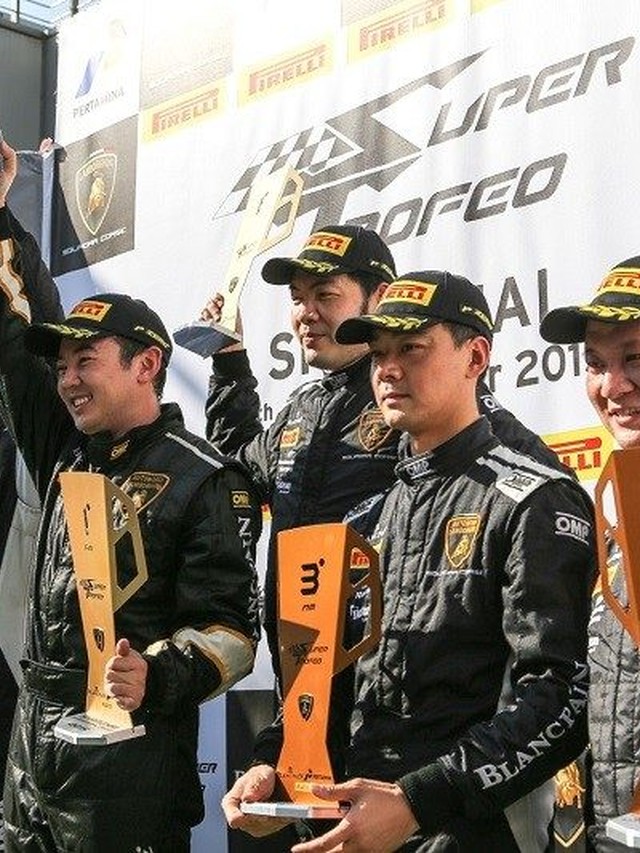
Race car drivers celebrate on the podium with their trophies after a successful day of racing at the Super Trofeo event.
The V10 as a Racing Proposition
Every car on the China Speed Weekend grid ran Lamborghini’s naturally aspirated V10, a powertrain that increasingly occupies a unique position in customer motorsport. In a customer racing context, naturally aspirated engines offer predictable power delivery that benefits amateur and semi-professional drivers who may lack the experience to manage turbo lag or hybrid power transitions under race conditions. The V10’s behavior is honest: push the throttle, get a proportional response. That predictability is a genuine competitive and safety advantage on a grid where skill levels vary widely between PRO, PRO-AM, and AM classes.
The engine also plays directly into Lamborghini’s brand-building strategy in China. For owners considering the leap from road car to race car, the V10’s linear throttle response and high-rpm character lower the barrier to entry. It makes the Super Trofeo series feel like a natural extension of the Huracán ownership experience rather than a foreign discipline requiring entirely different instincts. That continuity between showroom and circuit is precisely the kind of seamless ecosystem Lamborghini is trying to build around its Chinese customers.
Sebring and the Bigger Picture
With the China Speed Weekend concluded, attention shifts to the Super Trofeo World Final in Sebring, USA, where regional champions from Asia, Europe, and North America converge for the series championship. Lamborghini says the event will determine who earns the title of the series’ top competitor, and for drivers like Yazid and Liu, the China results provide both points and momentum heading into that finale.
The broader significance of the China weekend extends beyond any single race or championship. Lamborghini’s approach of layering motorsport events with owner experiences, service initiatives, and talent development programs reflects a brand that understands its Chinese customers want more than a car. They want membership in something. Ten years into its Chinese operations, Lamborghini appears to have grasped a principle that eludes many luxury competitors: the sale is not the finish line but the starting grid. Whether that formula translates into sustained growth remains to be seen, but as a model for how a low-volume supercar manufacturer can cultivate a market, the playbook is worth watching closely.


