Paul Miller Racing Signs On for Lamborghini’s IMSA GT3 Push
When Paul Miller Racing confirmed it would campaign the Lamborghini Huracán GT3 in the 2016 IMSA WeatherTech SportsCar Championship GTD class, the announcement carried more weight than a typical customer team deal. Lamborghini was staking its factory credibility on North American GT3 racing for the first time, and it chose a team with genuine endurance pedigree to spearhead the effort alongside Super Trofeo graduates Change Racing, O’Gara Motorsport, and Konrad Motorsport.
Automobili Lamborghini’s Head of Motorsport, Giorgio Sanna, framed the partnership in strategic terms:
“The GT3 is the pinnacle of our racing strategy and we expect a team with their experience and success in North American sportscar racing, along with our other customer teams, to raise the level of competition and elevate Lamborghini Squadra Corse in North America.”
Paul Miller himself brought a résumé few team owners in the GTD paddock could match: three starts at the 24 Hours of Le Mans, nine at the 24 Hours At Daytona, and a GTO class win at Daytona in 1988. His team arrived with two top-three GTD finishes in the preceding two seasons, so this was not a gentleman operation learning on the job. Miller’s own assessment of the car was pointed: his team followed the Huracán GT3’s European campaign closely and found its development “significant and impressive,” fully expecting it to contend from the first race of the season.
The official North American debut was set for the 24 Hours At Daytona on January 30-31, 2016, with Bryan Sellers and Madison Snow as full-season drivers and Bryce Miller joining for endurance rounds.
Lamborghini’s Racing Ladder and the GT3 Endgame
Lamborghini positioned its GT3 program as the top step of a pyramid that included Lamborghini Esperienza, Accademia, and three Blancpain Super Trofeo series running worldwide. The logic was straightforward: cultivate amateur and pro-am talent in the one-make series, then graduate the best teams into full FIA GT3 competition where they would race against Porsche, Ferrari, Audi, and Mercedes-AMG machinery on equal terms.
The timing mattered. IMSA’s GTD class adopted the 2016 FIA GT3 specifications for all entries, opening the door for any homologated GT3 car to compete. Lamborghini seized that regulatory alignment to expand beyond Europe, where the Huracán GT3 had already proved itself with a Blancpain Endurance Series win at Monza earlier that year through Grasser Racing Team. North America and Asia were the next targets.
What separated the Huracán GT3 from Lamborghini’s earlier Gallardo-based racing efforts was a fundamental shift in engineering responsibility. Lamborghini says the Huracán GT3 was the first GT3 car fully engineered, developed, and assembled internally by Automobili Lamborghini, rather than farmed out to an external constructor. That distinction matters for customer teams: factory-controlled development typically means faster parts supply, more consistent technical support, and closer integration between the road car engineering team and the racing program. For a brand historically perceived as more focused on road car theatrics than podium results, building the race car in-house signaled a seriousness the paddock noticed.

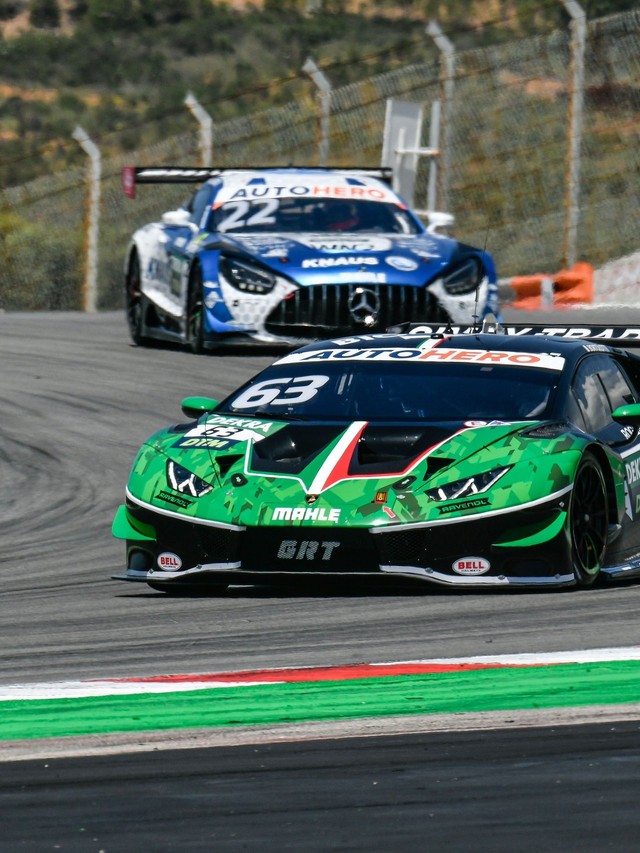
The green Lamborghini Huracán GT3 race car navigates a turn on the track with impressive speed and agility.
The Huracán GT3: What 585 Horsepower Bought Customer Teams
Lamborghini stated the Huracán GT3 produced 585 horsepower from its naturally aspirated V10. In GT3 racing, raw power figures are somewhat academic because Balance of Performance regulations equalize the field, but the engine’s character still defines how a team approaches setup and strategy. A naturally aspirated V10 delivers linear throttle response and a predictable powerband, qualities endurance drivers particularly value during long stints and night driving.
According to Paul Miller Racing’s website, the later Huracán GT3 Evo featured a hybrid chassis constructed from aluminum and carbon fiber, with a dry weight of 1,230 kg and a 5,204 cc ten-cylinder engine. The original car shared that fundamental architecture, and Paul Miller’s familiarity with mid-engine platforms from previous GTD campaigns gave the team a head start on setup.
For prospective customer racing buyers watching from the sidelines in 2015, the practical question was whether Squadra Corse could deliver the kind of trackside support that established GT3 manufacturers like Porsche and Audi provided as a matter of routine. The answer would come on the stopwatch.
From Debut Season to Championship Sweep
The 2016 season validated the bet quickly. One report indicates Paul Miller Racing secured Lamborghini’s first IMSA pole position at Detroit through Bryan Sellers, followed by the brand’s first IMSA race win at Virginia International Raceway, where Madison Snow also claimed pole. The No. 48 car finished third in both the GTD team and driver championship standings, a remarkable result for a manufacturer’s debut year in the series.
Two years later, the partnership reached its peak. Still running the Huracán GT3 with Sellers and Snow, Paul Miller Racing captured the 2018 IMSA GTD team and driver championships while Lamborghini earned the GTD manufacturer title the same year. The #48 car accumulated six podium finishes and two class wins across the eleven-race calendar, leading the GTD points for nine consecutive rounds heading into the Petit Le Mans finale. Paul Miller Racing’s history page also reports a Rolex 24 At Daytona victory and Michelin Endurance Cup title in 2020, cementing the Huracán GT3 as one of the most successful GT3 platforms in IMSA history.
Paul Miller Racing’s history page reports the team transitioned to the BMW M4 GT3 in 2022. That departure, while a loss for Lamborghini’s IMSA roster, underscored a competitive reality: customer teams evaluate their options at every homologation cycle, and the Huracán GT3 platform, by then approaching the end of its competitive evolution, faced newer rivals. The partnership’s legacy, though, was already secured.
What the Huracán GT3 Built for Lamborghini’s Future
The 2016 IMSA entry looks different in hindsight than it did at the time. When Lamborghini announced Paul Miller Racing as a customer team, the brand was still proving it belonged in professional GT racing. By the time the Huracán GT3 program wound down, Lamborghini held championship titles in IMSA, Blancpain, and Asian GT racing, and Squadra Corse operated one of the more respected customer support programs in the GT3 world.
As Road & Track noted in its 2025 coverage, the Huracán GT3 served as Lamborghini’s sole GT3 platform for a full decade while competitors like Porsche cycled through multiple generations. The Temerario GT3, revealed at Goodwood in 2025, represents the long-awaited successor, built around a twin-turbocharged V8 rather than the naturally aspirated V10. That transition will force every Lamborghini customer team to adapt to an entirely different powerband and turbo management philosophy.
For Lamborghini enthusiasts who care about the brand’s competitive credibility, the Paul Miller Racing partnership remains a foundational chapter. A team owner who won at Daytona in 1988 chose Lamborghini’s first internally engineered GT3 car, took it to a championship within three seasons, and proved that Sant’Agata could compete at the highest level of customer racing. Every Temerario GT3 that rolls onto a grid in 2026 will owe something to that decision.


