A Win, a Penalty, and a Championship That Slipped Away in Barcelona
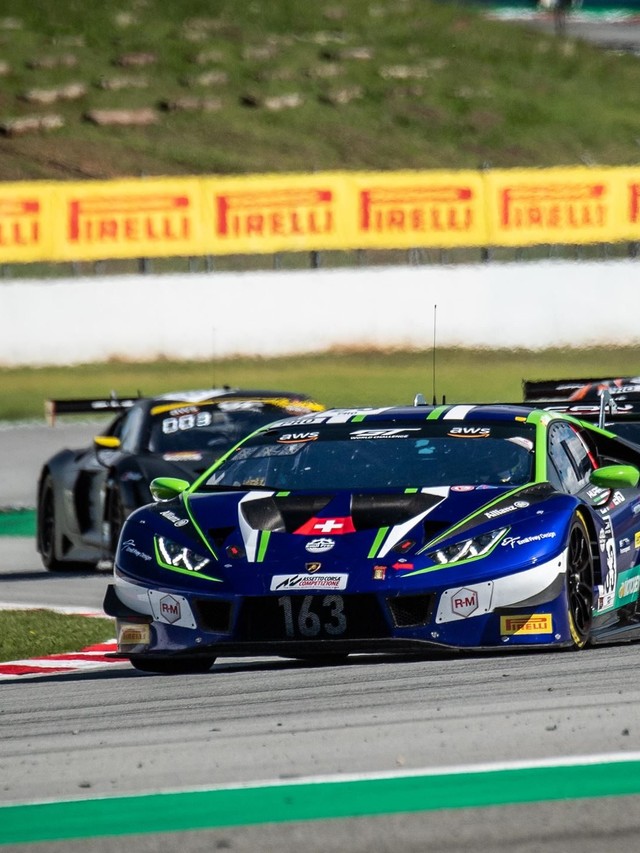
Emil Frey Racing‘s #163 Lamborghini Huracán GT3 Evo arrived at the Circuit de Barcelona-Catalunya for the GT World Challenge Europe Sprint Cup season finale sitting seventh in the standings. Albert Costa and Giacomo Altoè needed outright victories to mount a realistic title challenge across the three-race weekend. They got the speed. What they did not get was the result that speed deserved.
In the damp opening race on Saturday, the pair qualified third, lining up behind the sister Lamborghini of pole-sitters Riccardo Feller and Mikaël Grenier. Altoè jumped the Haupt Racing Team Mercedes of Maro Engel and Luca Stolz off the line to grab second, only to lose the position after cutting the chicane on lap one and dropping behind the #89 Mercedes. Costa took over at the mandatory driver change, leapfrogged the Mercedes, and inherited the lead when Grenier moved aside in the closing stages, recognizing the #163’s title ambitions. The winning margin was just over one-tenth of a second following a late full-course yellow.
Race 2 on Sunday looked even more convincing. Costa put the car on pole with a superb qualifying lap, led from the start, and Altoè extended the gap after the driver swap to cross the line more than seven seconds clear. Lamborghini says the Huracán was by far the fastest car in a straight line that afternoon. Costa and Altoè had closed to within 2.5 points of the Sprint Cup lead heading into the final race. And then the stewards intervened.
The Huracán GT3 Evo’s Raw Pace at Barcelona
Before dissecting the penalty, it is worth pausing on what the #163 actually demonstrated across the weekend. Qualifying on the front two rows for every race, winning from pole, and building a seven-second gap in Race 2 are not the marks of a car scraping by on strategy alone. Lamborghini’s official account emphasized the car’s straight-line speed advantage, and the results bore that out: Costa controlled the opening stint of Race 2 with a comfortable margin before handing over to Altoè, who stretched it further.
The Huracán GT3 Evo is an evolution of the original Huracán GT3, refined over years of customer racing to compete against the best that Mercedes-AMG, Ferrari, Porsche, and Audi field in the GT3 category. In Sprint Cup trim, where races are shorter and pit-stop strategy windows are tighter, raw qualifying pace and in-stint speed matter enormously. Emil Frey Racing, the Swiss squad that won the International GT Open title with Costa and Altoè the previous season, clearly extracted everything the platform could deliver.
Feller and Grenier in the sister #14 car reinforced the point. Feller set the fastest lap in Race 3 and finished third. Two Lamborghinis running at or near the front across all three races reflects a car and a team combination operating at a high level, which makes what happened next all the more painful.

The #163 Lamborghini Huracan GT3 Evo leads the pack during a thrilling race at the GT World Challenge Europe.
What the FHR Penalty Actually Means (and Why It Cost So Much)
The 35-second post-race penalty that dropped Costa and Altoè from first to 16th in Race 2 came down to a single procedural detail: the Frontal Head Restraint was not correctly positioned before the car left the pits after the driver change.
An FHR device (commonly known by the brand name HANS) is the U-shaped collar that sits behind a driver’s helmet and attaches to the harness. Its purpose is to prevent basilar skull fractures in frontal impacts, and it became mandatory in most professional motorsport categories after the deaths of Dale Earnhardt and others in the early 2000s. In GT3 racing, the FHR must be properly seated and connected before the car is released from the pit box. If it is not, the car is effectively racing with compromised safety equipment, and stewards treat the infringement accordingly.
A 35-second penalty for an FHR violation is not unusual in GT3 or GTE competition. The penalty exists precisely because the rule is non-negotiable: driver safety cannot be traded for pit-stop speed. What made this instance so consequential was the timing. Costa and Altoè won Race 2 by roughly seven seconds on the road. It did not just erase the victory; it buried the car deep in the classification, dropping it to 16th and obliterating the points haul they needed to challenge for the championship.
This is the kind of detail that separates professional GT3 racing from the spectacle most fans see on screen. Pit stops in Sprint Cup races involve a mandatory driver change, minimum stop times, and a checklist of safety procedures completed under intense time pressure. A mechanic or crew member misaligning the FHR by a few millimeters can cost a team everything. Emil Frey Racing’s crew would know the procedure intimately. These errors are not born from ignorance but from the relentless pressure of executing a stop where fractions of a second in the pit lane translate to positions on track.
The Championship Math After Barcelona
The penalty effectively ended the title bid before Race 3 even started. Costa and Altoè finished fifth, while Feller brought the #14 home in third with the weekend’s fastest race lap. Lamborghini confirmed this concluded a strong Sprint Cup season for Emil Frey Racing, though the word “strong” carries a bitter asterisk.
The team entered Barcelona seventh in points, won the first race, dominated the second on raw pace, and would have been within striking distance of the title had the penalty not intervened. The trajectory is clear: Lamborghini’s Sprint Cup campaign in 2020 produced speed, results, and a gut-punch moment that any racing fan can appreciate.
For teams running customer Huracán GT3 Evos, this kind of weekend is both encouraging and sobering. The car proved it could win outright and dominate on pace against Mercedes-AMG and other factory-supported entries. The lesson is that in GT3 racing, operational execution matters as much as lap time. A crew’s ability to nail every procedural detail under pressure is part of the competitive package, and Lamborghini’s Squadra Corse operation will have absorbed that lesson heading into the next major event.
Eight Cars for Spa: Lamborghini’s Endurance Pivot
With the Sprint Cup title gone, attention turned immediately to the 24 Hours of Spa at Spa-Francorchamps on October 23-25. Lamborghini confirmed it would field eight cars, a significant commitment to what remains one of the most prestigious GT endurance races on the calendar. The event was scheduled to run behind closed doors due to pandemic restrictions, but the competitive intensity would be undiminished.
The shift from Sprint Cup to a 24-hour endurance format changes the equation entirely. Sprint races reward qualifying pace and short-stint aggression. Spa rewards consistency, reliability, night-driving composure, and the ability to manage tires, fuel, and driver fatigue across hundreds of laps on one of Europe’s most demanding circuits. The Huracán GT3 Evo’s straight-line speed advantage, so visible at Barcelona, would need to be balanced against tire degradation through Eau Rouge, Blanchimont, and the long Kemmel straight over a full day of racing.
Eight entries represent a serious factory-backed effort. Lamborghini won the GT World Challenge Europe title in both 2017 and 2019, demonstrating that the brand’s customer racing infrastructure can deliver at the highest level when everything aligns. Spa offered a chance to close the season on a high note after the Barcelona drama, and the depth of entries suggests Lamborghini and its customer teams intended to compete for the overall GT3 victory rather than simply participate.
Anyone following Lamborghini’s motorsport trajectory knows the brand treats customer racing as a core pillar of its identity, not a marketing sideshow. Squadra Corse provides engineering support, factory drivers, and technical resources to teams like Emil Frey Racing. These are not token gestures. They reflect an operational philosophy where customer teams receive genuine factory backing, a model that Lamborghini executes with particular intensity given its smaller overall production volume.
Where the Huracán GT3 Evo Stands Against the Competition
The GT World Challenge grid in 2020 featured strong entries from Mercedes-AMG, Ferrari, Audi, and Porsche, among others. The Haupt Racing Team Mercedes of Engel and Stolz was a direct title rival at Barcelona, and the fact that Costa and Altoè needed team orders from the sister car to secure Race 1 illustrates how tight the competition was at the front.
Lamborghini’s advantage in this era centered on the Huracán GT3 Evo’s naturally aspirated V10, a powerplant that delivered linear throttle response and predictable power delivery, qualities that customer drivers particularly valued in wheel-to-wheel racing. The car’s straight-line speed at Barcelona was a standout characteristic, but GT3 Balance of Performance regulations exist to equalize machinery across manufacturers, meaning that advantage likely reflected circuit-specific BoP settings rather than an inherent engineering gap.
What the Barcelona weekend revealed more clearly was the quality of Lamborghini’s driver and team pairings. Costa and Altoè are proven winners. Feller and Grenier are quick enough to take pole positions and set fastest laps. The Huracán GT3 Evo platform, even as it matured, remained a car that professional drivers could extract consistent front-running pace from. The car’s reported price point of around $430,000 positioned it competitively against rival GT3 machinery, though exact current pricing varies by specification and market.
What Barcelona Tells Us About Lamborghini’s Racing DNA
The temptation with a weekend like this is to focus on the penalty as a failure. It was a costly error, full stop. But the more revealing reading for Lamborghini enthusiasts is what the weekend exposed about the car’s competitiveness and the brand’s commitment to fighting for championships rather than collecting participation trophies.
Emil Frey Racing won a race outright, dominated another on pace, and had two cars running at the sharp end of the field across all three encounters. The FHR penalty was a procedural mistake, not a mechanical failure or a strategic miscalculation. In the unforgiving world of GT3 racing, where safety regulations carry heavy consequences by design, these moments are part of the sport. The team and Squadra Corse would carry those lessons directly into the 24 Hours of Spa preparation.
For buyers and fans tracking Lamborghini’s motorsport presence, the practical takeaway from Barcelona is straightforward: the Huracán GT3 Evo remained a front-running car capable of winning races against the best GT3 machinery in Europe, and Lamborghini’s investment in customer racing showed no signs of slowing down. The championship slipped away on a technicality. The speed did not.


