Lamborghini’s LB744 Technical Preview: The V12 Goes Hybrid, the Dynamics Go Deeper
Days before the full reveal of its Aventador successor, Lamborghini released a detailed technical preview of the car it calls the LB744, focusing entirely on driving dynamics rather than design. The codename stands for what matters: a 6.5-liter naturally aspirated V12, mated to three electric motors and an entirely new chassis architecture, producing a combined peak of 1,015 CV in its most aggressive setting.
What makes this preview worth dissecting is the engineering philosophy it reveals. The LB744 does not simply bolt electric motors onto a familiar platform. Lamborghini rearranged the entire mechanical layout, moving the eight-speed dual-clutch transmission behind the V12 and mounting it transversely for the first time. That single packaging decision freed the central tunnel, home to the gearbox in every V12 Lamborghini since the Countach, for a lithium-ion battery pack. It cascaded into changes in weight distribution, chassis stiffness, and the way the car manages torque at all four wheels. One report indicates the engine itself is rotated 180 degrees compared to the Aventador’s powerplant. If the goal was to make a hybrid V12 that feels fundamentally different from its predecessor, the architecture alone suggests Lamborghini committed to that idea at the structural level.
The Monofusolage: Why a 25% Stiffer Chassis Changes Everything
Lamborghini describes the LB744’s structure as a “monofusolage,” an aviation-inspired term for an integral carbon fiber tub that replaces the Aventador’s monocoque. The company says it weighs 10% less than the outgoing chassis while delivering 25% more torsional stiffness. Those numbers matter because chassis rigidity is the foundation every other dynamic system builds on. Suspension tuning, steering response, aerodynamic load management: none of them work as intended if the structure underneath flexes unpredictably.
The Aventador, for all its drama, carried a reputation among track-focused owners for feeling less precise than its mid-engine rivals at the limit. A stiffer tub directly addresses that criticism. Combined with anti-roll bars that Lamborghini says are 11% stiffer at the front and 50% stiffer at the rear, the suspension geometry can be tuned more aggressively without worrying about compliance in the structure itself. The steering ratio drops 10% compared to the Aventador Ultimae, a calibration Lamborghini says it validated on the Huracán STO. Quicker steering on a stiffer chassis with wider front tires (Lamborghini cites a 4% larger front footprint from bespoke Bridgestone Potenza Sports) should produce a car that rotates more willingly into corners. For buyers who loved the Aventador’s theater but wished for sharper reflexes, this is the engineering answer.
Electric Torque Vectoring and Dinamica Veicolo 2.0: Precision Without Brake Drag
The LB744 introduces electric torque vectoring to a Lamborghini for the first time, and the distinction from conventional brake-based systems is worth understanding. Traditional torque vectoring slows an inside wheel by applying brake pressure, generating heat, wearing pads, and wasting energy. The LB744’s front e-axle, with its two independent electric motors, can instead add torque to the outside wheel while reducing it on the inside, creating a yaw moment through propulsion rather than friction.
Lamborghini says this system works in concert with four-wheel steering and a new vehicle dynamics controller called Dinamica Veicolo 2.0. In practice, the car can tighten its line in slow corners by pushing harder on the outside front wheel, then stabilize in high-speed sweepers by balancing torque across both fronts. Brake intervention happens only when strictly necessary. During deceleration, the e-axle and the rear electric motor contribute regenerative braking force, which Lamborghini says reduces stress on the physical brakes while recharging the battery.
This approach mirrors what several hybrid hypercar programs aim for, but Lamborghini’s specific advantage is scale. The LB744 is a series-production flagship, not a limited-run halo car. If the electric torque vectoring works as described, every owner gets a car that can rotate with precision the Aventador’s mechanical differential could never match. Ferrari’s SF90 Stradale uses a conceptually similar front-axle layout with two electric motors, but Lamborghini’s integration with four-wheel steering and the new dynamics controller represents a distinct calibration philosophy. How these two approaches feel at the limit remains the open question until independent track tests arrive.

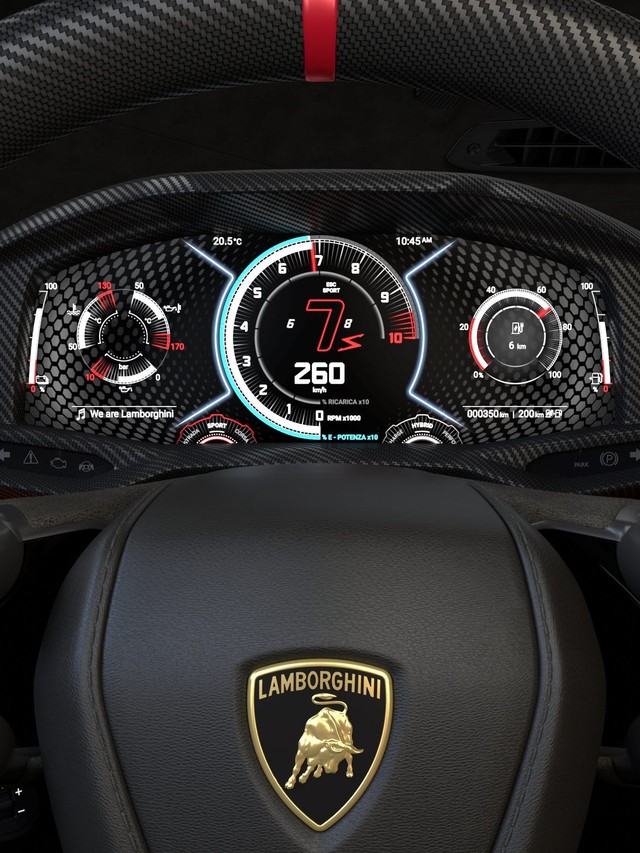
The Lamborghini LB744's digital dashboard in 'CORSA' mode, presenting a race-ready, minimalist display.
The V12 HPEV Powertrain: 1,015 CV and a Battery Where the Gearbox Used to Live
The LB744’s powertrain architecture is built around a completely new 6.5-liter naturally aspirated V12. According to Motor1, the engine alone produces 813 horsepower at 9,250 rpm and 535 pound-feet of torque at 6,750 rpm, placing its output close to the track-only Essenza SCV12‘s 818 hp. Previous top-spec Aventador V12 configurations, such as those in the Invencible and Autentica, produced 769 hp. The jump in specific output from a naturally aspirated engine of the same displacement is significant.
Three electric motors supplement the V12: two on the front axle and one integrated into the new eight-speed dual-clutch gearbox. The transverse mounting of that gearbox behind the engine is the packaging trick that makes the whole layout possible. By relocating the transmission out of the central tunnel, Lamborghini gained space for the lithium-ion battery in the car’s structural center, lowering the center of gravity and achieving a 44/56 front-to-rear weight distribution. Motor1 reports the new V12 weighs 218 kilograms, roughly 17 kg lighter than its predecessor. Every kilogram saved from the engine and repositioned in the battery contributes to that weight balance.
The dual-clutch gearbox itself represents a generational leap. The Aventador’s single-clutch automated manual was characterful but agricultural by modern standards. Multiple Revuelto owners on enthusiast forums describe the new DCT as a transformative improvement in daily drivability, smoother at low speeds while remaining aggressive under hard acceleration.
13 Driving Modes: From Silent City Cruising to 1,015 CV Track Attacks
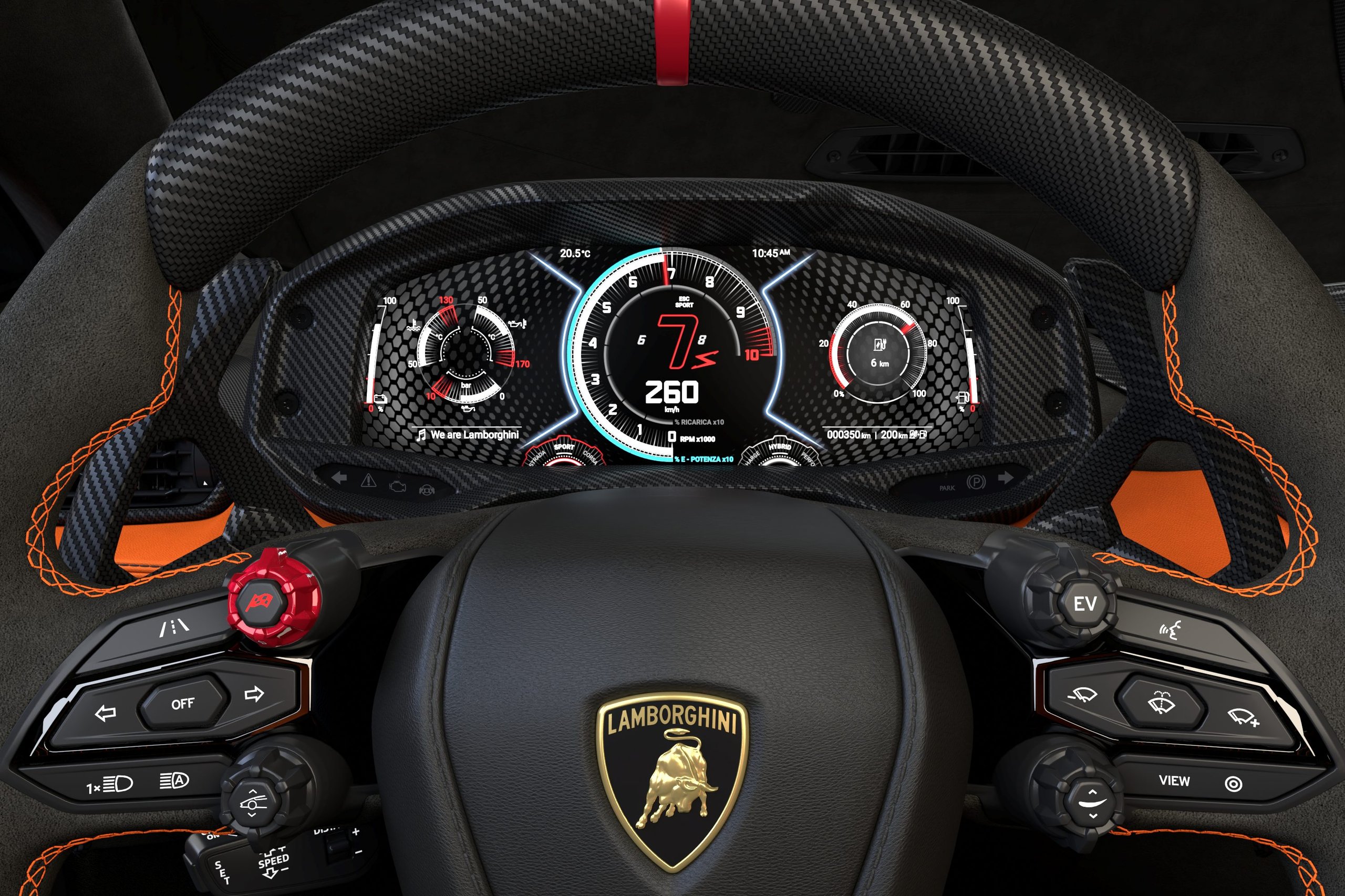
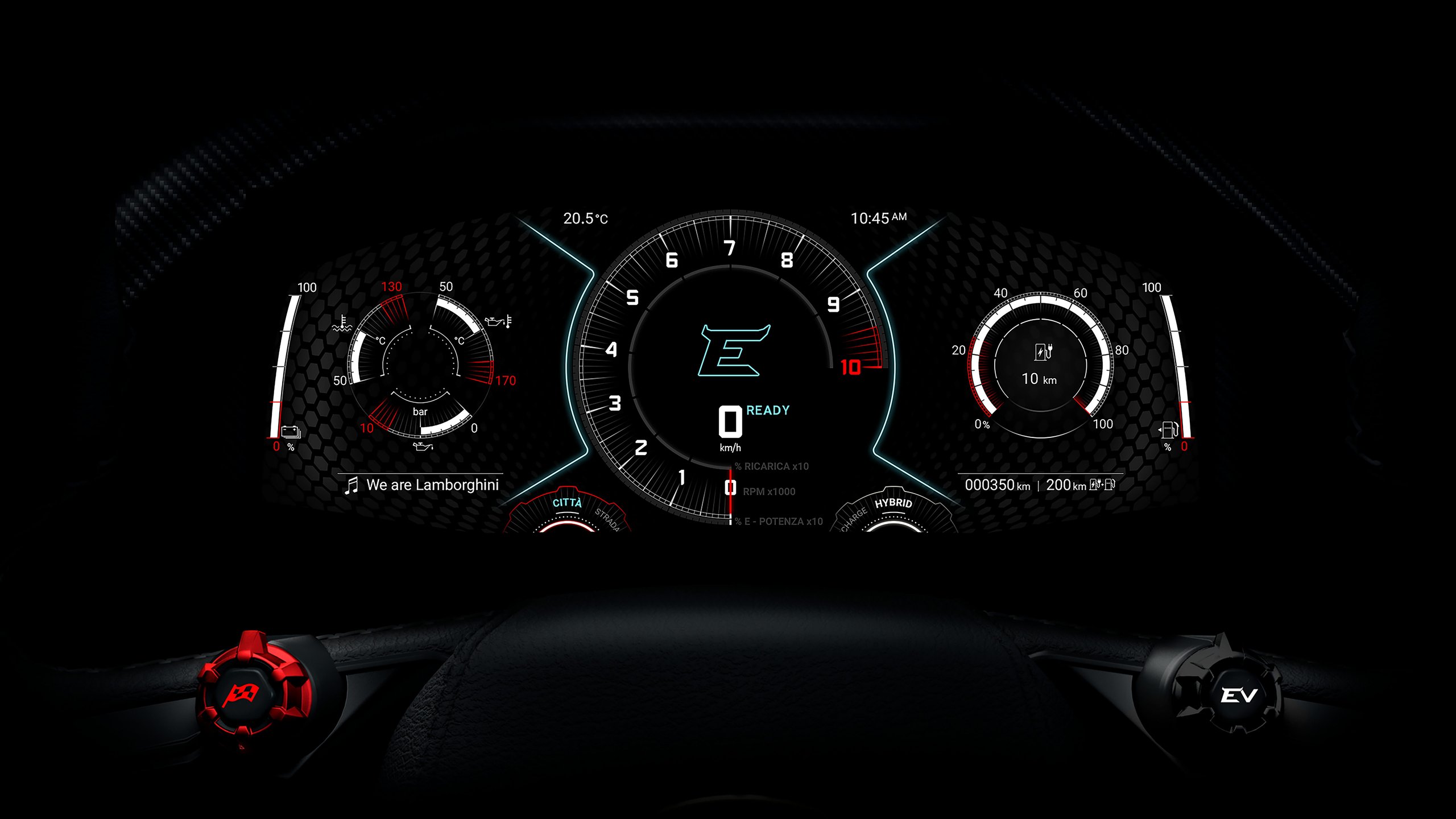
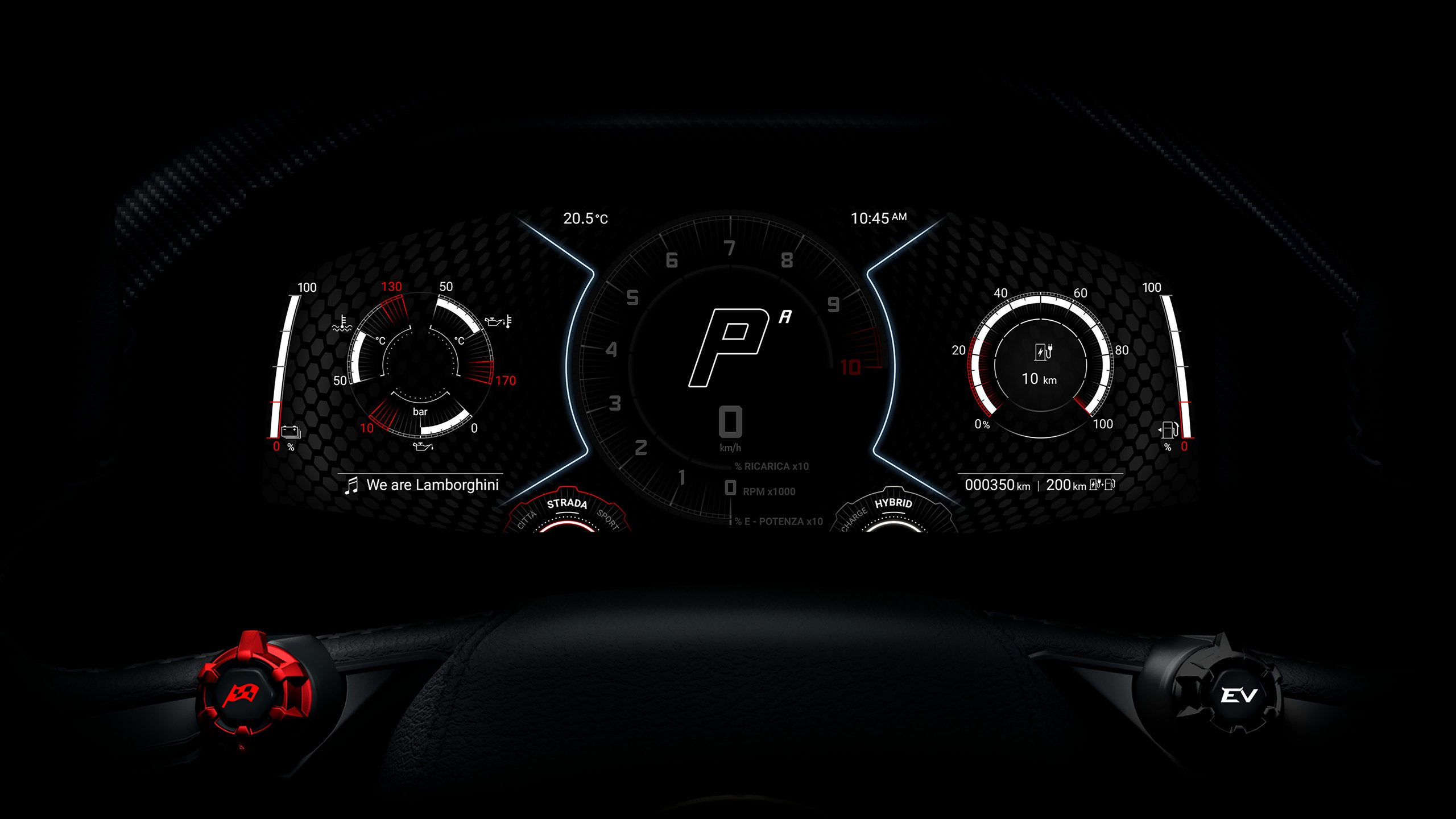
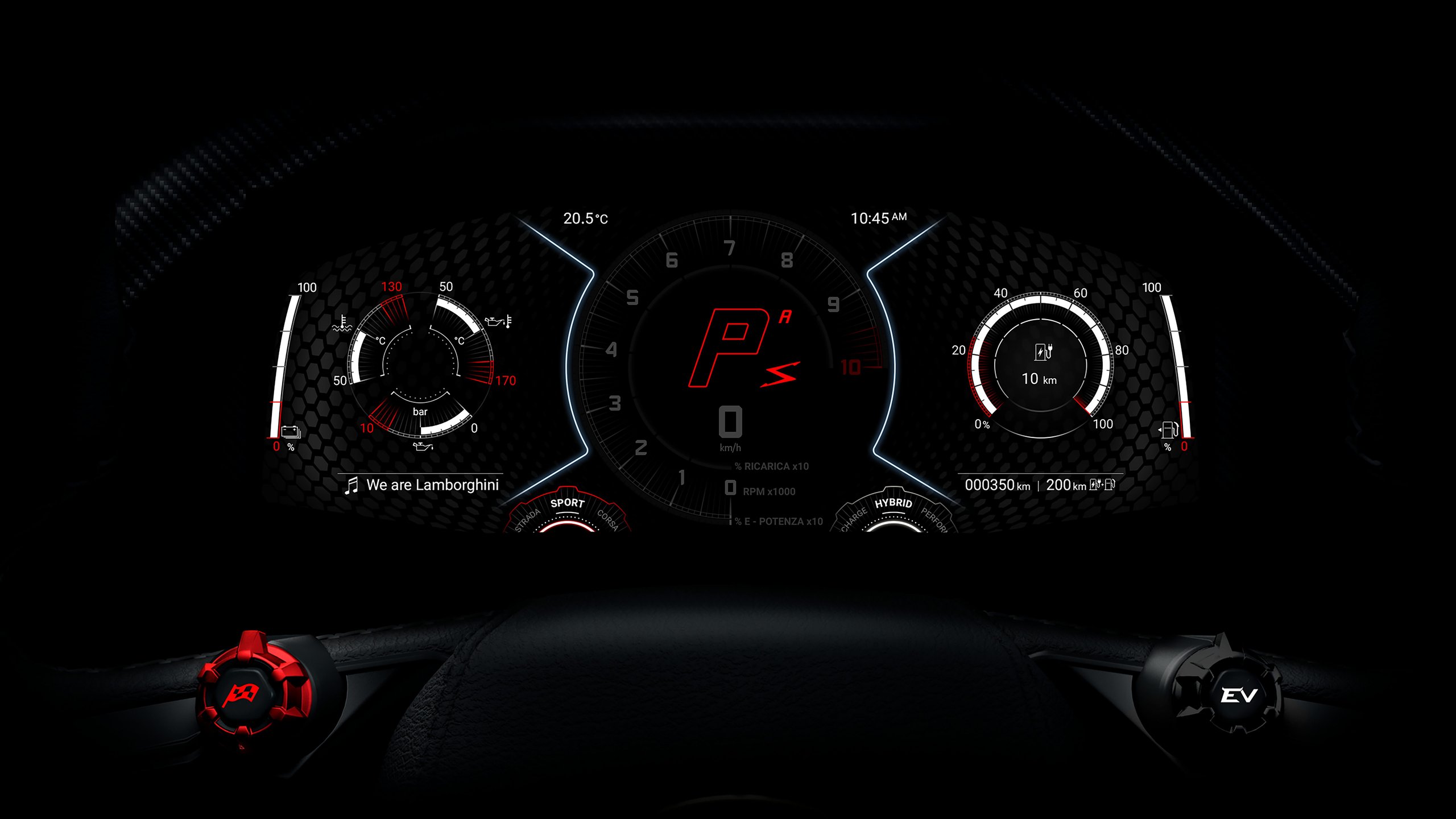
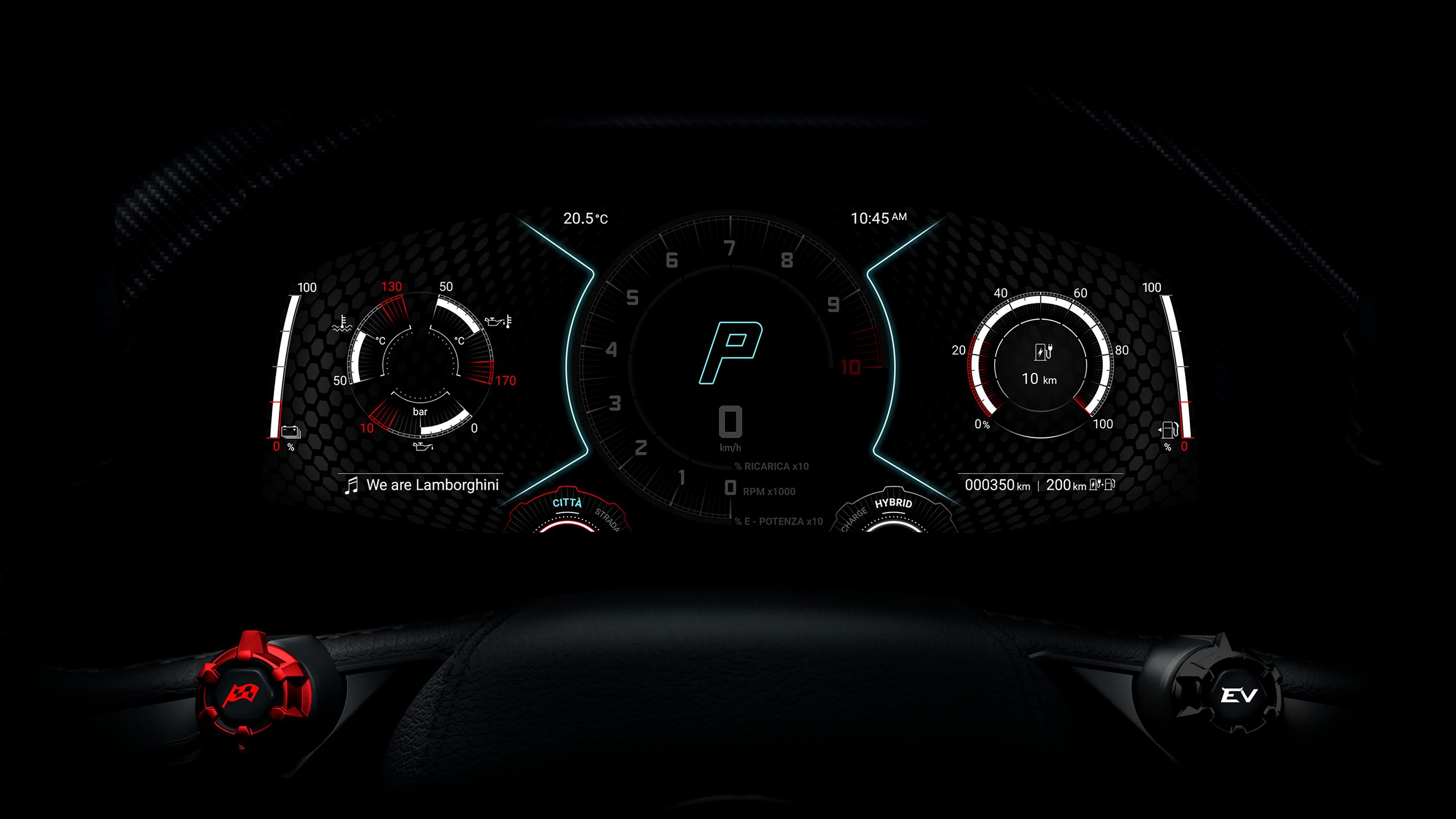
The LB744 offers 13 dynamic settings by combining four base modes (Città, Strada, Sport, Corsa) with three hybrid-specific overlays (Recharge, Hybrid, Performance), all selectable via two rotors on the steering wheel. The instrument cluster images confirm this interface: each mode produces a visibly different display layout, from the calm readouts of Città to the stripped-back, red-accented minimalism of Corsa.
Città limits output to 180 CV and runs on electric power alone for zero-emission urban driving. If the battery runs low, the V12 can recharge it in minutes. For owners in European cities with emission-restricted zones, this is a practical concession the Aventador could never make. Strada blends comfort with up to 886 CV, keeping the V12 active and the battery topped up while active aerodynamics adjust for high-speed stability. Sport pushes to 907 CV across its three hybrid sub-modes, sharpening gearbox response and suspension calibration. Corsa Performance delivers the full 1,015 CV with the hybrid system and e-axle optimized for torque vectoring. Expert drivers can disable ESC entirely and activate launch control via a button on the left steering-wheel rotor.
The breadth here is the point. The Aventador offered three modes. The LB744 offers 13, and the extremes of that range are genuinely different cars: a quiet, 180 CV electric commuter on one end, a 1,015 CV track weapon with no stability nannies on the other. For buyers who plan to actually drive these cars in varied conditions, and plenty of Lamborghini owners do, this versatility matters more than any single peak number.

The Lamborghini LB744's digital dashboard in 'CITTÀ' mode, ready for urban driving with essential information.
Braking and Aerodynamics: The Details That Separate Fast From Confident
Lamborghini says the LB744’s active aerodynamics deliver 61% more efficiency and 66% more downforce in high-load conditions compared to the Aventador Ultimae, with the front splitter and roof channeling air to a high-efficiency rear wing. These aero surfaces work in real time with the semi-active wishbone suspension through a system called Lamborghini Vertical Control, which electronically manages sudden load transfers during track driving by adapting both the suspension and the rear wing simultaneously.
The braking hardware reflects a similar philosophy of incremental, purposeful improvement. Latest-generation CCB Plus carbon ceramic brakes feature 10-piston front calipers, up from six on the Aventador Ultimae, paired with slightly larger 410x38mm discs. Friction-layered disc surfaces improve thermal management and reduce brake noise. Aerodynamic details like front suspension deflectors and rear NACA ducts channel underbody airflow directly to the brake cooling ducts, addressing a common complaint among Aventador track-day regulars about brake fade during extended sessions. Regenerative braking from the electric motors further reduces mechanical brake stress, which should extend pad and rotor life for owners who use track days as more than a photo opportunity.
What the LB744 Signals for Lamborghini’s V12 Future
Several important questions remain unanswered by this technical preview. Lamborghini did not disclose the electric-only range, the exact curb weight, or how the V12’s exhaust note changes across the hybrid modes. Pricing and production volume details are absent.
For prospective buyers, the practical takeaway is that the LB744’s architecture represents a clean-sheet commitment to electrified performance rather than a retrofit. The transverse gearbox, the battery-in-tunnel layout, and the electric torque vectoring system are all foundational decisions that will likely define Lamborghini’s V12 platform for the next decade. Ferrari’s SF90 Stradale proved that a hybrid V12-class car could be devastatingly quick, but it took a different path: twin-turbo V8 plus electric motors. Lamborghini’s insistence on keeping the naturally aspirated V12 and adding electrification around it is a philosophical statement as much as an engineering one. Whether that philosophy translates into a distinct driving character, one that feels more connected and analog despite the added complexity, will determine how the LB744 is remembered. The architecture suggests Lamborghini is betting heavily that it will.
Gallery