Racing Past the Twin Towers: Super Trofeo Asia Comes to Kuala Lumpur
Lamborghini brought its Blancpain Super Trofeo Asia series to the streets of Kuala Lumpur for the third round of the season, and the result looked nothing like a typical GT3 race weekend. The KLCGP circuit threaded Huracán GT3 race cars through the city’s commercial district, past luxury shopping malls and landscaped palm gardens, with the finish line sitting within sight of the Petronas Twin Towers. Lamborghini says the event drew the largest spectator turnout in the history of the Super Trofeo Asia series, a claim that carries real weight once you consider what a street circuit does that a permanent track cannot: it puts the car, the sound, and the brand directly into the daily life of a city.
Drivers from 11 countries lined up on a track defined by extremely tight corners, minimal runoff, and a bumpy surface that rewarded precision over outright aggression. Following earlier rounds at Fuji and Shanghai, this was the round where the series proved it could stage a genuine urban motorsport event. The visual spectacle of carbon-fiber race cars framed by tropical palms and skyscrapers gave Kuala Lumpur a character entirely its own, and the racing that unfolded on those streets told a larger story about what Lamborghini is building across Asia.
The Race: A 16-Place Charge Steals the Story
Qualifying put local PRO driver Afiq Yazid on pole. Yazid, a graduate of the Lamborghini Squadra Corse Young Drivers Program, carried the weight of a home crowd on his shoulders, with Kazuki Hiramine second and Yudai Uchida third on the grid. Toshiyuki Ochiai slotted into fourth overall and third in the PRO-AM class.
The race itself scrambled the order in ways that only a street circuit can. Yuan Bo, another Young Drivers Program participant, started eighteenth alongside teammate Eduardo Liberati. The pair carved through the field to finish second overall, a climb of sixteen positions that stands as the most dramatic result of the season so far. Ochiai advanced one spot to finish third. Uchida slipped to fourth. Yazid, despite his pole, dropped to fifth, a reminder that on a street circuit, qualifying pace and race-day survival require very different skill sets.
Hiramine held his nerve throughout, converting his second-place qualifying into a race win. In the AM class, Kimura Takeshi led from the front, taking the top grid position and the class victory. Akira Mizutami and Hajime Noma finished second in AM, with Michael Choi and Keith Chan rounding out the class podium.
The standout number remains that sixteen-position gain by Bo and Liberati. On a circuit with almost no runoff and walls waiting at every exit, passing that many cars requires bravery, racecraft, and a car that inspires confidence under braking. That a Young Drivers Program entrant could execute that kind of charge without ending up in the barriers says something important about both the talent pipeline and the machine underneath him.

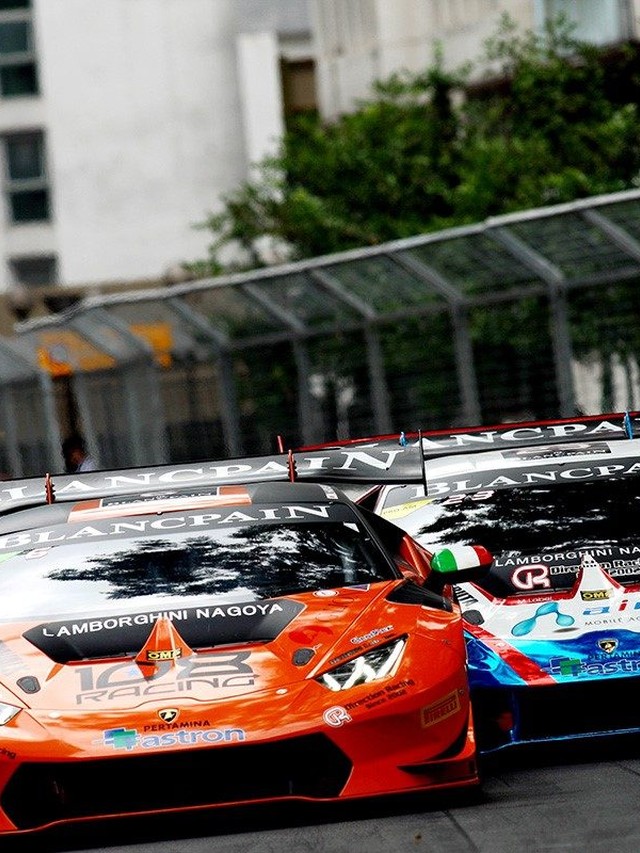
Two Lamborghini Huracan GT3 race cars, one orange and one one blue and white, compete closely on the track.
Why Street Circuits Matter to Lamborghini’s Brand Story
Permanent circuits are where lap times get set. Street circuits are where brands get made. The distinction matters because the Super Trofeo series serves a dual purpose: it develops drivers and it sells the idea of Lamborghini as a motorsport brand to people who will never turn a competitive lap themselves. Spectators at Kuala Lumpur watched GT3 cars thread past buildings they walk into every day. The experiential gap between seeing a Lamborghini race and seeing a Lamborghini race past your office is enormous, and the record crowd suggests Lamborghini understands that.
The one-make format amplifies the effect. Every car on the grid is a Huracán GT3, which means total visual saturation for the brand. No mixed-manufacturer grids diluting the message. For a company that sells fewer than 11,000 road cars a year globally, that kind of concentrated exposure in a high-net-worth Asian market is worth more than any billboard campaign. The gentleman-driver format also means that the people racing are often the same people buying road-going Huracáns and Aventadors, creating a feedback loop between the showroom and the paddock that few other manufacturers replicate as directly. Kuala Lumpur proved that when you combine that format with a street circuit in the right city, the series becomes something closer to a cultural event than a race meeting.
Forging Talent: The Young Drivers Program on Display
Both Afiq Yazid and Yuan Bo came through Lamborghini’s Squadra Corse Young Drivers Program, and their performances in Kuala Lumpur illustrate why the program exists. Yazid qualified on pole at his home race. Bo delivered the drive of the day from the back of the grid. These are not abstract development statistics; they are race-winning results produced by a talent pipeline that Lamborghini operates alongside its customer racing business.
The Young Drivers Program occupies a strategic position that few rival one-make series match in quite the same way. Ferrari Challenge, by comparison, leans heavily on client exclusivity, often requiring participants to own Ferrari road cars and positioning the series as an extension of the ownership experience. Lamborghini’s approach blends that gentleman-driver accessibility with a genuine talent-development pathway. The result is a grid that includes both wealthy amateurs learning racecraft and young professionals building careers, which produces more competitive racing and, critically, a better spectacle for the crowds lining the streets.
The practical takeaway is straightforward: the Super Trofeo series functions as both a proving ground for Lamborghini’s racing hardware and an incubator for the drivers who will eventually compete in higher-tier GT3 and GT World Challenge events. When Lamborghini talks about its motorsport commitment, the Kuala Lumpur results are the receipts.
The Huracán GT3 on Urban Asphalt
The Huracán GT3 succeeded the Gallardo Super Trofeo as the backbone of Lamborghini’s customer racing program, and the Kuala Lumpur circuit exposed qualities that rarely surface on a smooth, wide permanent track. The bumpy surface, the tight corners requiring late and aggressive turn-in, the complete absence of gravel traps or tarmac runoff: this is the kind of environment that punishes an unpredictable car and rewards one with transparent front-end feel and stable braking.
Bo’s sixteen-place charge is the most compelling evidence that the platform delivers exactly that. A car that felt vague or nervous under braking into a blind corner flanked by concrete walls would not invite a young driver to attempt that many overtakes. The Huracán GT3’s naturally aspirated V10 also offers a throttle response advantage on a circuit where exits are short and precise power modulation matters more than peak output. Turbo lag, even the small amounts present in modern racing engines, becomes a liability when the margin between apex and wall is measured in centimeters.
This matters beyond Kuala Lumpur because Lamborghini’s next-generation customer race car, the Temerario GT3, moves to a twin-turbo V8 architecture. According to Autoblog, the Temerario GT3 is Lamborghini’s first competition car to be fully designed, developed, and built in-house. How Squadra Corse translates the Huracán’s street-circuit confidence into a turbocharged successor will be one of the most closely watched engineering stories in customer racing over the next few years.
Super Trofeo Asia in the Competitive Landscape
Lamborghini operates the Super Trofeo across three regional series covering Europe, North America, and Asia, and the Asian series carries particular commercial weight. The region’s growing population of ultra-high-net-worth individuals represents a critical market for supercar manufacturers, and a one-make racing series that visits cities like Shanghai, Fuji, and now Kuala Lumpur functions as a rolling brand activation in exactly the markets where Lamborghini wants to grow.
Ferrari Challenge runs a similar geographic strategy but differs in emphasis, leaning on heritage and the Formula 1 halo effect to position the Challenge as a privilege of ownership. Lamborghini’s Super Trofeo blends accessibility with spectacle: the gentleman-driver format is welcoming, but the GT3-spec machinery and the willingness to race on demanding street circuits signal a brand that wants to be seen competing, not just parading. Porsche’s Carrera Cup occupies yet another lane, with deeper grids and a more established feeder-series reputation, but without the visual drama of a mid-engine Italian supercar sliding past palm trees.
The Kuala Lumpur round demonstrated that Lamborghini can draw record crowds and produce genuinely compelling on-track action on a street circuit that most series would never attempt. As the Temerario GT3 prepares to replace the Huracán on the grid, the strategic question becomes whether Lamborghini can maintain the naturally aspirated car’s street-circuit character in a machine built around a fundamentally different powertrain. The record attendance in Kuala Lumpur suggests the audience is already invested in finding out.


