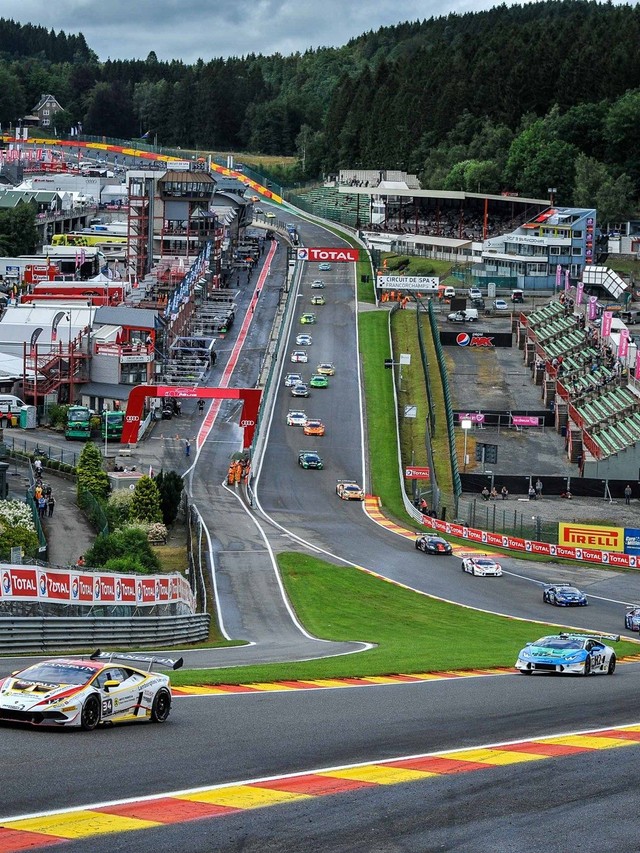
Fifty Cars on the Grid at Spa: A Milestone Worth Understanding
When 50 Lamborghini Huracán LP 620-2 Super Trofeo cars rolled onto the grid at Spa-Francorchamps on July 29, 2016, the number itself told a story no single race result could. Lamborghini says this was a record for the Blancpain Super Trofeo Europe, and for a one-make series only seven years old at the time, filling one of the world’s most demanding circuits with that kind of density meant the program was pulling weight far beyond what most manufacturer-backed series manage in their first decade.
Bonaldi Motorsport’s Adrian Amstutz and Patrick Kujala made the occasion count. Kujala, who took pole position in the opening qualifying session, built a lead exceeding 20 seconds during his first stint, turning what should have been a chaotic 50-car scrum into something closer to a masterclass. Even a safety car intervention, triggered by first-lap contact between Marco Mapelli and Amir Krenzia at La Source, failed to dent the pair’s authority. Amstutz brought the car home for what Lamborghini confirmed was their first overall victory of the season and their fifth class win, stretching their advantage in the PRO-AM championship standings.
Yet the grid count mattered more than the margin of victory. Earlier that season, the Monza round attracted 47 entries, itself a strong number. Spa pushed past it. The Lamborghini Blancpain Super Trofeo Europe series launched in 2009 with the Gallardo as its platform. Reaching 50 starters within seven seasons, on a circuit where logistics and track time are fiercely contested, signaled that Lamborghini’s customer racing ecosystem was scaling in a way that justified serious strategic investment from Sant’Agata.
Bonaldi’s Authority and the Multi-Class Battle Beneath It
Kujala and Amstutz’s dominance told one story. The battles behind them told several others, each revealing how the Super Trofeo‘s multi-class format turns a single grid into overlapping championships with genuinely separate narratives, all of them feeding the same conclusion: this series had outgrown its boutique origins.
In the PRO class, Harald Schlegelmilch of Artline Team Georgia finished second overall, earning his first PRO victory of 2016 after a sustained fight with the Konrad Motorsport pairing of Christopher Zöchling and Florian Spengler. “Another podium and important points. I’m happy with this result also from the point of view of the championship,” Schlegelmilch said afterward, the kind of measured satisfaction that suggests a driver playing the long game rather than celebrating a single result.
The real drama in the PRO standings belonged to Dennis Lind. The Dane, racing for Raton Racing, qualified a dismal twentieth. Over the course of the race he carved through 13 positions to finish seventh, a recovery drive that kept him at the top of the PRO championship with a four-point buffer over Vito Postiglione of Imperiale Racing, who finished fourth overall. For anyone who followed the 2016 season closely, Lind’s ability to extract results from poor grid positions became a recurring theme.
The AM class delivered a first-time winner in Nouri Shahin of Leipert Motorsport, who navigated tricky conditions as the track started wet and dried through the pit window, beating Philipp Schlegel of Sportec Motorsport. Schlegel had by that point strung together three consecutive podium finishes after debuting at the previous Paul Ricard round. Gerard Van der Horst, racing for his family’s own Van der Horst Motorsport squad, claimed his maiden Lamborghini Cup victory. “This is the first victory of my career,” he said. “The race was hard fought. I’m really happy.” In a series designed partly to give gentleman drivers competitive structure, moments like that carry real weight, and they only happen when the grid is deep enough to produce genuine racing at every level.
The Huracán Super Trofeo: Why the Platform Attracted Record Numbers
A 50-car grid does not materialize by accident. The Huracán LP 620-2 Super Trofeo, revealed in 2014, represented a significant step forward from the Gallardo-based cars that launched the series. One report attributes the 2016 season’s growth partly to the introduction of the Huracán platform in 2015, noting that the car was a more dedicated racing machine than its predecessor, featuring rear-wheel drive, an Xtrac sequential gearbox, and advanced aerodynamic elements.
For privateer teams and gentleman drivers, that combination matters enormously. A rear-drive layout with a sequential box offers a more accessible learning curve for amateur racers than a complex all-wheel-drive system, while still delivering the kind of mechanical engagement that keeps experienced drivers interested. The Huracán Super Trofeo gave Lamborghini a car that could serve both ends of its customer base: serious enough for professionals building GT3 careers, approachable enough for wealthy enthusiasts who wanted competitive wheel-to-wheel racing without the full complexity of open-class GT machinery.
Bonaldi Motorsport exemplifies the kind of established team infrastructure that grew alongside the series. The squad built consistent success within the Super Trofeo framework, and its prominence at the sharp end of the grid by 2016 reflected both the team’s competence and the series’ ability to sustain professional-caliber operations within a customer racing format. Three Bonaldi entries finished in the top seven at Spa, a depth of performance that only a healthy, well-supported championship can produce.
What the 2016 grid also demonstrated is something ownership-focused enthusiasts tend to overlook: a thriving one-make series directly supports residual values and brand cachet for the road cars. When 50 Huracán race cars fill Spa’s grid, the message to every Huracán road car owner is that their car’s DNA is being validated at the highest level of single-marque competition. That feedback loop between track and showroom is deliberate, and Lamborghini’s Squadra Corse division understood it well.
Customer Racing as Brand Strategy: The Super Trofeo’s Competitive Position
Lamborghini was not operating in a vacuum. Ferrari Challenge and the Porsche one-make series both offered well-established customer racing ecosystems by 2016, and the question for any prospective Super Trofeo entrant was whether Lamborghini’s program delivered comparable value in terms of competition quality, support infrastructure, and the social currency that comes with racing at iconic venues.
The 50-car grid at Spa provided a compelling answer. Grid density is one of the most honest metrics in customer racing because it reflects real purchasing decisions by teams and drivers who could spend their money elsewhere. When participants choose to buy, prepare, transport, and race a Lamborghini at that volume, the series is clearly delivering something beyond marketing brochures. The multi-class structure, spanning PRO, PRO-AM, AM, and Lamborghini Cup, widened the competitive aperture, allowing drivers at very different skill levels to race on the same grid with meaningful class battles rather than simply circulating as backmarkers.
For buyers considering Lamborghini ownership more broadly, the health of the Super Trofeo series functions as a practical signal. A robust customer racing program means better parts availability, deeper engineering knowledge within the dealer and team network, and a community of owners who use their cars rather than simply storing them. By its eighth season in 2016, the series had built exactly that kind of ecosystem, with parallel championships running in Europe, Asia, and North America.
From the Huracán Grid to the Temerario GT3: What 2016 Foreshadowed
The 2016 Spa grid looks even more significant when viewed through the lens of what Lamborghini built afterward. The Huracán Super Trofeo platform evolved through EVO and EVO2 specifications in subsequent years, each iteration refining the car while maintaining the series’ accessibility. But the real payoff came with the announcement that Lamborghini would develop the Temerario GT3 entirely in-house.
As Autoblog reported, the Temerario GT3 debuted at the 2025 Goodwood Festival of Speed as Lamborghini’s first competition car to be fully designed, developed, and built internally, rather than outsourced to a partner constructor. That decision carries enormous implications. Bringing GT3 development in-house means Lamborghini’s Squadra Corse division now controls the entire pipeline from road car engineering to race car homologation, a level of vertical integration that the Super Trofeo’s growth helped justify.
The connection between a 50-car grid at Spa in 2016 and an in-house GT3 program nearly a decade later is not a straight line, but the trajectory is clear. The Super Trofeo proved that Lamborghini could attract, retain, and support a large base of racing customers. It demonstrated that the brand’s motorsport credibility extended beyond marketing into genuine competitive infrastructure. And it built the institutional knowledge within Squadra Corse that made the leap to in-house GT3 development a logical next step rather than a speculative gamble.
For current and prospective Lamborghini owners, the practical takeaway is straightforward: the company’s commitment to customer racing is not a side project. It is a core strategic pillar that shapes how future road cars are engineered, how the dealer network supports performance-oriented customers, and how the brand positions itself against Ferrari and Porsche in the most tangible arena available.
Championship Stakes Heading Into the Second Half of 2016
Race 1 at Spa reshuffled several championship conversations heading into the season’s second half, and the scale of the grid made every point harder to earn. Amstutz and Kujala extended their PRO-AM lead beyond the single point they held entering the weekend, with Rik Breukers of GDL Racing (eighth overall, second in class) and Simone Pellegrinelli of Imperiale Racing trailing behind. In the PRO standings, Lind’s seventh-place recovery maintained his four-point cushion over Postiglione, setting up what promised to be a tense run to the season finale.
The weekend was not without complications. The second qualifying session was postponed to the following morning after an off-track excursion by the car of Eugenio and Sergio Montez during Q1 disrupted the schedule. Spa’s notoriously unpredictable weather added another variable: Shahin noted that the track was wet at the start of Race 1 and dried through the pit stop window, a condition that rewards adaptability and punishes rigid strategy.
Nicolas Armindo, who qualified second fastest with the lead Konrad Motorsport entry, saw his race unravel after a spin dropped him down the order. In a field of 50 cars, recovery from such incidents is exponentially harder than in a typical 20-car grid, a reality that made Lind’s 13-position climb all the more impressive and Amstutz and Kujala’s wire-to-wire control all the more decisive.
Rolf Ineichen and Martin Kodric, both running under the Bonaldi Motorsport banner, rounded out the top six in fifth and sixth positions respectively, giving the team three cars in the top seven. That kind of team depth reflects the operational scale the Super Trofeo’s growth enabled. Running three competitive entries at a circuit like Spa requires logistics, engineering support, and driver management infrastructure that only a healthy series can sustain. The record grid at Spa was not just a number for the press release. It was proof that Lamborghini’s customer racing ambitions had reached a critical mass, one that would shape the company’s motorsport trajectory for the decade to come.
Gallery


