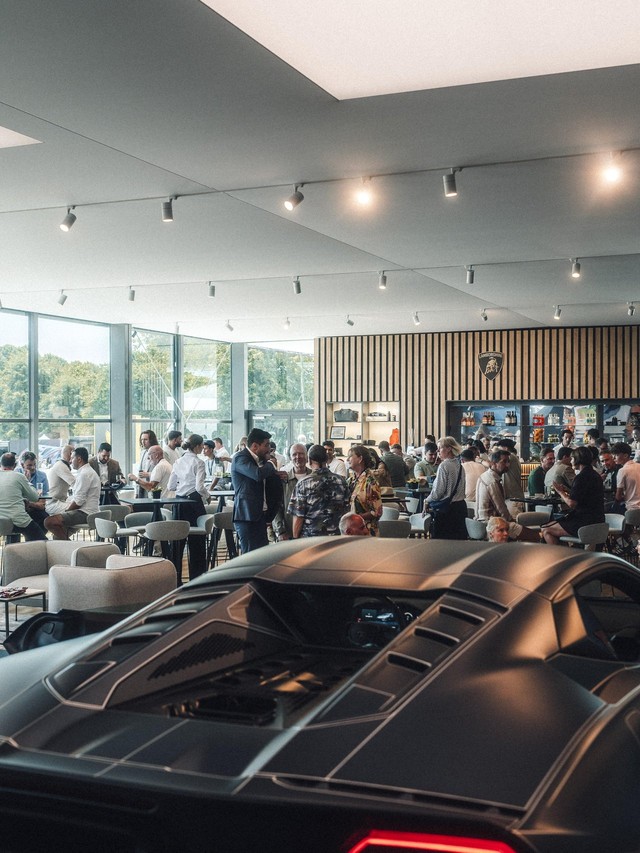
Lamborghini’s Third Consecutive Top Employer Accolade
In February 2016, Automobili Lamborghini confirmed it had earned the Top Employer Italy 2015 certification for the third consecutive year, a recognition awarded annually by the Top Employers Institute to companies demonstrating excellence in workplace environment and human resource management. A corporate HR award might not quicken the pulse of anyone who follows Lamborghini for its V12 symphonies and carbon fiber obsessions. What made this particular announcement worth reading was a single sentence from then-President and CEO Stephan Winkelmann.
Winkelmann stated that the certification validated Lamborghini’s investment in its people, calling it crucial for “the introduction of the third model and the doubling of the Sant’Agata Bolognese factory.” That third model would become the Urus, a vehicle that redefined Lamborghini’s commercial trajectory. The factory doubling was no figure of speech. In the measured language of HR awards and corporate strategy, Lamborghini was telegraphing its intention to become a fundamentally larger company. Building better cars requires building a better organization first, and this award served as public proof that the groundwork was already underway.
Why HR Excellence Paved the Way for the Urus and a Bigger Factory
Supercar manufacturers operate at the intersection of artisan craft and advanced engineering. Every panel fit, every calibration map, every hand-stitched interior requires people whose skills are difficult to recruit and expensive to lose. When Lamborghini reported employing 1,300 people at Sant’Agata Bolognese as of early 2016, that number represented a company preparing to roughly double its physical footprint and add an entirely new vehicle segment to its lineup.
The hiring data reinforced the ambition. Lamborghini says it brought on 150 highly qualified technicians and specialists in 2015 alone, and that nearly 600 people had joined on open-ended contracts over the preceding five years. Open-ended contracts signal long-term commitment, the kind a company makes when it knows it will need those people for a decade-long product cycle. The Urus concept had been shown publicly at Beijing in 2012, so by 2015 the development program was deep into engineering validation. Attracting and retaining the right talent during that critical window was not a nice-to-have. It was existential.
The production-ready Urus was unveiled in December 2017 and entered production in February 2018. One report indicates Lamborghini now employs over 3,000 people at Sant’Agata Bolognese, more than doubling the 2016 headcount. Winkelmann’s 2016 statement about doubling the factory was, if anything, conservative in describing what actually happened to the workforce.
Inside Sant’Agata: What Made Lamborghini a Top Employer in 2015
The Top Employers Institute certification process evaluates nine criteria, encompassing salary policies, working conditions and benefits, training and professional growth, career opportunities, and corporate culture. Lamborghini does not build cars in volume comparable to mainstream manufacturers, which means every employee carries disproportionate influence over quality. A poorly motivated assembly technician at a company producing 150,000 sedans a year is a statistical blip. At a company hand-building a few thousand supercars, that same disengagement can mean a customer receiving a car with a rattling trim piece.
This practical reality is why HR awards matter to enthusiasts, even when the connection feels abstract. The certification process examines whether a company creates conditions where skilled people want to stay, grow, and do their best work. For a brand whose entire value proposition rests on craftsmanship and engineering precision, the alignment between employee satisfaction and product quality is unusually direct.
Lamborghini’s HR leadership at the time emphasized the link between motivation and employer attractiveness, particularly through collaborations with universities and technical schools. In the Emilia-Romagna region, where Ferrari, Ducati, Maserati, and Pagani all compete for the same pool of engineering graduates and skilled technicians, winning the talent war is a genuine competitive advantage. Earning Top Employer certification three years running was Lamborghini’s way of advertising to prospective hires that it offered something beyond the badge on the building.
From People to Performance: How Employee Investment Shapes Lamborghini’s Cars
The connection between workplace culture and product excellence is easy to assert and difficult to prove, but Lamborghini’s trajectory from 2015 onward offers one of the cleaner case studies in the supercar world. The company used the years between the Top Employer certification and the Urus launch to scale up its workforce, expand its facilities, and develop a vehicle on the Volkswagen Group MLB Evo platform that required integrating competencies Lamborghini had never needed before: SUV chassis dynamics, a twin-turbocharged V8 powertrain, and manufacturing processes suited to significantly higher volumes.
None of that happens without deep bench strength in engineering, production, and quality control. The 150 specialists hired in 2015 were joining a company that knew it would ask them to do things Lamborghini had never attempted. Building the Urus demanded expertise in areas ranging from all-wheel-drive calibration for off-road modes to rear-seat ergonomics, disciplines that a two-model supercar company simply did not possess when the concept debuted in 2012.
For buyers and collectors, the practical takeaway is straightforward: Lamborghini’s investment in its workforce during this period is a meaningful part of why the Urus launched as a polished, competitive product rather than a rough first attempt. Companies that underinvest in talent during scale-up phases tend to produce vehicles with quality issues in their early production runs. The Urus largely avoided that trap.
The Competitive Landscape and What This Means Today
Ferrari did not enter the luxury SUV segment until the Purosangue arrived years later. McLaren has never attempted one. Aston Martin launched the DBX but faced well-documented production and quality growing pains during its own factory expansion at St Athan. Lamborghini’s decision to invest heavily in its people before attempting to double its output looks, in retrospect, like the strategically sound sequence: build the team, then build the factory, then build the car.
The long-term validation is striking. According to the Randstad Employer Brand 2026 survey, Lamborghini ranked first overall among 150 leading Italian employers, earning 79.8% of preferences from over 7,000 respondents. One 2026 report describes Lamborghini as “Italy’s Best Employer” for the twelfth consecutive year. The 2015 certification was not a one-off PR exercise. It marked the beginning of a sustained competitive advantage in talent acquisition that continues to pay dividends as Lamborghini navigates its hybrid transition with the Revuelto and Temerario.
For anyone who follows this brand closely, the lesson is worth remembering the next time Lamborghini announces a new model or technology shift. The cars that arrive in showrooms reflect decisions made years earlier about who builds them, how those people are trained, and whether the company created conditions where excellence is the default expectation. In 2015, Lamborghini was quietly assembling the human infrastructure for its most ambitious expansion in decades. The Urus, and everything that followed, was the result.
Gallery


