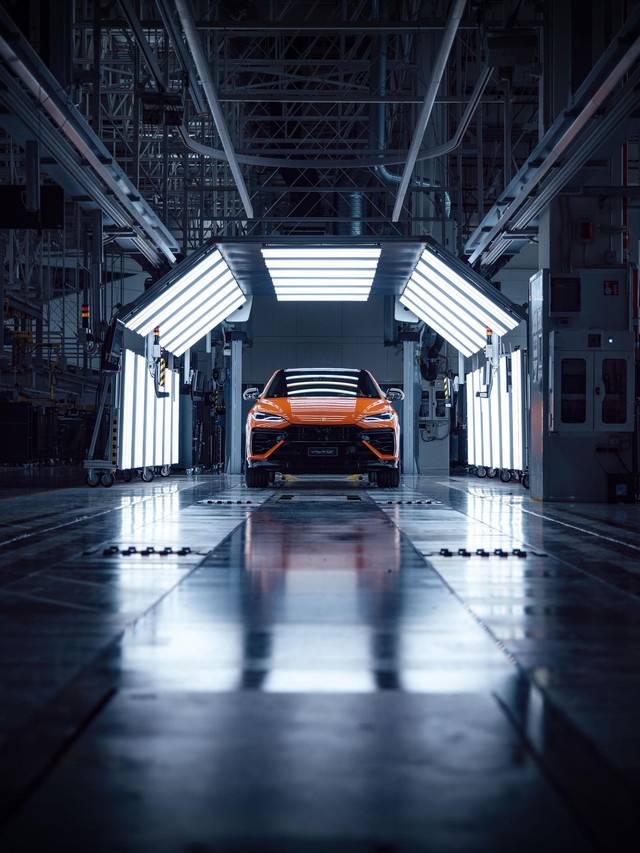
A New Paint Facility, a New Manufacturing Philosophy
When Lamborghini opened a dedicated paint shop for the Urus Super SUV at Sant’Agata Bolognese, the company did more than add square footage. It built the first automotive paint plant in the world to integrate artificial intelligence directly into the painting process, a distinction that sounds like marketing until you understand what it actually does for the cars rolling out the door.
Color is one of the most emotionally charged decisions an ultra-luxury buyer makes, and Urus paint work was becoming too complex and too personalized to manage with conventional linear systems. Lamborghini’s answer was to bring the entire process in-house, under AI supervision, at the same site where the SUVs are assembled. For prospective Urus owners weighing Ad Personam options, this is the infrastructure that makes a truly one-off color feasible rather than theoretical.
How AI and Factory 4.0 Actually Work on the Paint Line
Lamborghini describes its Factory 4.0 concept as the integration of traditional craftsmanship with advanced digitalization, and the new paint shop is the clearest expression of that idea to date. The AI system functions as a process manager: it remembers every paint job completed, calculates the time required for each individual vehicle, and programs subsequent steps based on accumulated experience. If a particular Ad Personam shade requires a specific quantity of pigment or an unusual number of coats, the system learns that and applies the knowledge to the next order.
The warehouse feeding the paint line is fully automated and managed by the same AI, staging and delivering color materials without human scheduling delays. Lamborghini says this approach provides responsiveness and flexibility that traditional warehouses cannot match, a claim that makes practical sense when you consider the sheer variety of finishes moving through the facility on any given day.
Just as critical is the modular layout. Unlike standard automotive paint shops, which push every body through the same linear sequence regardless of color type, this plant activates different process paths depending on what a specific vehicle requires. A standard Bianco Monocerus and a bespoke Ad Personam metallic do not follow identical routes. That modularity is what makes the “infinite color” promise logistically real rather than aspirational.
Robots and Hands: Where Machines Stop and Craftspeople Start
The painting process blends robotic and manual phases in a deliberate division of labor. Robots handle repetitive, ergonomically demanding tasks such as consistent primer application across large body panels, while human operators contribute the manual precision that defines a luxury finish. Exterior aesthetic elements like bumpers and mirrors are painted in parallel with the bodywork to guarantee color uniformity, a detail that matters more than it sounds. Anyone who has seen an aftermarket-painted bumper that doesn’t quite match the fender knows the value of simultaneous application under identical conditions.
The workforce expansion tells its own story. The new facility required approximately 200 additional employees, with over half already integrated into the plant at the time of the inauguration. Lamborghini says each new hire underwent twelve months of specialized training before touching a production vehicle. That investment in human skill alongside AI capability captures the real Factory 4.0 thesis: technology handles logistics and repeatability, people handle judgment and finesse.
What “Infinite Colors” Means for Ad Personam Buyers
The new paint shop enables Lamborghini to offer color options divided into four categories: standard, special, matte, and Ad Personam. Through the Ad Personam program, customers can develop their own unique color, a process that goes beyond selecting from an expanded palette and into genuine bespoke creation.
For context, one source indicates the 2026 Urus configurator lists 103 exterior color options. That figure likely encompasses the full range of standard and catalogued Ad Personam choices, but the real point is that the number is no longer fixed. If a buyer wants a shade that does not exist in any Lamborghini database, the modular process and AI scheduling can accommodate it without disrupting production flow for other vehicles.
The facility’s ability to handle one-off shades without the quality compromises that sometimes plague custom paint work at other manufacturers is a genuine competitive advantage. Lamborghini did not disclose the typical cost premium for a fully bespoke Ad Personam color, and lead times remain unconfirmed, but the manufacturing infrastructure now exists to deliver on the promise at volume.
Sustainability That Serves the Product
The environmental credentials of the new facility are worth noting because they directly affect paint quality, not just corporate responsibility metrics. Lamborghini says 95% of the paints used are water-based, and the air-misting systems achieve 80% paint application efficiency on the bodywork, double the rate of standard systems. Less overspray means less waste and more consistent coverage per pass.
E-Cube technology captures remaining overspray during the painting process, eliminating water consumption for air filtration entirely. An afterburner system recovers heat and reuses it to power the line’s ovens, contributing to a 25% reduction in energy consumption. The vertical design of the building itself reduced the plant’s physical footprint by 30% compared to a conventional facility of similar capacity.
These numbers matter to buyers who care about how their cars are made, but they also matter operationally. Lower waste and higher transfer efficiency translate to better color consistency across panels, which is exactly what you want when you are paying for a color that exists on no other car in the world.
Where This Puts Lamborghini Against Rivals
Ferrari’s Tailor Made program and Porsche’s Exclusive Manufaktur both offer bespoke paint options for their clients, and both are formidable. What Lamborghini claims with this facility is a structural advantage: purpose-built AI scheduling and modular process routing designed from the ground up for high-volume personalization on its best-selling model. Neither manufacturer has publicly described an equivalent AI-managed paint process at this scale.
Lamborghini did not provide direct comparison data, so the competitive gap remains difficult to quantify precisely. What can be said is that building a dedicated, AI-integrated paint facility for the Urus signals where Lamborghini sees its growth: not just in unit volume, but in per-unit personalization revenue. Making each Urus more individually configured raises the average transaction value and deepens the ownership bond, two things that matter enormously in a segment where loyalty determines whether a buyer’s next car carries the same badge.
The broader implication for Lamborghini’s lineup is worth watching. If this AI-driven modular approach proves successful at Urus production volumes, the technology and processes could migrate to future supercar and GT paint lines. Lamborghini confirmed nothing on that front, but the investment in infrastructure, training, and AI learning systems suggests a platform, not a one-off project.


