The Engine Songs: Lamborghini Turns Its V12 Into a Spotify Playlist
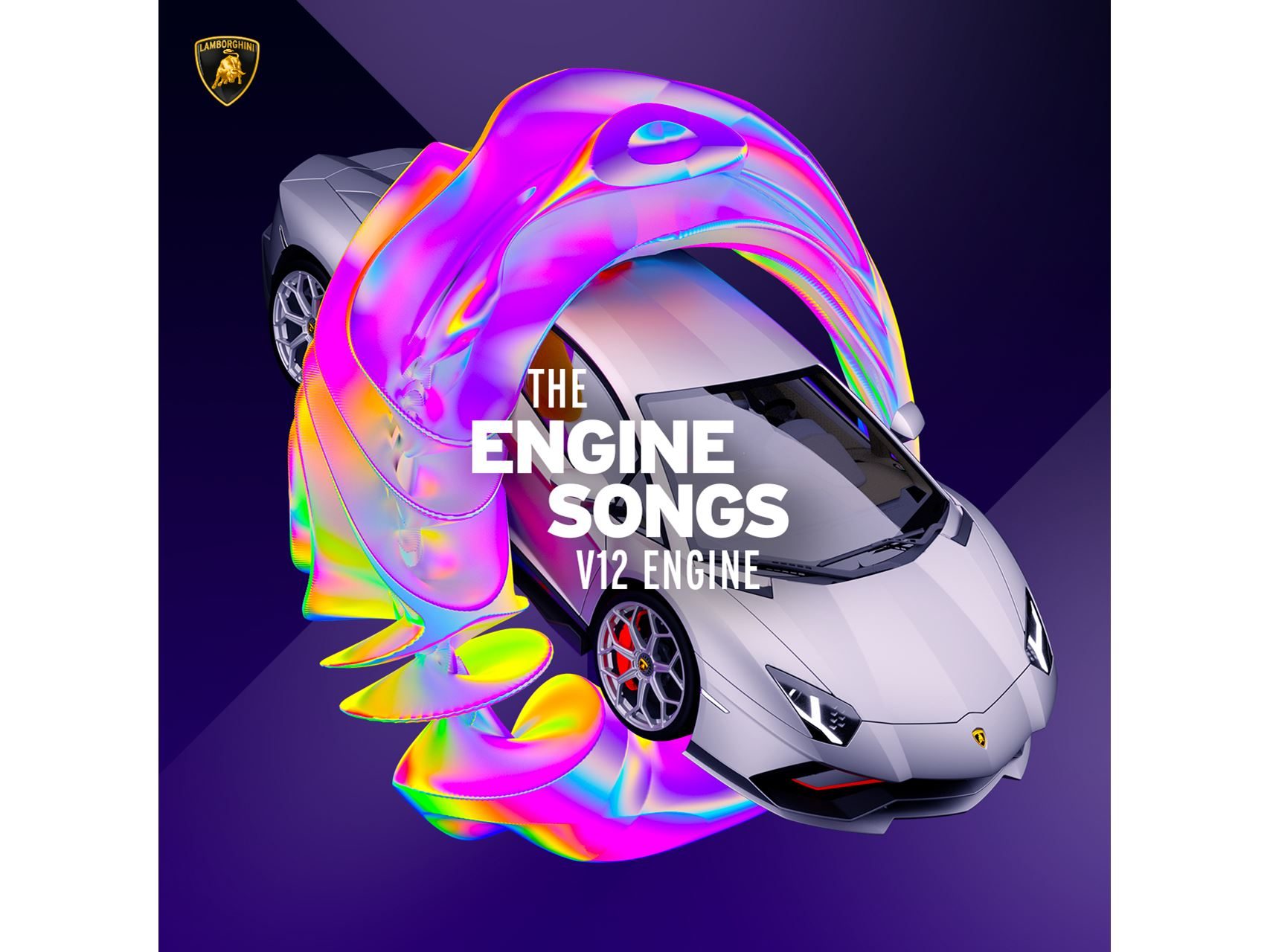
Lamborghini has never been shy about noise, but “The Engine Songs” marks the first time the company tried to prove, mathematically, that its V12 is a musical instrument. Working with music producer Alex Trecarichi and its own sound engineers, Sant’Agata created three 24-track Spotify playlists, one each for the naturally aspirated V12, the V10, and the twin-turbo V8. The concept goes well beyond branded background music. Trecarichi applied the Fourier Transform, a mathematical function that decomposes complex sound waves into their constituent frequencies, to the exhaust note of the Aventador LP 780-4 Ultimae‘s V12. The result: specific musical keys at specific engine speeds, matched to tracks selected to harmonize with the engine rather than compete against it.
An accompanying video, “The Engine Songs: Let’s Talk V12,” pairs Trecarichi with Mario Mautone, whom Lamborghini identifies as its NVH Whole Vehicle Coordinator. Together they unpack why the V12 sounds the way it does and how music can be scientifically calibrated to complement it. Graphic designer Vasjen Katro created custom artwork for the playlist covers. The whole package is polished, deliberate, and a little unusual for a company that normally lets its exhaust do the talking. Yet the real significance lies not in the playlists themselves but in what they reveal about how Lamborghini values, and plans to protect, the voice of its most iconic engine.
Why Now? A Farewell Note for the Pure V12
Timing tells the story the playlists alone cannot. Lamborghini describes the Aventador LP 780-4 Ultimae as the final descendant of a nearly 60-year tradition of twelve-cylinder sports cars, a lineage stretching back to 1963, when Giotto Bizzarrini designed the original 60-degree V12 for the 350 GT. The Miura, Countach, Diablo, Murciélago, and Aventador each carried a version of that architecture forward, growing from 3.5 liters and 280 horsepower to the Ultimae’s 6.5 liters. According to Car and Driver, Lamborghini even released a vinyl record capturing V12 sounds from the Miura through the Revuelto, another sign the company treats this engine’s voice as cultural property worth archiving.
Celebrating that sound now, through a structured multimedia campaign rather than a simple press video, reads as an acknowledgment that the pure, unassisted V12 era is over. What comes next still carries a V12, but the context around it changes fundamentally. For owners and enthusiasts who collect these cars partly because of the noise they make, the campaign validates something they already felt: the sound is the point, not a byproduct.

F-Sharp at Idle, G-Sharp at Redline: The V12 as an Instrument
The specific findings give the campaign its substance and its credibility. The Aventador Ultimae‘s V12 resonates in F-sharp (92.50 Hz) at its lowest revs, shifts to G (98 Hz) at 4,000 rpm, and climbs to G-sharp (103.83 Hz) at 8,000 rpm. These are not arbitrary marketing numbers. They represent the dominant fundamental frequencies extracted through Fourier analysis, the same mathematical tool used in everything from audio engineering to medical imaging.
Trecarichi matched each key to tracks in the V12 playlist. Lamborghini says the selection includes “Canone Infinito” by Lorenzo Senni for F-sharp, “Run Away” by Ben Böhmer for G, and “We Can All Dance” by Sam Collins for G-sharp. Playing these tracks while driving, or while listening to the engine on its own, is meant to create consonance rather than dissonance between the music and the mechanical sound.
Mautone frames the V12’s character in terms familiar to anyone who studies acoustics. He highlights what he calls the “harshness of sound” that distinguishes Lamborghini from competitors: a raw, metallic quality he compares to a violin’s ability to build from loudness to sharpness. Whether you buy the violin analogy or not, the underlying point is defensible. Lamborghini’s V12 occupies a different acoustic space than, say, Ferrari’s smoother, higher-pitched flat-plane V12. The Lamborghini note carries more mechanical texture, more of what audio engineers would call harmonic distortion. Mautone’s job is to ensure that texture stays deliberate rather than accidental, and the Engine Songs campaign amounts to a public declaration that the texture has been measured, mapped, and deemed worth preserving.

Two individuals discuss the unique sound of Lamborghini engines in a studio setting, surrounded by musical instruments.
What This Signals for the Revuelto’s Sonic Future
The campaign focuses on the Ultimae, but the real question it raises concerns the Revuelto. That car retains a 6.5-liter naturally aspirated V12 paired with three electric motors. The engine itself still breathes without forced induction, which preserves the high-frequency character that turbocharging tends to muffle. The hybrid system, however, introduces new variables: electric motor whine at low speeds, regenerative braking sounds, and the potential for the V12 to operate in concert with or independently of its electric partners depending on the drive mode.
Lamborghini has not publicly detailed how the Revuelto’s NVH team calibrated the interaction between the V12’s acoustic signature and the electric drivetrain’s contribution. By codifying the pure V12’s frequencies so precisely, the Engine Songs campaign establishes a documented baseline. That baseline could serve as a reference point for future sound engineering, or it could simply be a sentimental bookmark. Either way, it suggests Lamborghini understands that the transition to hybrid power requires managing perception as carefully as managing kilowatts.
For prospective Revuelto buyers, the practical takeaway is straightforward: the naturally aspirated V12 remains the car’s acoustic backbone. The hybrid architecture adds torque and reduces emissions, but the engine note that matters, the one Lamborghini just spent a multimedia campaign celebrating, still comes from twelve cylinders and no turbochargers.

The striking front fascia of the Lamborghini Aventador illuminates the sound studio, ready to unleash its V12 symphony.
Lamborghini’s Sound Philosophy in a Crowded Field
Ferrari, the obvious comparison, also treats its V12 as a brand signature, but its approach leans toward refinement and high-RPM smoothness, a fundamentally different acoustic philosophy from Lamborghini’s deliberately raw, textured output. Codifying engine musical keys and releasing curated playlists around them is a more public, more structured declaration of intent than anything a direct rival has attempted. It positions engine sound not as a marketing afterthought but as intellectual property worth documenting and defending.
The broader industry context sharpens the point. As more competitors adopt turbocharging, electrification, or both, the naturally aspirated engine sound becomes scarcer. Porsche’s flat-six, BMW’s inline-six, and AMG’s V8 all now run through turbochargers that alter their acoustic profiles. Lamborghini’s decision to celebrate the unfiltered V12 frequency spectrum, with mathematical rigor attached, functions as a quiet competitive claim: this is what an engine sounds like before engineering compromises intervene.
Whether a Spotify playlist can capture the chest-cavity resonance of a V12 at full throttle is another question entirely. It cannot. But that may be the point. The Engine Songs works better as a reminder of what the real thing sounds like than as a substitute for it. For anyone on the fence about experiencing a naturally aspirated Lamborghini V12 before the format evolves permanently, the campaign’s subtext is clear enough: the clock is running.
Gallery