Chassis Number 53 and the Dirt Road That Changed Everything
Most Lamborghini origin stories begin on a racetrack or in a wind tunnel. The Huracán Sterrato’s begins on a gravel road outside Nardò, with a battered prototype and three engineers who had no business being there.
The company’s own retrospective traces the car to Huracán chassis number 53, a development mule that Maurizio Reggiani, then Lamborghini’s CTO (now Motorsport Vice President), and his team fitted with off-road modifications and increased ground clearance. The first drive, by Reggiani’s account, reframed what a Huracán could be:
“The first time I had the chance to drive it I immediately realized how much fun this unexpected super sports concept could be.”
The testing ground was the Strada Bianca of Nardò, the unpaved white-gravel roads surrounding Lamborghini’s southern Italian test track. Reggiani draws a direct parallel: the Strada Bianca is to Lamborghini’s off-road development what the Nürburgring Nordschleife is to its circuit work. That comparison reveals how seriously the company treats loose-surface dynamics, even if the public rarely sees that side of its engineering culture.
Around 2017, Reggiani, CTO Rouven Mohr, and Head of Design Mitja Borkert sat down to dinner after a day of testing at Nardò. The concept they sketched over that meal was not a lifted Urus competitor or a rally homologation special. Mohr described the goal plainly: “an unprecedented super sports car for all surface conditions.” Something halfway between the Huracán and the Urus, built not to conquer the Dakar but to make a V10 supercar genuinely entertaining on surfaces where no supercar owner would normally dare to drive. That dinner conversation set in motion the project that would become Lamborghini’s first all-terrain super sports car, and the thread connecting chassis #53 to the sold-out production run is remarkably direct.
Why Lamborghini Built a Supercar Nobody Asked For
No focus group requested a raised Huracán with all-terrain tires. No dealer survey identified “gravel drifting” as an unmet need in the $260,000-plus segment. The Sterrato emerged because a handful of engineers found something genuinely fun and then had to convince Lamborghini’s management board to let them build it. In an industry that worships customer clinics and market research, the car’s origin is a pointed counterexample.
Reggiani’s account makes clear that the board was won over not by spreadsheets but by seat time. Once executives drove the modified chassis #53 prototype, the emotional case made itself. Borkert reinforces this from the design side, calling the project “fun from the first moment” and describing the internal pitch as a demonstration that the idea was “cool and brave” enough for production.
That process reveals something about Sant’Agata Bolognese that gets lost in the usual spec-sheet coverage. Lamborghini operates with a degree of engineer-led autonomy unusual at a larger automaker. The LM002, born from a military contract that went sideways, followed a similarly unconventional path to production in the 1980s. The Sterrato sits in that same tradition: a car that exists because the people who build Lamborghinis wanted to see if they could, and then proved the result was worth selling.
Borkert’s design brief captured the ethos. The stated aim was to create something “distinctly different, for active, sporty people who are fun seekers and want to drive the world even beyond roads and race circuits.” Strip away the marketing polish and the message is straightforward: Lamborghini wanted to sell driving joy on surfaces where supercars traditionally represent a liability, not a thrill. The playful experiment that started on Nardò’s gravel was becoming a real product, and the engineering challenges ahead would test whether that enthusiasm could survive contact with physics.

The Lamborghini Huracán Sterrato Concept carves through a dusty track, highlighting its rugged design and adventurous spirit.
Making a Mid-Engine Supercar Survive Gravel: The Engineering Problem
Lifting a mid-engine supercar and fitting chunkier tires sounds simple enough on paper. In practice, nearly every dynamic assumption that makes a Huracán work on smooth asphalt had to be rethought, and the solutions tell you just how far the team traveled from that first improvised prototype.
The 2019 concept increased ground clearance and improved both approach and departure angles. Track width grew on both axles to accommodate wider wheel arches with integrated air intakes. The tires were a bespoke development: wider rubber with increased sidewalls, featuring open shoulder blocks designed to self-clean on loose surfaces while still providing adequate grip and shock absorption. For the production car, that specification became the run-flat Bridgestone Dueler All-Terrain AT002, a tire that simply did not exist before Lamborghini asked for it.
The underbody required serious attention. A standard Huracán’s flat floor sits close enough to the ground that a modest pothole can cause expensive damage. The Sterrato concept’s underbody and front frame were reinforced with integrated aluminium elements, protected by an aluminium bulkhead. The same material was used for side skirt reinforcements. The goal was structural resilience without piling on weight that would dull the car’s reflexes.
The production Sterrato carries 6.4 inches of ground clearance, placing it nearly two inches above a standard Huracán. Car and Driver reports revised electronically controlled dampers, softer springs, and softer anti-roll bars compared to other Huracán variants. The higher center of gravity that comes with a 44mm suspension lift is a fundamental change to vehicle dynamics; softer roll control and recalibrated damping are the engineering answers to a car that would otherwise feel nervous and top-heavy at the limit.
One detail that often gets overlooked: the production car gained 25% more wheel travel at the front and 35% at the rear. For a supercar platform originally designed to minimize body movement on smooth circuits, that represents a philosophical inversion. The Sterrato’s suspension was deliberately engineered to move, to absorb, to let the car breathe over uneven terrain rather than fighting every surface irregularity. Chassis #53’s rough promise had been translated into precise, repeatable engineering, and the result vindicated the instinct that started the whole project.

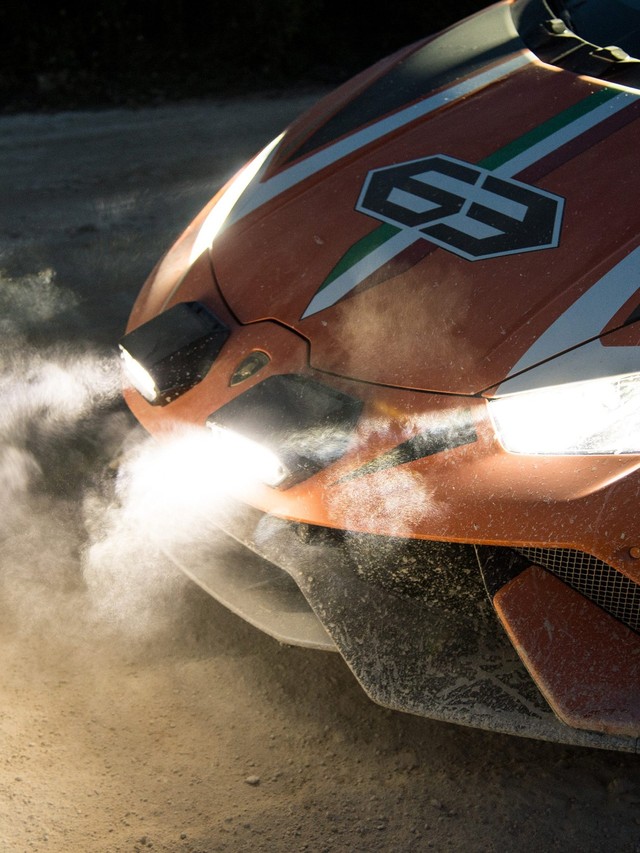
The Huracán Sterrato Concept's auxiliary lights cut through the dust, emphasizing its readiness for any adventure.
The Sterrato’s Quiet Legacy: What It Proved and What Comes Next
All 1,499 units of the production Huracán Sterrato sold out, and that number alone validated the dinner-table hypothesis from Nardò: buyers wanted a supercar that could go places other supercars couldn’t. Some reviewers went further. Motor Authority called it the best Huracán for daily driving, a verdict that would have sounded absurd before the car existed. The raised ride height that enables gravel drifts also eliminates the constant anxiety of urban speed bumps and parking garage ramps, a practical benefit that resonated with owners who actually use their cars.
The Sterrato also occupies a fascinating position in Lamborghini’s lineage. The LM002, the brand’s original off-road anomaly, was powered by a Countach V12 and built for a market that barely existed in the 1980s. The Urus, arriving decades later, proved that Lamborghini could dominate the luxury SUV segment. The Sterrato sits between those two ideas: not a truck, not an SUV, but a genuine mid-engine supercar that treats unpaved roads as an invitation rather than a threat.
Lamborghini described the Sterrato as a forerunner of its broader philosophy of expanding what a supercar can do. According to Autoblog, the company is actively considering more off-road-capable variants across its lineup, including models beyond the Huracán platform. A separate Autoblog report indicates Lamborghini is plotting even more extreme special editions in the mold of the Sterrato and the track-focused STO, potentially extending to V12 supercars and SUVs. The Sterrato, in other words, was not a one-off farewell gesture for the Huracán. It was a proof of concept for an entire category of future Lamborghinis, the logical extension of the skunkworks spirit that animated chassis #53 from the start.

The Huracán Sterrato Concept leaves a trail of dust and excitement, showcasing its powerful off-road capabilities.
Where the Sterrato Stands Against the Porsche 911 Dakar and Ferrari’s Next Move
The Sterrato did not emerge into a vacuum. Porsche launched the 911 Dakar around the same time, applying a similar logic to its own iconic sports car: raise it, fit all-terrain tires, and market it as an adventure machine. The two cars share a philosophical premise but diverge in execution. The 911 Dakar is a rear-engine, turbocharged flat-six car with a long history of rally-adjacent special editions (the 953 and 959 were Dakar competitors in the 1980s). The Sterrato is a mid-engine, naturally aspirated V10 car with no rally heritage whatsoever, which makes its existence more surprising and, arguably, more audacious.
Lamborghini’s advantage in this niche is that the Sterrato feels genuinely unlike anything else the brand produces. The 911 Dakar, impressive as it is, still reads as a variant within Porsche’s enormous 911 ecosystem. The Sterrato reads as a one-off experiment that became a product, and that narrative carries real collector appeal.
Ferrari’s position is worth watching. The Purosangue is a high-riding four-door with a V12, but it occupies SUV territory rather than the all-terrain sports car space. Lamborghini currently owns that niche in the mid-engine supercar world without a direct competitor from Maranello. Whether Ferrari eventually responds with a raised mid-engine car remains speculation, but the Sterrato’s commercial success gives any rival manufacturer a clear data point: buyers will pay for a supercar that can leave the pavement.
The broader competitive lesson circles back to Nardò. Lamborghini moved first and moved decisively. The Sterrato was conceived years before the 911 Dakar reached production, and Lamborghini’s willingness to greenlight a project born from engineer enthusiasm rather than market analysis gave it a head start that competitors are still chasing. For a brand often characterized as the wilder, less methodical alternative to Ferrari and Porsche, the Sterrato’s journey from chassis #53 to 1,499 sold-out production units is a reminder that spontaneity and engineering rigor are not mutually exclusive. Sometimes the best product strategy starts with a dusty prototype and a good bottle of wine at Nardò.
Gallery


