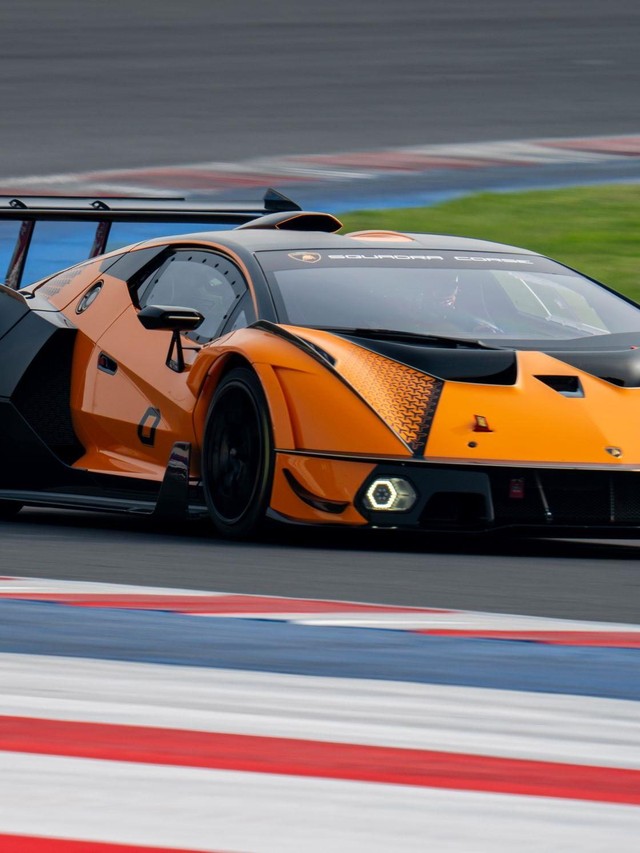
Twenty-Three Drivers, One Ladder Into Sant’Agata
Lamborghini Squadra Corse selected 23 drivers, aged 17 to 26, for the 2017 edition of its Young Drivers Program. The group spans three continental Super Trofeo championships (Europe, Asia, and North America) and includes returning participants like Ben Gersekowski, Loris Spinelli, Nicolas Costa, Bar Baruch, and Rik Breukers alongside a dozen new faces drawn from winter testing and early-season results. Among the newcomers: Axcil Jefferies, champion of the then-new Super Trofeo Middle East series, German racer Carrie Schreiner, and Americans Brandon Gdovic and Trent Hindman.
Established in 2014, the program functions as a structured pathway for Super Trofeo competitors to develop into professional-caliber racers. The 2017 intake was the fourth edition. The roster matters less than the architecture behind it: a factory-integrated development system that blurs the line between racing academy and engineering feedback loop, treating young talent not as spectators of the Lamborghini machine but as active contributors to it.
From Super Trofeo to Sant’Agata: Inside the Training Regimen
The training goes well beyond seat time. Participants receive a pre-race dossier covering sporting regulations and circuit specifics before every Super Trofeo round. During race weekends, a dedicated staff led by Raffaele Giammaria, director of the Federal School ACI Sport, supervises the young drivers through meetings on practice and qualifying performance, track walks, and post-session debriefs. After each round, every driver compiles a technical and personal report modeled on the format used by Lamborghini’s factory drivers.
The more intensive work happens at training camps held at Imola and the Sant’Agata Bolognese factory in June and September. These three-day sessions combine track testing with factory immersion: visits to the production lines, the museum, and the engineering departments. At Imola, participants drive Huracán Super Trofeos and GT3s not in a competitive context but for development purposes, working alongside Squadra Corse and Pirelli engineers. The goal is to teach young racers how to translate physical sensation into useful engineering language, a skill that separates competent amateurs from professional-grade talent.
Classroom sessions cover communication, racecar engineering, and Lamborghini road cars, while specialized performance coaches oversee physical conditioning. Every element reinforces the same principle: motorsport is a professional discipline requiring structured growth across multiple dimensions, not just raw lap-time improvement.
The Career Ladder: GT3 Junior and Accademia Instructor
Promotion through the system follows a clear pattern. Dennis Lind, the 2016 Super Trofeo world champion, moved up to the GT3 Junior Program for 2017, a path that places promising drivers into Lamborghini’s GT3 racing efforts. Independent reports indicate the program includes an end-of-year shootout assessment where drivers are evaluated on progression, consistency, technical feedback quality, physical fitness, and professionalism. The top performers earn support to race GT3 machinery the following season.
A less obvious but commercially significant pathway leads to the Lamborghini Accademia, the brand’s official driving school open to customers and enthusiasts. Drivers who demonstrate the right temperament can train as certified instructors, a role that requires different skills than wheel-to-wheel racing. Lamborghini obtained federal certification for all its Accademia instructors through a course at the Federal School ACI Sport’s Vallelunga facility. For young racers whose careers may not reach the factory-driver level, this represents a genuine professional outcome within the Lamborghini ecosystem rather than an unceremonious exit.
The program’s long-term track record supports the investment. Maximilian Paul, who entered the system and debuted in a Huracán GT3 EVO in 2021, earned a DTM race victory at the Nürburgring in 2023 and was promoted to a Lamborghini Squadra Corse factory driver role in early 2026. That kind of progression, from one-make series newcomer to factory contract, validates the pipeline’s design.
ISO 9001: Why a Quality Certificate Matters for Driver Development
Lamborghini Squadra Corse received ISO 9001 certification from TÜV Italia at the start of 2017. The certification covered development, manufacturing, and trackside assistance processes for race cars, plus the organizational management of competition events at European circuits. An ISO quality standard sounds more relevant to a widget factory than a motorsport department, but it signals that Squadra Corse formalized the processes governing how race cars are built, maintained, and supported, the same processes that young drivers interact with during development testing at Imola.
For a department simultaneously running three continental one-make championships, a GT3 program, and a driver development academy, standardized procedures reduce the risk of inconsistency. When a 19-year-old driver provides feedback on chassis behavior at Imola, that input flows through the same documented engineering process used for factory development. The certification does not guarantee better race cars, but it does mean the feedback loop connecting young drivers to car development operates within an auditable, repeatable framework. It is the organizational backbone that makes the entire scholarship concept credible rather than aspirational.
Lamborghini’s Approach Compared to Ferrari and Porsche
Both Ferrari and Porsche operate their own junior driver programs, and the broad strokes look similar: identify young talent in one-make or junior series, provide coaching and factory resources, promote the best into GT3 or higher categories. Lamborghini’s structure differs in two specific areas.
First, the Accademia instructor pathway creates a secondary career track that neither Ferrari’s Driver Academy nor Porsche’s Junior Programme explicitly offers. Young racers who develop strong communication and coaching skills can transition into a customer-facing role that keeps them inside the brand’s orbit. Second, the direct involvement of young drivers in Huracán race car development, working with Pirelli engineers on tire feedback and chassis tuning, gives participants experience that goes beyond driving fast. They learn the engineering side of the profession at a stage when most academy drivers are focused purely on lap times.
Whether this translates into a higher success rate for Lamborghini graduates compared to Ferrari or Porsche alumni remains difficult to measure. Lamborghini does not publish conversion statistics, and the sample sizes across all three programs are small. What the structure does demonstrate is that Squadra Corse, by 2017, was treating driver development with the same systematic rigor it applied to race car manufacturing, building not just faster cars but the people capable of making them faster.
Gallery


